Presence in Practice
Presencia en la Práctica
A conversation about how deepening presence transforms everyday activities, from piano practice to household tasks, and the discovery of effortless enjoyment in simply being.
Presence in Practice
A conversation about how deepening presence transforms everyday activities, from piano practice to household tasks, and the discovery of effortless enjoyment in simply being.
It makes a lot of sense. It really resonates. It's wonderful to hear. Thank you so much for sharing your experiences. It all melds together: my experience, your experience. It fits into this beautiful picture. It's so helpful.
It's hard for me to remember clearly, too, because I can notice that I'm stressed. For example, I'll have a stressful day, and I think it's the same kind of stress I had a year ago. But a year or two ago, there was more suffering. Now there isn't any of that. The stress is just stress. It was a stressful day, but I can't correctly remember what it used to be like. And that's where my bodyworker's observations are quite surprising. She'll say, "There's nothing there. You're softer than ever." And I think, "Well, yes, I remember being stressed in the past," but obviously it's not the same.
Do you find yourself more and more available to use the skills you have? Do you find that your skills are getting sharper because you're more present, or because there's less distraction?
A shift in piano practice
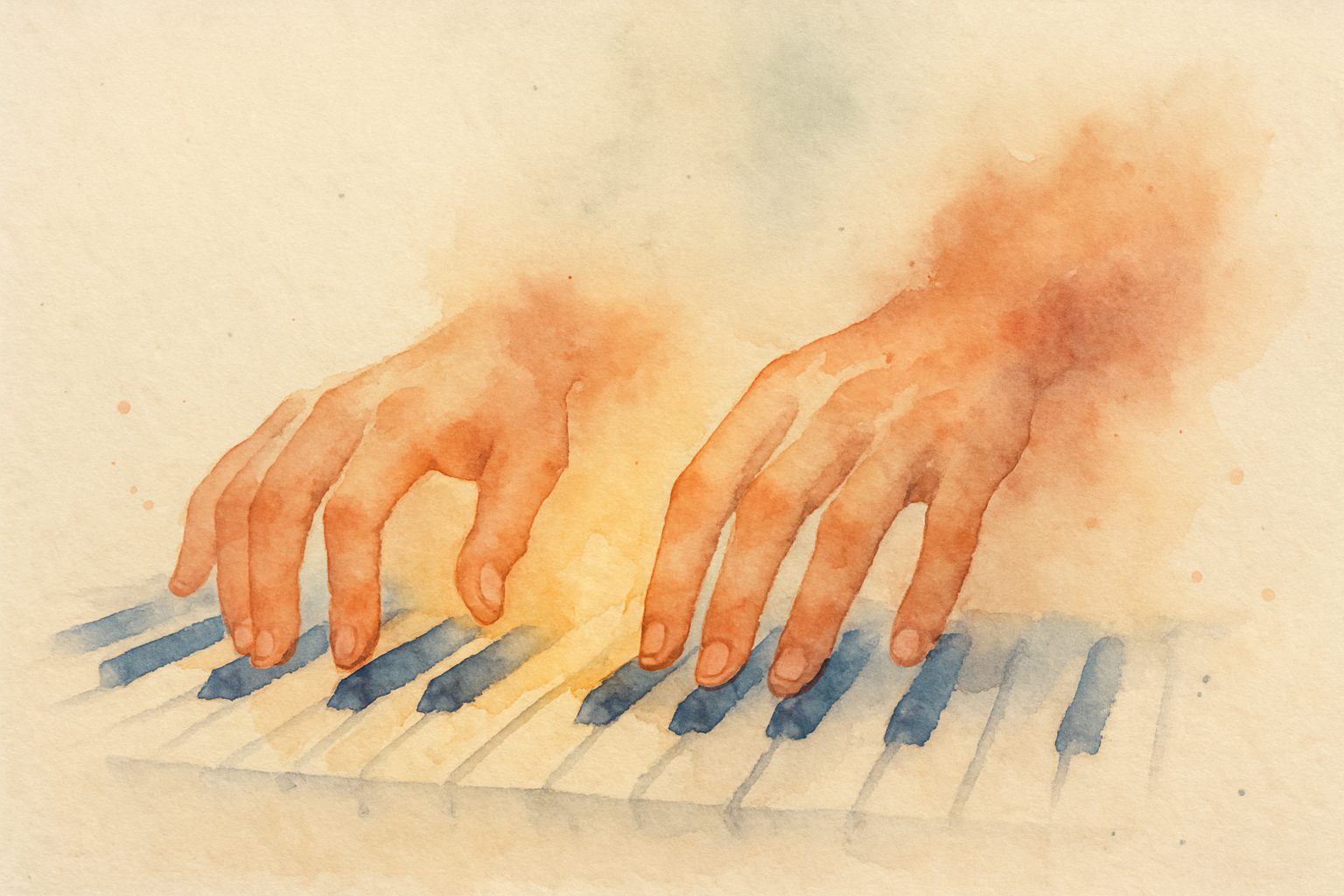
I notice that very, very explicitly with playing piano. There has been a huge shift there. Otherwise, I'm always working on very new things now, so it's always uphill challenges. In work, I'm not doing the same thing I was doing one, two, or three years ago, so I can't really monitor whether my skills are improving. But with piano, the shift was big.
What is different with piano?
It's a lot of what we're talking about. In the past, it was very hard for me to do a proper practice. Proper practice means you have to go slow, you have to relax, you have to take the time things take. You repeat, you put attention in, and you don't try to play things more difficult or faster than you can. You maintain a regular routine. That was very hard for me. Now it's almost the most enjoyable thing. I can sit there and do things really slowly and very repetitively, and it's just pure joy. My skills are improving rapidly. I don't even have a piano here, but when I'm in Vancouver, the time I put into practice produces so much faster growth. My playing gets so much better.
That is incredible to hear. You can see the results on the spot, maybe even during a single session. That's incredible.
Gifted musicians and the ego stepping aside
It really is. And I realized that this is what very gifted musicians were able to do from day one, when they were four years old. They may not have been present in other parts of their life, because that's how things tend to work. The ego can step aside if it's contained and controlled within a specific domain. The challenge is making that the way we relate to reality, period, always. One of the things I actually had a hard time doing was bringing presence to practice on the instrument. Being able to do that was a deep meditation for me.
When we were in Temecula and you played the piano, it stood out. The clarity of the music was remarkable. I don't know if you were improvising then, but I remember sitting with someone at lunch, and all of a sudden we all stopped and listened. It really stood out. I don't know what you played like before, but I can almost relate to what you're saying.
Thank you. That's beautiful. One of my deep desires (though it's not something I need) is to have more time to put into that work. It's just a matter of balancing priorities.
I play the guitar, and the times I felt I improved the most were periods where I was already patient, willing to stay with one thing for days and days, working on the details every day, not rushing or trying to reach some objective. It's a world of difference.
Exactly. And you can bring that same quality to drying yourself with a towel after a shower, doing the dishes, everything you think of as a bother or an annoyance. This is very common in Zen. That is the meditation. Chop wood, carry water.
But back then, when I would hear that, I would think it was about the doing: notice the doing. But it's not the doing. It's the not getting into the thinking, and then the doing simply happens. That's what I'm beginning to discover, that effortlessness. Through non-duality, it's made more sense to me.
Discovering enjoyment in the ordinary
And to discover this sense of acquired taste: I can almost guarantee that something you don't currently enjoy, you can enjoy. If you hate doing dishes, you can really enjoy doing dishes. You can discover a deep enjoyment in them. Any routine daily task that feels like you want to rush through it to get to the next thing, that is precisely where the practice lives. The Zen approach to mindfulness is quite useful in this sense, but it's really not about doing something annoying and forcing yourself through it. It's about discovering that, in presence, an enjoyment of being can become the foreground while the task moves to the background. Then beingness itself is what makes that task enjoyable. It's simply the nature of beingness.