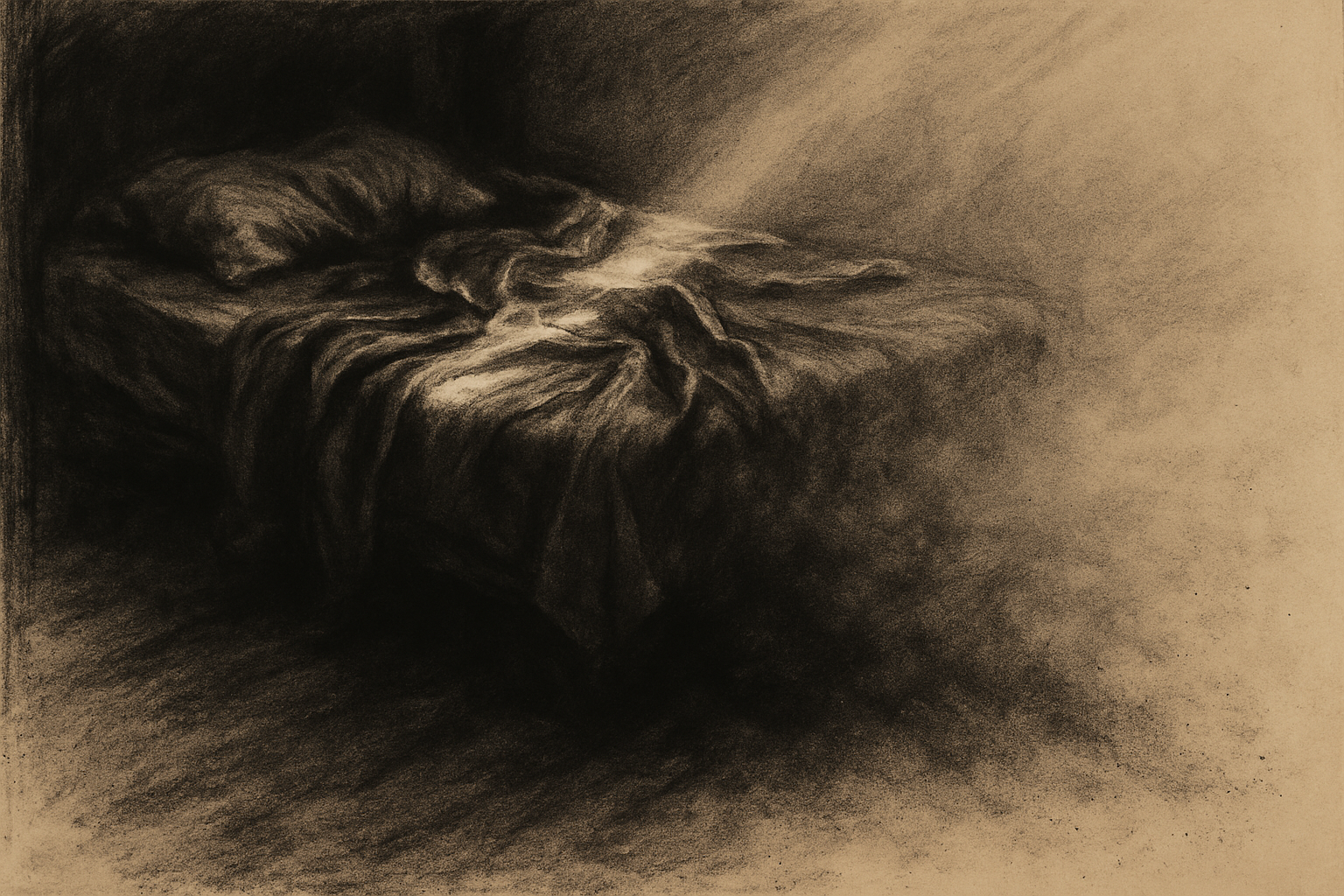
The Con Man Under the Bed
El estafador debajo de la cama
A student shares how the gradual falling away of questions and the simple act of seeing have begun to dissolve a lifelong pattern of terror, and the teacher responds with a map of what is primary, secondary, and tertiary in experience.
The Con Man Under the Bed
A student shares how the gradual falling away of questions and the simple act of seeing have begun to dissolve a lifelong pattern of terror, and the teacher responds with a map of what is primary, secondary, and tertiary in experience.
For quite a few months now, I've noticed something. Maybe it's actually been a few years; it's been a process. I have fewer and fewer questions. Here and there, last year or so, it was important for me to know this, important for me to know that. But it seems like what the questions led me to was the noticing that I don't need to know, that there's nothing I can know that will do it for me.
The meditation, the different approaches, the different angles you talk about regarding mind and reality, they're just a gentle rubbing away of the conditioning, or something. I'm not sure what it is, but it's great. And I often resonate very deeply.
What I'm finding is that it's all it ever is: seeing. It's all it ever is. That's what I keep coming to again and again. Just the seeing, the noticing. And when I notice, it's like, "Okay, that's what is, okay," and then we just move on. Maybe that's just another way of saying presence. It's all so mysterious to me, but it feels like it's becoming more and more solid, or there's less and less agitation.
There have been lots of ups and downs, lots of despair. And then I just come back to, "Oh yeah, oh yeah." It's exciting. Am I fooling myself? Who knows? Doesn't matter either, because what is, is.
Over time I just keep being brought to exactly what I need. It's a miracle. Earlier this year, it hit me: it was me that brought you to me. There's something rigged about this. It's not what I thought it was. I still don't get it, I'm not clear on it, but I don't need to find the answer.
The curtain opens on terror
One thing I noticed this week: I think the terror has been so chronic, so much a part of how I operate in the world, that the curtain kind of opened for a moment and I actually got a glimpse of it. It's exactly like a con man. It says, "Don't let go, because something's going to happen. Hold on to the chair, because then it's going to get even worse." And I know that's just my whole culture, everything I grew up with: "Thank God it isn't any worse. It could be worse. Hold on tight." But again, it was the seeing. I saw that whole apparatus, at least for a moment, a very short moment. And I saw that it's not based on anything but a thought. And it's one thought at a time, one moment at a time. It's not like I can get rid of all terror forever. It's now. Again, it's now.
I think for most of my life I've been afraid to own things like this, because it's like, "Oh, now watch out."
The fear comes back in.
Yes, it's the same old con. But at this point, I say to the con man, "Take all my savings. If that's what you want, take it. I'm going for the truth."
Three layers of reality
A lot of what you say is exactly that. What I was pointing to in the meditation is that we have reality upside down. Even if we intellectually know how it is, we will still operate in our day-to-day life with whatever the mind is doing. We engage with the mind. We intentionally create a reality by going to our thinking, and then that becomes the reality. Everything else, the world out there and the presence that is the foundation of reality, becomes secondary.
This is why meditation, the basic practice, is to sit, look at the mind, and become aware of sensation through breath, for example. That's the most basic meditation around the world. What it intends to do is create a distance from the thinking and bring attention to something more real. But that is just the most basic first step. It's very simple and very powerful, but it's not enough.
The subtlety is that it's not about just going to sensation, because sensation is also appearing. Sounds and sights are also appearing in the same way that mind activity is. You can think of reality as having three aspects. One is what the mind is doing. Another is the world of perception and sensation. And the third is the world of presence.
What is actually real and fundamental is presence, but it's unknowable. You cannot point to it. Everything that appears in it is secondary. So once you go to what is secondary, the world of sensation and perception, there is something that's in a sense tertiary: the mind. The mind creates images and sounds based on what it has learned from perception and sensation. A child is born and doesn't have much mind. It's basically sensation and perception. As the mind develops, it creates an inner world. At some point, that inner world just becomes the center, the foundation of what is real. But that wasn't there when we were born. How is it real? How is it foundational? It can't be. There's something more real than the world of mind. People who have brain injuries to the thinking mind (this is completely studied and documented) suddenly have an experience of presence, through an aneurysm for example, and they experience peace. It's simply because they become aware that there is something more real and more fundamental than the world of thinking.
What you are describing
What you're describing is the subjective experience of that shift happening progressively. You're saying questions start to go away, and "what is" is all there is. That starts to point to presence. When something starts to stop mattering so much, when you say to the terror that could be the central part of your life, "You only exist in thinking," that is the only place terror exists.
The believing in what terrifies you produces a chemical release that creates sensations in the body, and that makes it seem even more real, because now it's happening at the level of sensation. It actually happens: your heart can race, there's a lot of cortisol in your body, creating sensations that validate the thinking. The mind knows that what is more real is the body, so it creates this body experience of reality that is really just another form of mind. This is why emotions are also considered to be a mental process.
When one stops believing, even for a moment, that whole reality goes "poof." You're left with: that's gone, and something's still here. How was that real if it can go away? It's not real.
What "real" means
That's the difference, in the Sanskrit sense, between reality and illusion. In Sanskrit, reality means that which cannot go away. If something goes away, it's not real. For example, a chair can disintegrate. It was made and then it can end. So what's real isn't the chair; it's something that took the form of a chair. This is just semantics, but what I'm pointing to is that which things take form from.
Waves take form from the ocean. That's why it's such a popular metaphor. What it's pointing to is that the waves are secondary and the ocean is primary. The ocean is so vast that it evokes the vastness of awareness or consciousness. It points to something very clearly. Another metaphor that is used is gold. If you have a golden ring, is the ring real? No. What's real is the gold, which is taking the form of a ring. You can melt the ring and turn it into something else, a new ring or whatever. The form it was taking isn't real. And that's just semantics. You could create a new word in English that refers to the same distinction between what is real and what is not.
Flipping reality right side up
What I was pointing to in this meditation is to go from something that is tertiary form, thinking, to something that's closer to reality, sensation and perception, and from that to what is absolute reality: the presence where it all appears. Nothing of our experience has to change. Only the knowing of what is real and what is not. Because we have it upside down, because we think that what is fundamentally real is our thinking world and the rest is secondary, there is suffering.
If we flip that right side up, where what is real is the infinite, unknowable presence that is always there, you don't have to discover it. You can have realizations of the contrast, seeing, "Okay, that wasn't real and this is." But it's always there. When we have that flipping right side up, then body, perception, and sensations are secondary, and thinking is tertiary. So whatever the mind is doing, even if it's telling the same stories that were terrifying you, because you see it as tertiary, it becomes, "Whatever. Keep doing that." It becomes a puppet, not a terrifying demon, because you see that it's not real. It's like looking under the bed and seeing there's no ghost, nothing real.