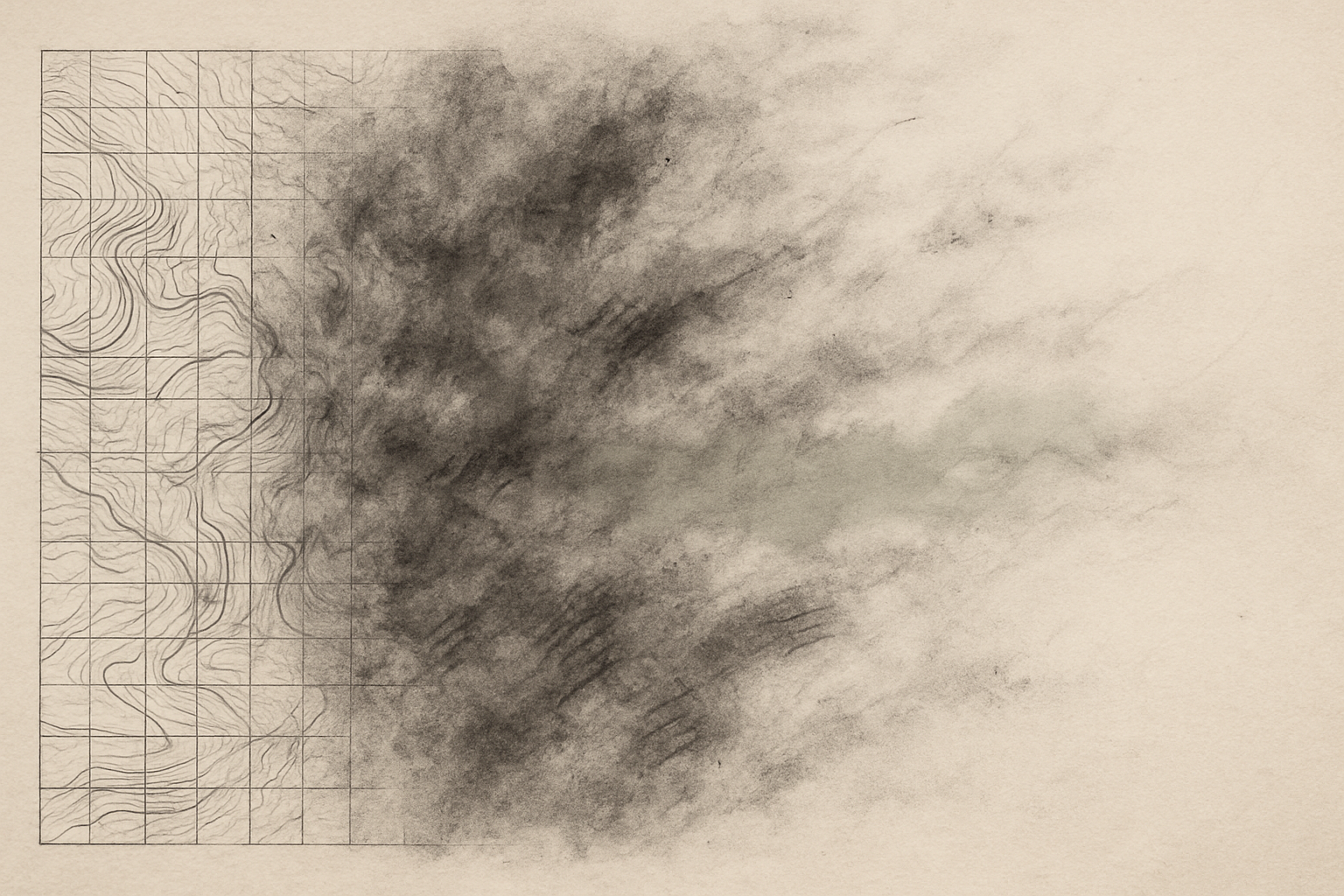
The Map and the Raw Experience
El mapa y la experiencia cruda
A student describes the shift from thinking to sensing the environment during meditation, and asks how to move beyond the mental map of that experience into something more fundamental.
The Map and the Raw Experience
A student describes the shift from thinking to sensing the environment during meditation, and asks how to move beyond the mental map of that experience into something more fundamental.
Generally when I start meditating, there are thoughts rolling in my head and I'm trying to get into my body and my experience. Once the thoughts calm down, I'm experiencing my breath, my body, the noises, and I start identifying less with my thoughts and more with my surroundings. My reality becomes the noise of the fridge, the noise from outside. It creates this space. But then I know these are my thoughts and my experience of the space. How do I push beyond that? When you talk about infinite space and identifying what is not present, I'm experiencing the present, and you talk about a switch. I'm wondering how I can move beyond the space I'm experiencing. My mind has created this map, which is not reality, but that's how I experience reality. How do I go beyond that into something more?
Appreciating the shift already happening
That makes a lot of sense. First of all, I would say the shift you're describing is really valuable. You're talking about pushing beyond, and I would say pushing is not the right energy. It's all really about seeing and understanding, not intellectually, but directly.
What you're already describing is a huge step for somebody just starting to meditate. I'll talk about what you're asking, but I would recommend that you stay there, in a sense. Going from everything you're thinking to being aware of the physical environment, the sensations, the sounds, even if you're still thinking about them: that's a big shift. You can have an understanding and see it, but for that to become the more normal place from which you operate takes time. It could happen during a meditation session with us here, but then two hours later in your day, you might be quickly pulled back into the world of thinking and away from the environment.
So I would say: celebrate that you are having this shift. You're able to be aware of the space of the physical environment, the sensations and sounds, and you're also noticing that you're thinking about it. That's already a lot. The fact that you recognize you are thinking about the environment, that your mental understanding of it is not the environment itself: that's a really valuable understanding.
Distinguishing raw perception from the map
As for how to go beyond it: the first thing is to recognize that what you have is already a really big step, and to spend more time there. In your daily life, when you're cooking, when you're doing whatever you're doing, keep going to that more expanded sense of "there's an environment, there are sounds, and it's not just the contracted world of the mind." From there, it's going to become much easier to start discerning the subtlety of what is actual raw sensation and perception of the environment versus the thinking about it. Because now it's a much more subtle kind of thought. It's the thought that creates a map of the physical environment. There's a sound, and then the mind says, "That's the sound of a car, that's the sound of a bird, that's the sound of..." All of that is thinking. This is what you're noticing, correct?
So just notice: "Oh, it's a thought about the sound. It's a thought about the room. It's a thought." That's already a big step. Then you can start to see where the thoughts about the space are happening, and all you have to do is see that they're just thoughts.
If you stay with that as a practice, I think it could sound too effortful or pressured. For you, I prefer the word "contemplation," just a curiosity. Like a scientist discovering what the mind is doing. The mind is always going to create maps around the space: thoughts about who you are, thoughts about your life, your past, the future, your relationships. That's going to be a constant activity. You're already having an experience of the spaciousness of being aware of the room, the physical environment, while seeing your mind active. Just keep doing that. Keep seeing it. Keep contemplating and noticing.
Usually what also happens is that you might have sensations at the level of emotion or feelings that are a little uncomfortable or difficult. That's often what we start to meet when we move out of the thinking mind.
I don't really feel the emotions. I just have the thoughts identifying what I'm experiencing. There's nothing like that there for me.
Two aspects of experience
That's fine. I'm just saying it might happen, and it might come and go. But the main thing is this: you're noticing that there are thoughts about your experience. So then, just as we were doing in the meditation, distinguish the two aspects of experience. One is the thinking, which consists of images and inner sounds, the thinking about things. The other is the raw sensation of perception. You're going to be having both. Just notice the difference. Notice there's a raw sound, the raw experience of sound, and then there's the thinking that tells you what it is and where it is. The thinking is going to label the sound by its source, and that label is always going to be an image. "Bird" is an image. It's a concept. "Car," "door," whatever. The mind always says, "The source is this object that I know." That's the mind. Just notice those two, and notice that they are two separate things.
The experience and the image of the experience.
Yes. The image of the experience is what I call the map-making. The mind is labeling, understanding, explaining, creating a map of reality, of the world. A baby doesn't have that. What we want to do is not stop the map-making, but be able to notice the difference. Jesus said that when you can be as children, you will enter the kingdom. He doesn't mean you should lose all capacity for thinking about the environment. He means that when you can have the raw experience of reality be the fundamental aspect of what your reality is, when that becomes like a child's complete openness, that freedom from the dominance of thinking, we can rediscover that simply by noticing the difference.
Location and time are also thinking
So whether you sit to meditate or you're noticing in your daily life, you're going to hear the sound of a car and the thought "it's a car over there." The sense of location is also thinking. It's part of the map-making. There is no location outside of thought. The sense of time is also part of map-making. It has to do with creating memories and projecting the future. It's all in the mind. Anything you can identify as something of the past or what's going to happen is also part of thinking. It's not about stopping all of that. It's about noticing: "Oh, that's thinking. Oh, that's also thinking."
Foreground and background flipping
So there's no pushing, really. It's just seeing. Right now, your experience is that there's raw perception and there's thinking about it, and the thinking is actually in the foreground while the raw sensation and perception are in the background. What we're moving toward is having that flip the other way around, where you start to see that thinking about reality is a more distant thing. But it's not about stopping it. It's just seeing that it's not fundamental. It's a secondary layer laid over the raw experience.
You can explore this just with sound. Focus on sound. Sit, and you hear sounds happening, and you can notice that the mind is going to be constantly labeling the sound and locating the sound. Labeling and locating. That's all you need to do. And then when you get pulled back into the stories about "me," it's the same practice of returning to the breath and to the environment.