The Lamp That Is Already Lit
La lámpara que ya está encendida
A student reflects on losing the desire to meditate alone after a significant shift, and the teacher explores how to discover what is always present, whether in a group or on one's own.
The Lamp That Is Already Lit
A student reflects on losing the desire to meditate alone after a significant shift, and the teacher explores how to discover what is always present, whether in a group or on one's own.
For about a year and a half, I was meditating for around two hours every day, sometimes more. Something happened to me, exactly what you're describing. But then when the shift happened, I didn't want to meditate anymore. I don't know what that's all about. That's when I started to intensify going to a teacher, listening to teachings. But it's interesting: sometimes I'll meditate on my own and it feels totally different from when you're present, for example, and you're guiding it. I have this inner debate. I don't feel much when I meditate on my own, or it feels pointless. Since the shift happened, the desire to meditate on my own kind of disappeared. I don't know if it's resistance. I don't like to force myself, but sometimes it's good to gently beckon. I don't know.
I would suspect that what happened is a shift where something old was no longer wanted, and that's a good thing. But then, for the new to come, there might be a need for some time, and for not throwing the baby out with the bathwater.
The gap between group and solitary practice
The key thing I heard you say, and to me it signals something important, is that you don't experience in meditation on your own what you experience in this group or with me present. I would say: explore that. It doesn't have to feel the same, because something happens with group energy. But still, there's something you can explore where that gap will become smaller.
What you're sensing when you're in this group, the most important aspect of it, is always present whenever you are doing whatever you are doing. So the proposal I'm offering you is to be curious about what that is and to see how you can explore discovering it also on your own. Not only on your own, because that could be interpreted as, "I need to find out on my own, so I shouldn't get close to a group or a teacher because I need to develop this independence." I don't believe that. I think being in presence with somebody else is always an opportunity. But also explore how you can start discovering it on your own, even if it's a few minutes a day, until it becomes second nature.
Ordinary moments as practice
You're waiting for a bus. You're drying yourself after coming out of a shower. Moments like that are very habitual because they're repetitive. This is very Zen, but: the moment you come out of the shower and you're drying with a towel, how can you take that minute to explore what is there that is the same as when you're here in this group or when I'm guiding a meditation? Find, more and more, that there's something essential that's also there.
A hypothesis, not a belief
It's in a sense a hypothesis. My teacher always said to trust him and trust his mind more than our own when there was a conflict. If I thought something and he said something and there was a disagreement, then I should trust his mind over mine. I think that was great, but I prefer to say: trust the proposal and experiment for yourself.
The proposal is this: there is something, the most important thing you experience here, that keeps you wanting to come back, and it is always present no matter what's happening in your life.
That's not true to me? Oh, you mean that I don't experience it on my own.
Right. You experience a discrepancy between the group and guided meditation with me, as you said, and when you're meditating on your own. There's a gap. It's not the same. So to you, the experience is that there's a difference. And I'm saying there's something that is the same, and it's there. So the hypothesis I offer, rather than a belief for you to buy into, is that the most essential thing is there when you're meditating on your own. You just need to find it. And the exploration of how to find it, that we can talk about. There are ways to explore meditation on your own.
I like the way you put it.
Exploration, not construction
It's never about building something up. I was talking earlier about the mind, the developing, the muscle, but that's a side effect. You don't do the neural changes. The brain synapse changes happen on their own. If I lift weights, my muscles are going to grow. I don't grow the muscles. I just do the weightlifting. In the same sense, the focus is on exploring the hypothesis that nothing is missing. The essential is always present. Try to discover it.
Even when your mind says, "Something's missing, this isn't it, it's not the same, I don't feel good," find ways to explore and work through that. Be present with it. See what's just mind. See what's just feeling, sensation. Stay with it. What is the space in which the difficult experiences of discomfort are appearing? The more you create that active exploration, the more a presence is going to start flowing, which you will begin to discover as always there. It will start to have a flavor of the meditations with me or with whomever where you find that.
The lamp
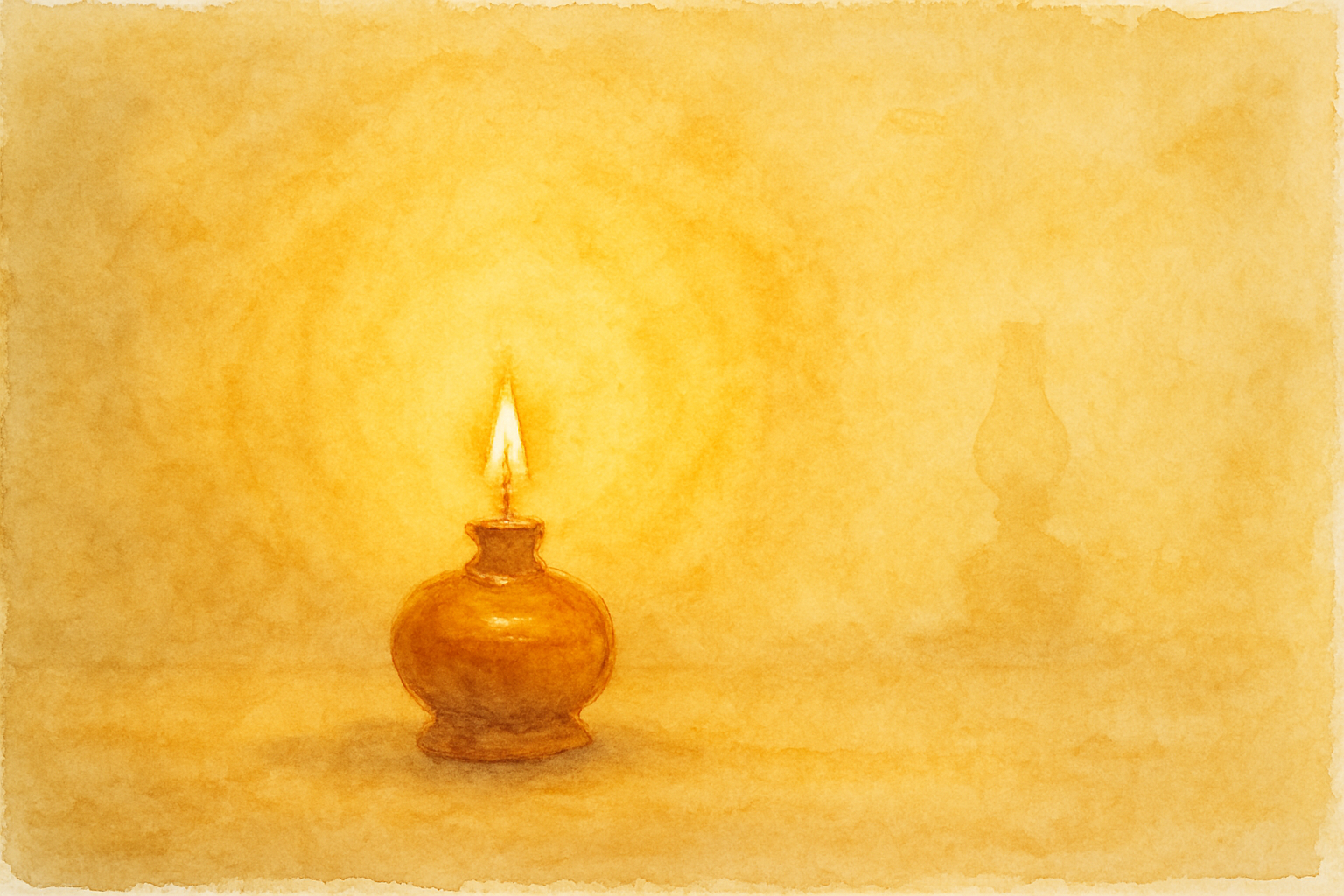
This is what is pointed to when they say the teacher lights the flame in the student. The metaphor, probably from thousands of years ago, is this: you have a lamp. Your lamp is off. The teacher has a lamp with the fire burning. You come close, your lamp lights, and now you go with your lamp lit.
My teacher would say: you leave, you cross the door, and as soon as you walk out, you forget everything. The lamp lights up, then it starts to dim, and then it goes off. You come back, it lights up again, until at some point you learn how to keep it lit.
But I'm pointing to it as something that's already there. There's already a lamp that's lit. It's not that yours is unlit. Your eyes are closed and you don't see the light. That's the matter. Until you start to learn: actually, it's there. It's there whenever I look. The light on the lamp is burning. And then it starts to become something so obvious and always present.
Group energy is not the essential thing
There's another aspect worth mentioning. Certain sensations of group energy will only happen in group energy. The sensation of swimming in an ocean is only going to happen when you're swimming in an ocean. If you're walking in a forest, it's not going to feel like swimming in the ocean. Similarly, when you're sitting in a group with a teacher, there will be sensations that only happen then. But those aren't the important thing. The important thing is something else, something more subtle, that starts to become recognized.