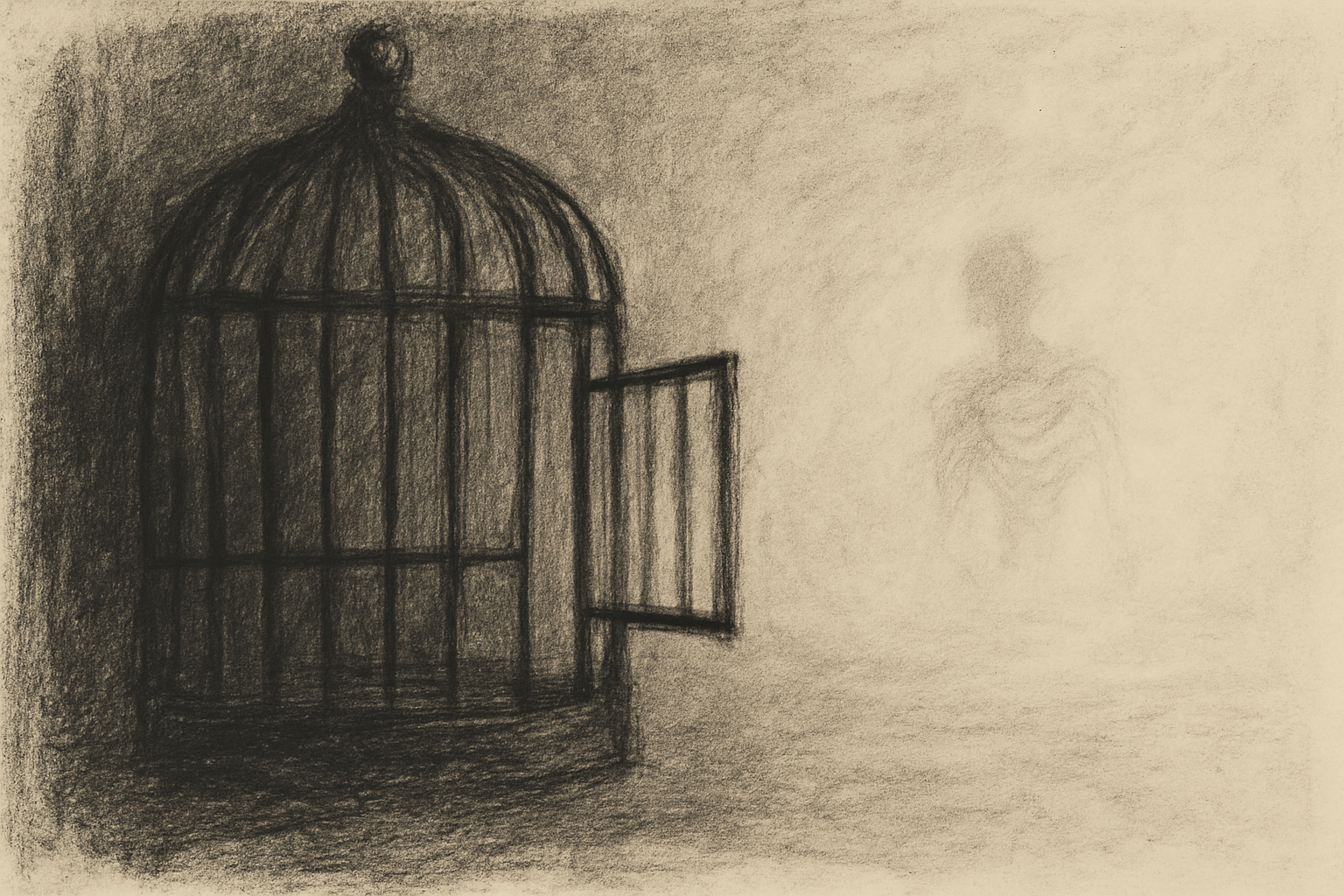
The Cage of Avoidance
La jaula de la evitación
A conversation about how avoiding unwanted experiences progressively narrows our lives, and why the body is the doorway out of that self-imposed confinement.
The Cage of Avoidance
A conversation about how avoiding unwanted experiences progressively narrows our lives, and why the body is the doorway out of that self-imposed confinement.
The big mistaken assumption, the belief that fuels it all, is our sense of what we need. I was speaking to this in the meditation: what we really long for, what we really need, is to relate to reality. But we don't know that deeply, so we carry a mistaken notion of what is valuable. We think what's valuable is whatever we're pursuing, because that's going to give us what we want. To know that what's truly valuable is actually not that, but rather to sit with the thing we don't want to feel: there is value there. Because once you can sit with that, you don't have to create a whole bunch of noise around it. And once you can sit with pretty much everything you don't want to sit with, you're free.
You're not free from it. You're free to be with it. You're free from having to avoid it. And that's the self-imposed cage that is described as ignorance, or living in illusion. It's as if you say, "I don't want to experience anything that's outside of this cage." And the cage gets smaller and smaller and smaller.
When you talk about freedom, what do you mean?
In this case, I'm using freedom in a very specific way. I don't mean to define freedom in its entirety.
The house of inner experience
Think of it this way. Freedom to walk the streets versus being in jail: that's a freedom, right? In this case, imagine the space I'm describing as land, the space of all experiences. But there are many I don't want, and they happen to me regularly in my normal life. So those rooms I lock the door and try to keep those experiences away. And now, in all the rooms of my house of experiencing, I start closing doors everywhere until I lock myself in the bathroom, because there's so much I don't want to experience in the world of my inner life.
So the freedom I'm referring to is not freedom from those experiences. What avoidance actually gives me is the absence of freedom. I am locked in my small, controlled room of not-experiencing. I'm referring instead to the freedom to walk into all of those rooms and savor those experiences: fear, pain, shame, loneliness, and all the forms and ramifications of fear, all the forms and ramifications of pain. The ways in which we meet and encounter those feelings.
Because avoidance also limits our experience of what we actually want, and limits what we actually want to live. In order to not feel fear, I have to not do the thing I want to do, because it's scary.
So this continuing to meet reality as it is has to be expansive, because it's constant.
Exactly. It's the definition of expansiveness. To be able to meet everything that is takes you all the way out into infinity.
It lets us dance, to be in a place of "go for it."
Exactly. And then there is the freedom to choose. You will still have preferences, and the more you're in touch with your deeper desires, you will have a direction. I phrase it as: what does the universe want to experience through you? That points to the grandness of that desire, versus "what do I want to get so that I don't have to feel that?" That's my small desires.
What a contrast. It's day and night. I think I'm more and more aware of these things, but it's still not ingrained in me to go to the body. And it seems like going to the body is a really big help. I guess it's a matter of practice. I don't go there automatically. I can be in a space for quite a while and then say, "Ah, body. Where do I feel?" It's so not automatic.
Why the body matters
It's important, not as a way to enshrine the body as more important than other things, but because it's the natural progression out of our minds: out of mind, into the body, into the world. Otherwise, we will be trapped in the avoidance of bodily sensations, bodily feelings.
I find the mind so compelling and the body so boring.
I get it. I relate.
Then there's the looping. It's like I'm going nowhere, but it's a wonderful thing. It's a wonderful meditation practice to say, "Okay, you're looping, go back." It's so helpful. I'm so glad I'm finally aware of that component.
What you really want is not in your mind
Yes, and also: what you really want is not in your mind. You can take that as something to blindly trust as an experiment, or I recommend you take it as a hypothesis. What if I have been wrong, and this hypothesis is a better one? Meaning: you have been wrong in thinking you will find what you really want in the world of mind. And maybe that's coming to an end, in the sense that it's no longer satisfying.
The mind is beautiful, and it's a beautiful world, but I'm talking about a deeper longing, a deeper satisfaction or fulfillment. There is nothing wrong with the goods of the world of mind. But it might come to a point where something is no longer satisfied there. And that doesn't mean you throw the mind out or stop having the satisfactions of mind. That's not necessary. I still enjoy playing chess. I still enjoy mental problems, philosophy, all of that. But there was something so unsatisfying about the space of mind. That deeper longing became burning, and its fulfillment only happened outside of mind. Then I was able to see that all of that looking for satisfaction in the world of mind was an avoidance. And it had to go through the body. The body was the door.
Did your teacher talk about the body a lot?
A lot. Even my teacher, who is less of a "body person" than others I've known, was all about the yoga: how much yoga he did with his own teacher, going every year, twice a year, for a whole month, doing yoga starting at five in the morning. Body, body, body, body.
When I heard him talk about that in an interview, that's what made it click. I said, "I have to see this person." I got a little introduction, but I didn't feel I got enough. I feel like I need a lot more. But he did open that world to me, and that was really invaluable.
He's getting older, so he's not guiding those meditations the way he used to. The last time I was there, he did no yoga at all, whereas in earlier sessions he was sitting with yoga mats, guiding movements, which were still gentle. I think he's just done that for so many years that at his age he's slowing down that kind of body practice. But does he talk about it and say how important it is? Absolutely. It's very central.