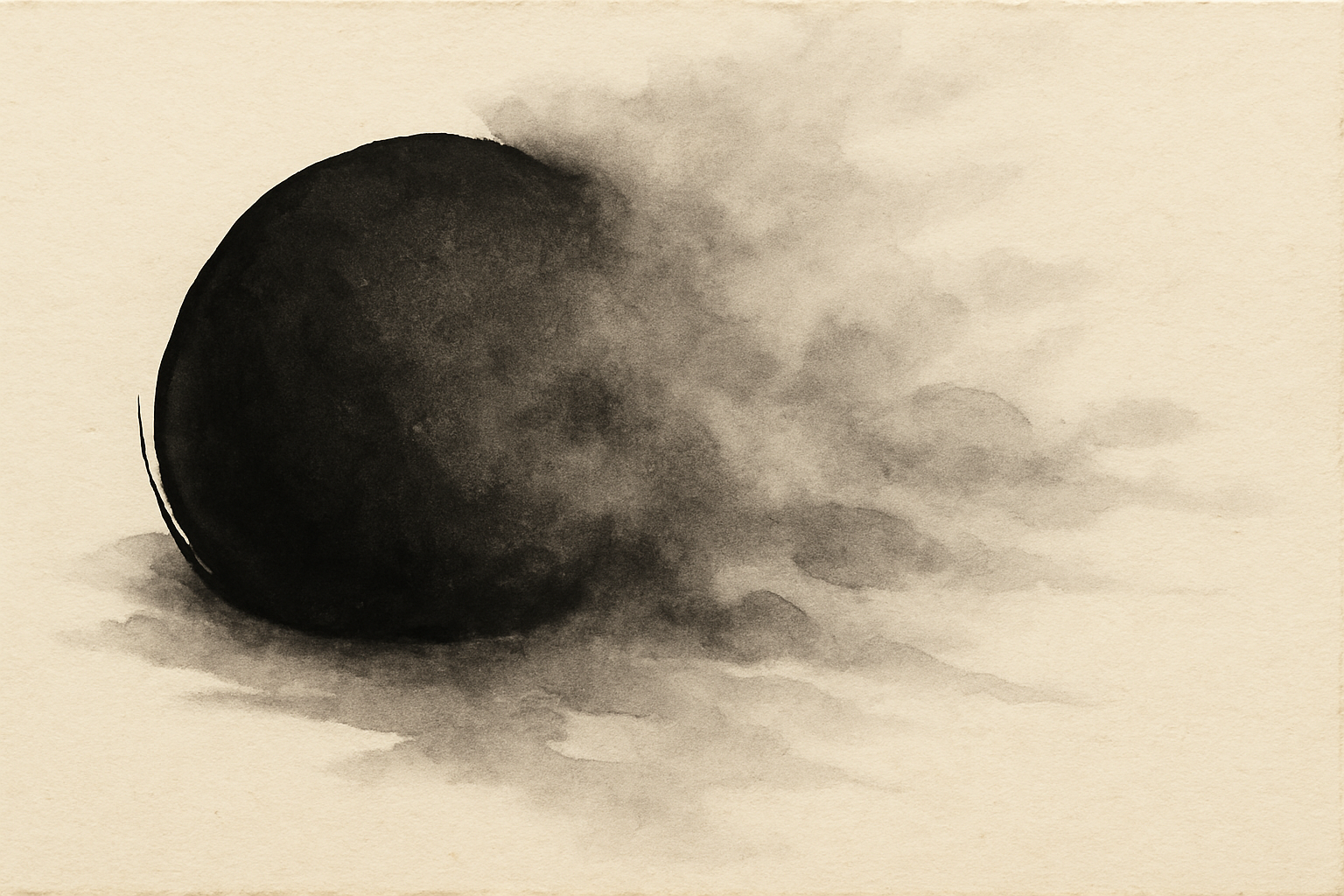
Boundaries, Objects, and the Mind That Draws Them
Límites, objetos y la mente que los traza
A reflection on how the mind's capacity to draw boundaries creates the world of separate objects, and how careful observation can dissolve that very separation.
Boundaries, Objects, and the Mind That Draws Them
A reflection on how the mind's capacity to draw boundaries creates the world of separate objects, and how careful observation can dissolve that very separation.
I wouldn't say duality is a product of language. It is definitely connected to language, but the more fundamental thing is the mind's capacity to draw boundaries. Making something into an object can only happen by drawing a boundary.
The foundation of duality
Think of the yin-yang symbol. It is essentially boundaries: black, white, a line separating. That image shows the foundation of duality, the fact that drawing a boundary separates something from something else. From there, we can name things "black" and "white," but they are two sides of the same coin. The fundamental thing is the mind's capacity to draw a boundary and separate something from something else. Language is simply the way we communicate, internally with ourselves or with others, about the world of form that the mind has broken up into objects.
Transcending separation through observation
So how do we transcend that? By observing. You only experience the yin-yang image as two colors with a separating line when you think about it. Even in direct perception, there is only a boundary that separates it as an object in mental space.
What science found when it zoomed in
If you were to zoom in, and this is what science has done everywhere, the paradigm of the atomic universe collapsed. The atomic model is still a useful representation, and it is still taught in school as the foundation of reality, but it is false. The more scientists zoomed into atomic reality, where they literally thought the whole universe was made of objects, really small objects, the more they discovered otherwise. First they found electrons, protons, and neutrons. Then they were able to look a little closer, and they realized it is empty space. It appears like an object, but it is empty space. So when you observe closely enough, the paradigm collapses.