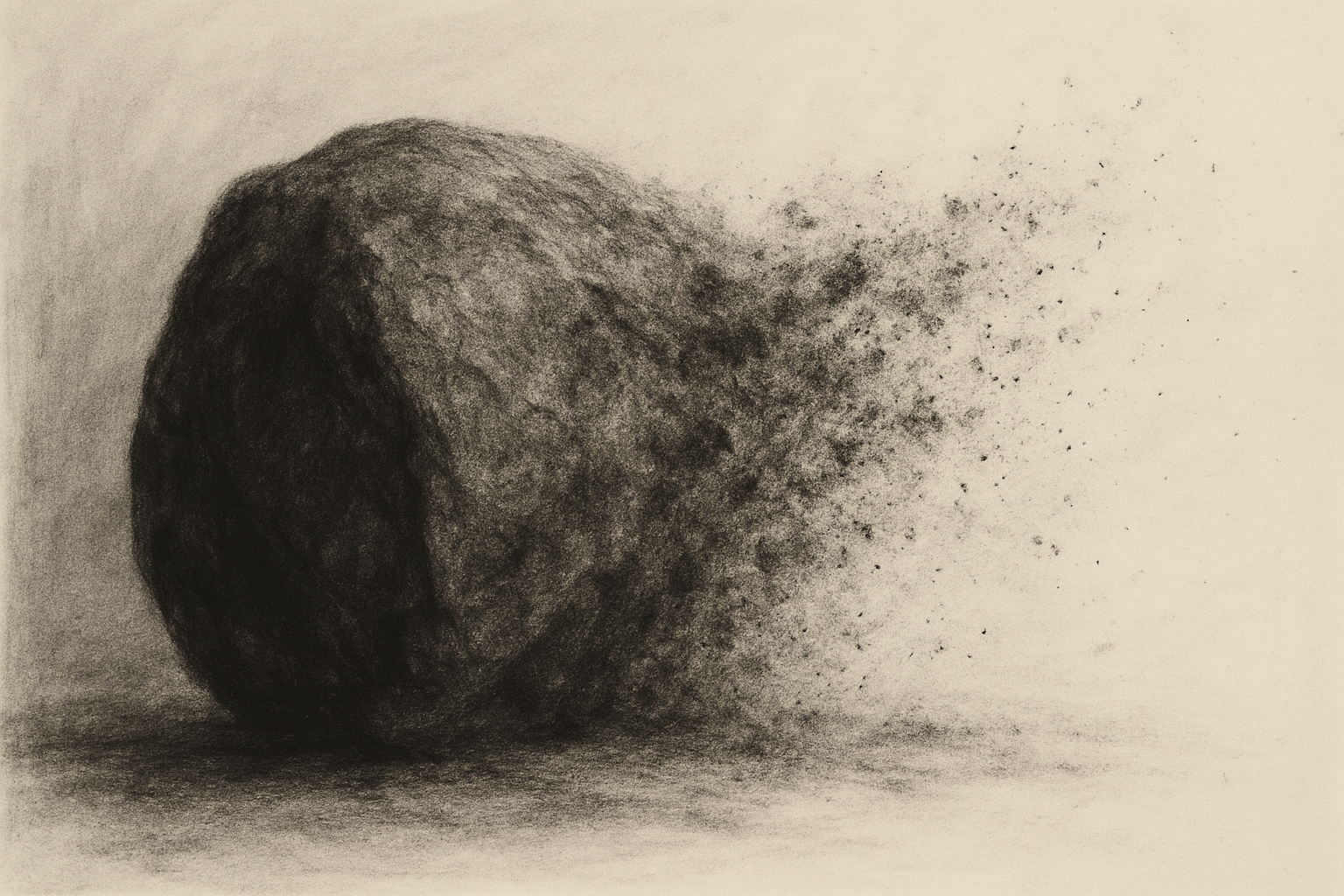
Substance and the Fear of Dissolving
La sustancia y el miedo a disolverse
A question about whether we are emptiness leads into a discussion of substantiality, ponderability, and the terror of ego dissolution.
Substance and the Fear of Dissolving
A question about whether we are emptiness leads into a discussion of substantiality, ponderability, and the terror of ego dissolution.
So does that mean that we are also emptiness?
Yes, empty and full, but just not objects. You could say we are subject, but not subjects, because then those would be separate objects that you call "subject." If you say everything is one subject, that approximates something more correct. But if you follow that through, the sense of a subject makes no sense if everything is subject.
Yeah.
That is why I prefer the word "being." "Subject" has a really strong implication of object, whereas "being" implies non-being, something more intuitively impossible.
It's the difference between a verb and a noun. The noun is unchanging and stationary, like a concept set in stone, with boundaries. So in the beginning, it's boundless.
Yes. Words like consciousness, awareness, reality, being: they point to something closer, more intuitively aligned.
Emptiness as a corrective, not a belief
We are emptiness, but when you believe you are form and only form, the realization of emptiness is needed to contrast that belief, because the belief in form supports the belief in separation, in objects as absolute reality. In Buddhism, they talk about the recognition of emptiness. But it is only in the service of removing the belief in form. So if somebody is walking around believing they are empty and everything is empty and there is no form, then they need to remove the belief in emptiness.
That is more unusual. A lot of the teachings point to emptiness because people in general believe in form and separation. But more and more today, in non-dual circles, there is a belief in emptiness, a belief in non-separation, and people walk around carrying this belief. It is very easy to spot.
How do you spot it?
It is just seeing. It is pretty obvious. There is no formula.
Yeah, I think I know what you're talking about.
Emptiness that is full
So that emptiness, when you say, "then we're also empty," it is an emptiness that is full. It is empty of boundaries but full of substance.
Sorry, full of what?
Substance. There is an expression I love, one I loved decades before I even had any grasp of what it meant. "Substantiality is inversely proportional to ponderability."
Say it again, please.
Substantiality is inversely proportional to ponderability.
Could you talk more about what you mean by "ponderable"?
It is anything you can turn into an object, anything you can talk about, anything you can separate from something else. It can still be abstract, like having control or not having control. But to your question of whether we are empty: yes, but substantial.
For me, it took quite a bit of time. I was talking about a substance because that was the best word for what I was experiencing. It took me months to connect it with that statement, because I had forgotten about it. Then I realized: that is the word, right there.
Nobody was talking about the substance. I actually got on a call with a well-known teacher and asked him, "But it's all a substance, right? It's just this substance, because I don't hear anybody talking about it." And he said, "Yes, yes, this is something." That was enough.
From ponderable to substantive
Can you say anything more about substance? I know you're making it into something ponderable, but still.
Your experience right now of being is substantive. The knowing of that can be experienced so directly, like how you had that experience of your hand. That is what it means to go from ponderable to more substantive. "My hand" with a story, as an object, with a history: that is ponderable. But then there is this large blob of sensation, and I am imagining this is more how you felt it. It has more of a substantive quality. There is a presence, an energy, sensations, versus the image of a hand that is there, that has a function, that is a part of me, that does things, that feels a certain way. The latter is more ponderable. The direct, raw experience of those sensations is more substantive.
You can think of the inverse equation as going toward infinity. Something can be infinitely closer to ponderable and less substantive, or vice versa. What this equation defines is a mathematical aspect of reality: when we are experiencing and functioning from the perspective that things are very ponderable, we are farther away from substantiality. When we are operating from the mind, we are farther away from what is real.
When I hear you use the word substance, the picture I get is this: ponderability, or mind, or whatever you want to call it, comes and goes. But substance feels like this big, thick liquid of what everything is. It is always there, constantly dancing or whatever the word is. When I think of substance, you can't see it, you can't put your finger on it, yet it is the most solid thing and the most constant thing. There is something about the word "substance" that feels like a much more direct experience than "presence" or something like that, if that makes sense.
Presence is another word, but if substance resonates more for you, that is fine. I have experienced it as presence, but substance is preferred. It is more like an ocean, which is why the ocean is such a common metaphor. Something more ponderable would be a wave. Waves are referred to as something ponderable: there is this wave, then that wave, then that other wave, little waves, bigger waves. But if the universe is an infinite ocean, then there is a substantive quality to it that you cannot define any border around. That is a good metaphor, but it can also be experienced directly, known directly.
The substance arriving
Did that experience of substance hit you all at once, or was it gradual?
It started hitting me as a teenager, and it would knock me out, literally. I was having what seemed like blackouts. I would be sitting and then have this experience of that substance coming up. I would faint but still be sitting; I would not fall. I would have visions. I went to the doctor because I thought something strange was happening.
Not much later, when I had more of a direct sense of it and after I had met my teacher, I recognized that those visions were basically my mind switching off and going into the dream world to preserve a sense of identity, to not dissolve into that. I was too uninformed, too young, too weak of a mind to survive it.
Over time, it started becoming more and more present and more intense. I had conversations with my teacher about it, and he was basically asking me to go toward whatever invited that direct experience. But the more that became my experience, the more I felt it was overwhelming, because the more that form of experiencing or being became present, the more the sense of self was threatened. That is what, a few years ago, basically took over. After that, the foundation of reality became that substantive nature, and form, the ponderable, is just floating around.
From your story, I go straight to this: here you were, and it was very difficult, and you were blacking out, and it was overwhelming, and there was a certain resistance there. Yet another example of "that's where the treasure is, go for it." It is an incredible example.
Between the sword and the wall
Yes. My teacher told me, "It has been chasing you all your life. Your destiny has been chasing you, and it finally got you. You have been escaping." It was basically like being caught between the rock and the hard place. The more I followed my desires to live, the more that substantive nature of reality started to bubble up and become present. And the more it bubbled up, the more I tried to pull away from terror. It was twenty, twenty-five years or more of that back and forth.
That sounds pretty general, right? Like what they say about the ego having to be strong enough. It seems there is no way of not resisting. At first, and then... I don't know what they mean by the ego having to be strong enough, in what sense.
It is that way. It is impossible. The ego cannot not resist, because that is the definition of what the ego is. But what can happen is that it can be surrendered too early. For me, there was some kind of intuitive or deep intelligence: whenever it was too close too soon, the pulling away was strong enough to work on being more prepared. Then at some point, you feel completely unprepared, completely not ready, completely trying to resist, and none of it matters. You have no control, no power over it. It is like a fruit on a tree trying not to fall, but it keeps growing, and the little twig starts getting weak, and it is saying, "No, no, I'm staying here," and then it simply cannot hold. There is nothing that can be done.
The role of samadhi in building trust
What was interesting for me, which I do not fully understand, is that there was first the recognition of nirvana, or samadhi. At the egoic level, that calmed the fear of death enough so that when that substance came on really strong, I think at a deep level there was a trust that was new. That trust came through my teacher. The first time I went to see him in person, on the second or third day, I had a glimpse. I entered samadhi.
Over time, at the level of ego or identity, that created a trust where death could be faced more fully. Because what we are talking about is basically like dying. The mind cannot distinguish between anything projected around the body dying and the ego stopping for a moment. It is still experienced as going toward death. There is no way the mind can distinguish. It is the same thing, and so it is going to be experienced as, "I am going to die. I am dying."