When the Strategy Falls Away
Cuando la estrategia se desvanece
A student describes a pivotal shift that came from stopping the relentless drive to work and fix, and the teacher offers a map for understanding how suffering projects itself outward and how freedom comes not from changing direction but from trusting the present moment.
When the Strategy Falls Away
A student describes a pivotal shift that came from stopping the relentless drive to work and fix, and the teacher offers a map for understanding how suffering projects itself outward and how freedom comes not from changing direction but from trusting the present moment.
Over the past several months, something important has shifted for me. During meditation, when I noticed the distractions arising, I saw something I had been caught in for a long time: this constant pressure of "I have to work, I have to work, I have to work, because I need money." It was my ego telling me, "You're not enough. You can't do it well."
Then I made a small but very important decision: I simply stopped working. I stopped chasing after more. It was as if the meditation revealed something to me. Trust appeared. I saw that what I actually want is to do my best with my work, to learn what I need to learn, to do things with confidence, more concretely, rather than constantly looking at what everyone else is doing.
I appreciate this opportunity so much, because sometimes the mind tries to pull me somewhere else. But seeing this clearly makes me feel more complete. Before, I was always looking outward at other people, trying to see myself through them. And there was this voice that only pointed to my past or my future, always saying "poor me, poor me." I would think, "My God, I don't even know who wants all of this," and yet I kept buying the ticket.
You buy the ticket.
Yes, with the finger pointing. And then in one moment I said, "No. No more. This is the last time I show up like this." Now I continue to see those patterns, but I feel good, because that is their life. My life is my life.
In this moment I can see the whole panoramic picture so clearly. I am here.
You mentioned something about stopping work. Is that something that happened recently?
About six or seven months ago, I decided to stop. I told myself, "You are not working anymore. You are going to see what happens." Suddenly I let go of what the mind had been saying about me, and that was the change. I literally stopped my job, because I kept telling myself, "I'm not doing things well. I have to take another course, and another course, to get more clients." But then I said, "Just stop. Try to relax. Enjoy. What is the problem?" I live with my partner, he covers part of what is financially necessary, so I allowed myself to be in that way.
The mind's strategies and the map of projection
The mind is always going to come with strategies. Something doesn't feel right. We feel something is missing, something is not okay, either with the moment or with ourselves.
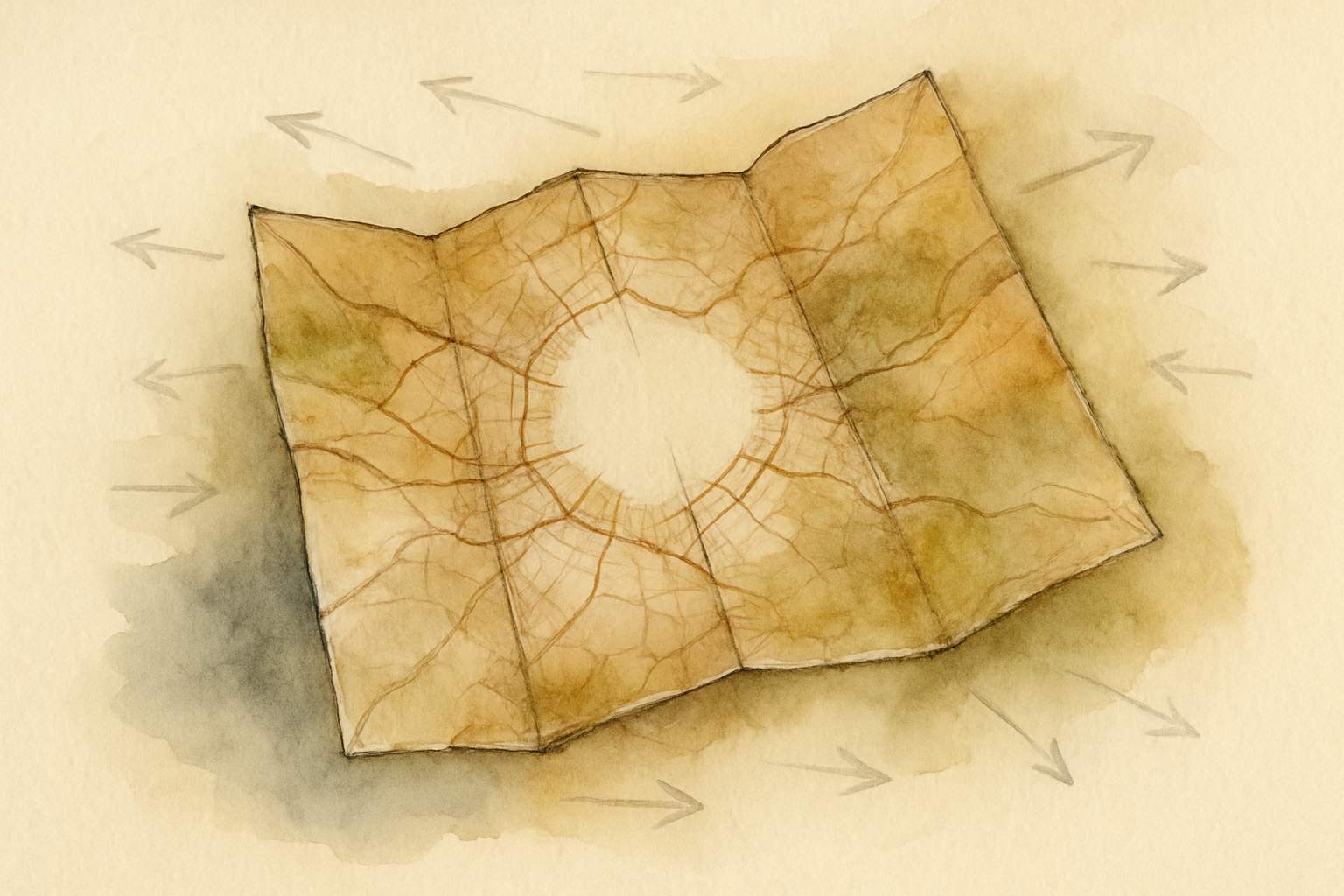
If we are really lost, the problem is going to be projected very far away. It's going to be the government, or something equally distant. That is when we are deeply lost in beliefs and the stories the mind is offering. The more lost we are, the farther away the problem appears. The more aware we become, the closer it gets, and the more it becomes a sensation: something at the level of feeling, like an anguish, without much story attached. You can take this as a kind of map. If we are very distracted, the problem is far away.
It is also going to be far away in time. It will be something that happened long ago, and the solution will be somewhere far in the future. As we become more aware, the beliefs in that faraway problem start to fall, because we begin to see their falseness. We are essentially removing our self-deception. There is a lying to ourselves in believing, for example, that if the government were different, then I would be okay.
Notice too that the farther away the problem is, the more irresponsible we become. The problem and the responsibility are far away. I have no responsibility. I am a victim.
The subtlety of what is closer
As we get closer to understanding what is real and removing this self-deception, the experience becomes more subtle. It comes closer to a sensation: an angst, an anxiety. It becomes harder to name, but there is a sense that something is missing.
We will also try to find strategies by slipping from one side to another. For example, if it was all "work, work, work," now the solution becomes "no work." That contrast helps us see: "This is very different from what I thought it was." This is why, when we make big changes, or even smaller ones like a vacation or going on a retreat, we create contrast and can experience reality differently. By doing that, we see that what seemed so real has now changed, so it must not have been that real.
How contrast reveals deeper layers
For example, something seems very real. We are immersed in it: the most important thing is this problem I am having with my brother. Then I go on a retreat, take some time, and I forget about the problem with my brother, because I am doing other work in a different situation. Now I see that the problem with my brother doesn't seem so real anymore. We create this contrast and a suspicion arises, a skepticism: maybe that is not the real problem.
Some people will live a whole life with one or two problems that they believe are the cause of all their suffering, but these are very deep beliefs, and they are not really the problem. I am describing a larger map here.
When we create this contrast, we can find something deeper. This is what I think is happening in what you are describing. You created a big contrast and discovered that there is a well-being that becomes possible by dropping the strategy you had been using to solve the problem. You drop that strategy and discover, "There is a well-being here." That is what you meant when you said, "This is what I want."
Strategies replacing strategies
But at the same time, what can happen is that we think or believe that this other approach is the solution. And so it becomes a process of going deeper into more subtle layers.
Yes, I understand what you are saying, because for me it was not simply switching to another option. I think I used it as an opportunity to go a little deeper and see what was going on. Now I have created a new plan and started again, and at the same time I have been able to address some physical symptoms. That period was not entirely relaxed, but within it I was able to resolve problems with my partner and begin addressing health issues. It was a real opportunity. And now, being able to speak about it here, this is the first time I can see the whole picture so completely. Thank you very much for hearing me.
That is beautiful. That is really beautiful, isn't it?
Yes. I was listening to your last meditation, and it was also amazing. Thank you very much.
Freedom is not in the direction
What I wanted to offer was, first, a map to confirm and validate the shift, and also to point toward more subtle refining for you to take with you. It no longer has to be about the action or the direction. It is not that important what kind of work you do, or how you work, or whether you work at all, because freedom is not in the action. Freedom is not in the direction. Freedom is when we stop trying to fix something by projecting a solution somewhere else.
In a sense, things can turn around completely: you are surrendered, in trust with this moment, and from there you can choose whichever direction. That is where it becomes free and creative. Compare these two orientations: "Something is fundamentally not okay now, and I will fix it by going in this direction," versus "Now is fundamentally okay, and I want, I desire, I have this deep movement to go here or there, to work or not work, but it is not coming from something that is not okay that I need to fix."
Two ways of relating to the moment
These are two very different ways of relating to the moment. In one, we are escaping something that feels untrustworthy, something painful, sensations we cannot face. In the other, we have learned to face these sensations, to feel these feelings, to question what the mind is telling us when it says, "This is not okay."
One way moves toward consciousness, toward freedom, toward trust. The other moves away from that, into a mechanism of suffering.
Thank you. It is really lovely to hear you.