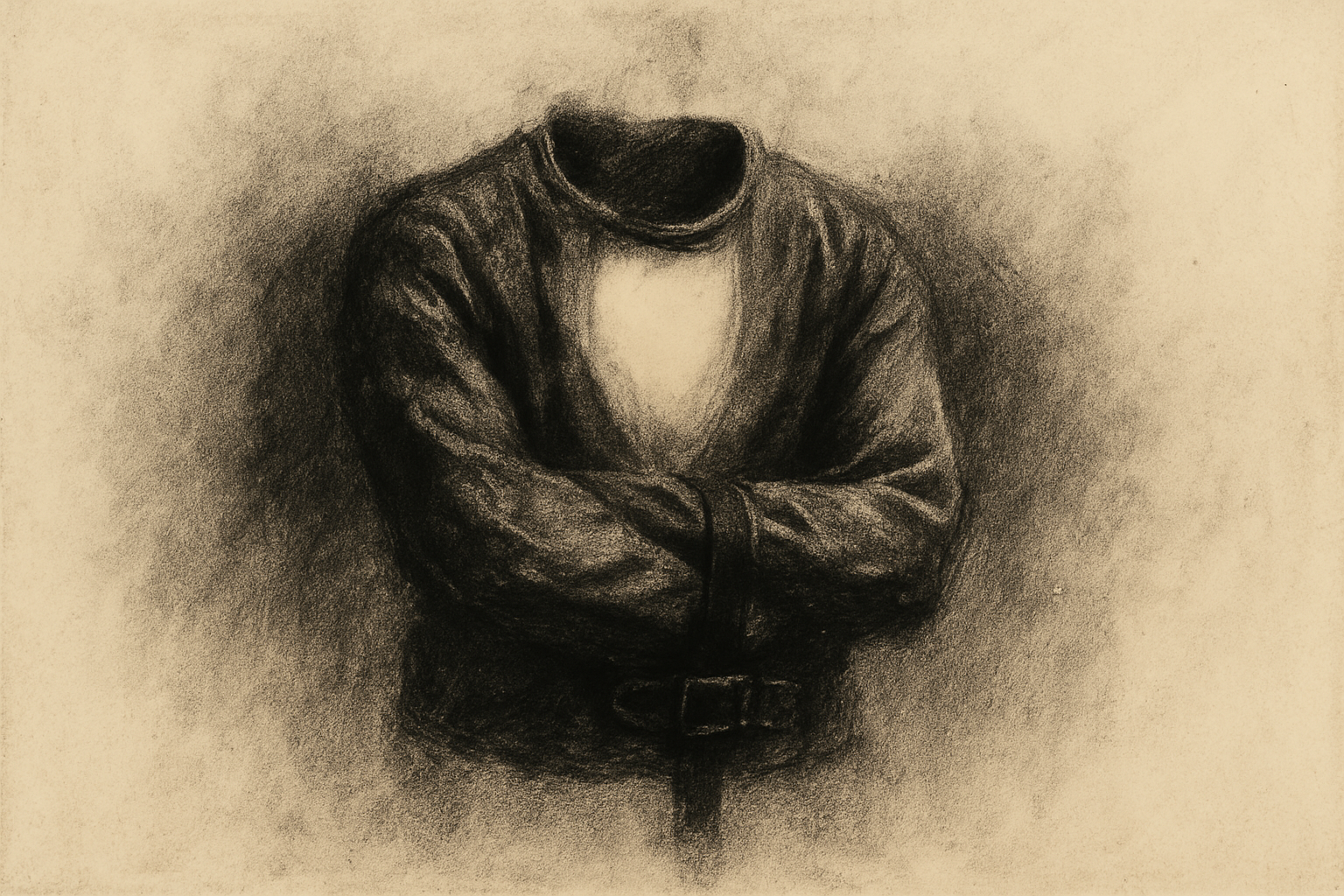
The Straitjacket and What Wears It
La camisa de fuerza y lo que la lleva puesta
A student questions the usefulness of the word "illusion" for direct bodily experience, and the teacher uses the student's own felt sense of contraction to illustrate where the real illusion lies: not in sensation itself, but in the identification with it.
The Straitjacket and What Wears It
A student questions the usefulness of the word "illusion" for direct bodily experience, and the teacher uses the student's own felt sense of contraction to illustrate where the real illusion lies: not in sensation itself, but in the identification with it.
I want to comment on the word "illusion." I don't need anyone to convince me that my senses don't give me anything objectively true, because nothing is objectively true. I can see that. I've had certain thoughts I was sure were the truth, and then I found out they weren't. I've seen someone and been sure they were so-and-so, and it turned out they weren't. It's clear to me. I get that, and it's very useful for me to see it that way, so I don't take myself too seriously, and I don't take other people too seriously, because everything just leads to the next thing.
I get it on a pretty deep level. It helps me be humble. It looks that way to me, one hundred percent, but who knows? Before I know it, things evolve, they change. However, the use of the word "illusion" is tricky for me. I've been in situations where I thought I saw water on the road, and then I got up close and saw there was no water. But if I have pressure here, it doesn't feel like an illusion experientially. I understand that in the great scheme of things, it's just how I interpret it, how I experience it, and there's nothing objective there. I get that. But when I want to apply the word "illusion" to my own experience, it doesn't work unless I can uncover the illusion.
During this meditation, what I found myself doing was looking for what's behind the experience, so I wasn't really so much into the experience itself. I also understand that it's a useful exercise to go deeply into an experience, and before I know it, that experience dissipates. But somehow that word "illusion" makes me feel like, if I'm feeling something and I keep feeling it, maybe I'm doing it wrong. I know I'm not doing it wrong, and I don't need an explanation about that either. It just feels like a stumbling block, that word. Maybe it's like the word "God": you use it so many times, and then all these concepts get attached to it. Anyway, that's my comment.
Someone once was asked whether there's a reality out there, and he said, "Yeah, things are real, but they're not really real." That helped me a lot. It's not just the conceptual aspect; I could feel the different levels, not just know them.
The word behind the word
I was quoting Hinduism, and I think part of the difficulty has to do with translation. The word in Sanskrit is maya, and it's typically translated as "illusion." But I defined it as something that isn't what it seems to be.
If we try to understand and define reality, we get into a lot of trouble, because reality cannot be defined. What you can do is uncover it experientially. That's what I believe this teaching points to when it says the world is an illusion. It's one of the ways in which this work is taught.
So the translation is "illusion," but I was qualifying it as "not what it appears to be." When you said you were on the road and it looked like there was water and then there wasn't, it appeared like water, but there was something else that wasn't illusory. There was something real that looked like water. It's actually a reflection of the sky. Mirages are created because of heat inversion. The hot surface becomes a mirror and reflects the sky. So you're seeing the sky, and at a certain level of reality it is real, but it looks like water because the sky shouldn't be on the ground. That's what I'm pointing to.
Where the illusion actually lives
When you say you have tension and you feel pressure, at the level of sensation you're experiencing exactly what you're experiencing, and that's a real part of your experience. But what could be illusory in that example is, for instance, a narrative saying that the tension is caused by X and will be solved by Y. You will probably have an inner narrative interpreting that sensation and relating to it in a way that carries beliefs. Those beliefs can be uncovered so that the experience can be experienced more directly. When I say "raw perception" or "raw sensation," I'm referring to something less interpreted, less filtered by beliefs.
A lot of what you were describing refers to "I myself," and that is where the primary illusion happens. What is this "I myself" that we're referring to?
It takes time to go down the layers, from being confused at the level of thinking to being confused at the level of perception and sensation. We could clear the confusion at the level of thinking but still interpret sensation through a kind of thinking. There's going to be an interpretation, for example, that the sensation I'm experiencing is absolutely real in the sense that there's something there that doesn't depend on me. That this table is how it appears to be. That it is solid, and that solidity is in some sense objective and real in itself. That's what science assumed when it took matter to be real. But when scientists went to the depth of it, they found they could not guarantee there's matter other than by looking at it, and looking at it removed all the properties they thought matter had. It seems that it's only there if it's looked at.
So in all these ways, the most important misunderstanding to question is that sense of "I am" and the belief about what that is. Look at it more closely, because that's the mirage. You're looking at the sky on the ground. The sense of "I am" is real, but the definition of what it is, that is where the confusion lives. It's actually the sky, and the ground is not water.
I think that's where I was getting so frustrated, because I kept feeling like there's a barrier. It feels like a straitjacket, this meanness, this contractedness. I feel the contractedness of it. And I think the meditation brought that out more than ever.
The trap of trying to undo the contraction
Let's stay with what you're describing: the straitjacket. You said this "me" or this "I am" is like a straitjacket. The contraction doesn't have to go away, and that's exactly the illusion, the trap. We create a contraction and identify with it: "This sensation of straitjacket is me." Then we decide that this "I" that is now contracted needs to decontract for me to be okay. And so we're trying to undo this contraction while at the same time we are causing it.
Imagine: a lot of this is actually physical. There's a contraction in the body that then creates a whole bunch of stress. We attach the sense of self to that contraction, and then, "Here I am. And this 'I' that is here feels pretty uncomfortable, so I'm going to try to decontract it." But as soon as I decontract, it goes against my identification, because I need to contract in order to identify with it. I need to create a sensation that I can identify with.
So now I'm in a tug of war, trying to undo a contraction. If I undo it, the sense of self starts to feel like, "I'm disappearing, because I am this contraction." So I contract again. This habitual back and forth is what we do, and it will never resolve itself that way.
Which are you: the straitjacket, or that which notices the straitjacket? How could I feel that I'm in a straitjacket unless there was something noticing that?
Exactly. Which are you?
The straitjacket. That's what I've always been. That's the quiet inside of me.
Disidentification, not removal
It doesn't actually have to undo. It's just a contraction, just more sensation. It's about looking at the "I" that feels "I am contracted." You describe it as a straitjacket; that's how you touch it, how you relate to it. For another person it's going to be different. But for you, sit with that whenever you have the experience of "I am in this straitjacket." Come really close to it and look at it. Look at all of these dynamics I'm pointing to, especially the sense that "this needs to relax for me to be okay." That's the trap.
It's all about seeing that sensation is appearing, and what I am has nothing to do with that sensation. One of the ways you can uncover all of the hidden beliefs and agendas is by asking: "Can I be okay with this for the rest of my life, if the contraction never goes away?" That question is going to bring up all the resistances and beliefs. "No, I can't." It's uncovering the agenda.
Really look closely at the sense that "what I am is this contraction, this straitjacket." It's going to have a physical sensation component, and it's going to have a tremendous amount of emotional components, all the reactivity around that contraction.
The word "illusion" applies here in that what you believe yourself to be is not what it seems. You believe yourself to be this contraction. It seems obvious to you that that's what you are. There's an experience of, "Well, obviously I am this contracted thing."
It does seem that way, but it also seems like it's not that. It's an old, attached story.
It's old, but it's also new. It's happening right now. It has momentum, it has a whole history, but that doesn't matter. Bringing in the history will create a sense of, "It's been there for so long, it's going to take a long time, I shouldn't even bother, this is really hard." More contraction, and the agenda comes back again.
Realize: right now, you could look at it, because the disidentification takes no time. It's actually a decision. But there's a lot of resistance. We don't want to make that choice. We might make it for a millisecond, and then we go back. It's not really about the contraction. We separate from it by just that millimeter between "me" and the contraction. I say, "I am here, the witnessing presence, and there's something in the body that I am experiencing that is contracted, and there are emotions in the mind that are rushing." Just that separation, over time, removes all of the behaviors and mechanisms that create the contraction. But if you try to resolve it by undoing the contraction, you're stuck in an infinite loop.
The snake and the rope
That infinite loop is maya. That's the cycle of birth and death and rebirth, samsara. It's the pursuit of pleasure in a cycle of pain and pleasure, pain and pleasure, looking for the off button. The way through is to see what you truly are. In this case, it's the disidentification from that which you experience yourself to be as the straitjacket.
There's a well-known teaching that uses the example of the snake. You see a snake and you jump. Then you look closely and realize it's not a snake. The fear wasn't necessary. But it's also important to see what it actually is. In the metaphor: it was a rope.
So there are two steps of seeing clearly. The first step is to see that what I am experiencing, this contraction, the straitjacket, I am not that. I am witnessing it. I am experiencing it. I can describe it, I can see it, I can talk about it. Therefore, there is no way that I am that. This is also described as neti neti: not this, not that. I'm not this. I'm not that.
But then, what am I? That's for later. The first step is neti neti: I am not the straitjacket. And not as a mantra, not just repeating "I'm not the straitjacket." Rather, look at the experience of "I am the straitjacket." Look at the felt sense of "I am this contracted straitjacket, this is what I am, this is what I have always been, and I always will be." Look at that and really start to disentangle the sense of "I" from that sensation. Just look at it and notice: the contraction is experienced by me. That contraction can be there for the rest of my life, and it will always not be me. Just doing that exercise, giving yourself time, is going to unravel a bunch of resistances, beliefs, and emotions. That's what you need to sit with.
What meditation is actually for
I think sometimes there's this expectation that meditation is a time of calm, and that's another story I carry. "Damn it, this meditation, I feel so uncomfortable." But I realize now how perfect it was. That's the duality of it: the calm and the stuff that's brought up both fit together.
Look at how there's the belief that meditation needs to calm down, that "I need to get calm." When you are experiencing that lack of calm, the awareness that you are, that which is experiencing the storm: is it stormy? Of course not. It is what it is. It is what it has always been.