The Storm That Feeds Itself
La tormenta que se alimenta a sí misma
A student describes discovering, during meditation, that most of their inner turmoil was recursive: hatred of hatred, struggle against struggle. The teacher explores why this discovery is valuable and how sitting with discomfort differs from pursuing expansive states.
The Storm That Feeds Itself
A student describes discovering, during meditation, that most of their inner turmoil was recursive: hatred of hatred, struggle against struggle. The teacher explores why this discovery is valuable and how sitting with discomfort differs from pursuing expansive states.
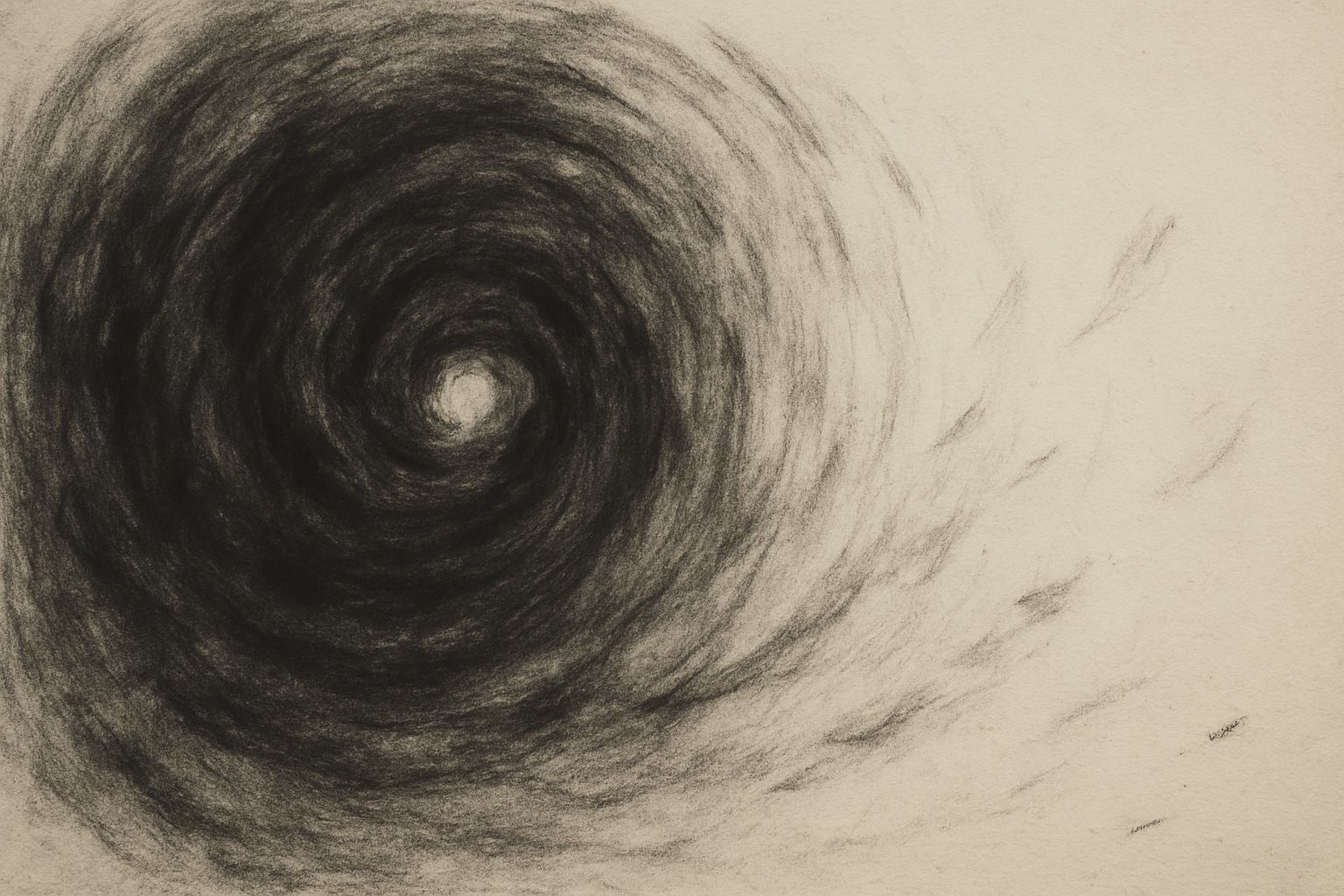
During the meditation, I was concentrating on knowingness, and it just got larger. Then at a certain point, something like annoyance arose. Fighting the annoyance was the annoyance. There was this self-referential quality where the very thing that was annoying about it was actually what was producing the annoyance. Maybe there was a kernel of sensation I didn't like, but the vast majority of this ball of hatred was actually hating hate. I could see that, but it still continued. It would drop for a moment, there would be less hating going on, and then the thing I was hating would feel a lot better.
I know very well what you're referring to. That's the kind of thing that is just so loopy and senseless. When you get into the core of things, what's really there just makes no sense. It's some mad way of saying no to what's happening.
The recursion of struggle
Exactly. It was like struggling against a sensation, and then there's a layer of struggle on top of that, and then you're struggling against that struggle. There's a lot of recursion. All the self-referentiality to the hatred or the struggle, that is actually most of it. It's the Buddhist "second arrow" terminology, but really there's the first arrow and then there are the 999 after it, and those are the real problem. That meditation made it very clear, though it would slip away and come back.
It's the amplification. But the only way we can do that is by coming up with stuff that's not true or real. And how do you do that? The mind can be so creative. A scenario where you're hating hate: that's like discovering an amazing mechanism to create a storm. Fire on fire on fire. When you look at it, it makes no sense, but it does make sense at the level of creating somebody who is struggling with something that's happening. One small discomfort, it could be a tension in the neck.
There was tension in the neck. Stop reading my mind.
It can be as simple as that, and you're sitting in meditation, and it's going to fire up that "hating hate" storm. Notice that this is going to be like onion layers. It creates a massive, distracting storm, because actually that is the distraction. But then it becomes the problem, and then there's the meta-problem, and then the meta of the meta, and then more thought about all of that. Or you go do something, get busy, and it all goes away.
This thing was like a gas giant where you can't see the internals. One of the outermost layers was: I started to get beyond this, and then I thought, "Oh, this is interesting, I want to say something about this when we talk." Then there was a whole formulation of what I was going to say, and then I thought, "I can't get this out of my head, I'm trying to meditate right now." So it was meta, meta, meta, meta, all the way.
Difficulty means it's working
But that's the thing. If you remember, at one point during the meditation I said: if something like what you're describing is happening, it's going well. That's the point of this work, to be able to stay with that and go deeper and deeper and deeper.
At one level it is a progression: sitting with that first storm, seeing what the storm is about. I would use the pointer of seeing that it's kind of pointless, senseless, irrational. It seems to have no motive or reason, but there is one. There's actually a very good reason. When we were born and came into this world as humans, there were things we struggled to handle, because naturally we were babies and we developed. What you're describing is most likely a form of coping with something, and it just became the way you're a little bit wired right now. That can be undone. It's not necessarily a lot of work, but it has to do with sitting with what this was helping you cope with.
Yeah, deep dissociation. There's an avoidant thing going on, a desire to avoid. And then sitting with it feels like desensitization almost. I don't know if that misconstrues what you're saying, but that's how it lands.
Especially if you resonate with what I'm saying, that's great. The more you can explore that, the better. Obviously, if you have a practice and meditation that takes you into an expansive state, that's fine. But I would suggest giving room for the kind of work we did in today's meditation. You can explore that on your own. It's about going into that discomfort and looking at it, sitting with it more closely.
Staring at a brighter sun
I definitely spend time in both modes. I have a meditation that takes me in expansive directions, and I also spend time in confrontation with sensations or patterns I'm avoiding, where I try to stare at the sun, so to speak. This was like staring at a much brighter sun for much longer. Probably the social obligation of being in the group turned my competitive, socially compliant instincts toward "let's just stare even longer," which intensified it. The guidance was helpful, so this is probably a recording I would revisit.
You described it as social compliance or competition, but you could also say it as a high level of commitment. You joined a meeting in a group and you did what the group was doing. To me, there's a lot of freedom in that. Sometimes what brings us to this work is not the greatest of motives, but it has served a good direction.
The more you describe it as a much brighter sun, the more I feel like: go there. When you find this kind of thing, it's a good discovery, because there's a lot of juice in that work. Going to expansive states in other practices (and I'm not saying to stop doing that) is likely going to go less far.
I accept that reframing. I like it, and I think it's true. There is a way where you use the thorn to dig out the thorn. But definitely, when I get into expansive states, there's a way in which I bump up against a barrier. If you've ever seen an infinity wall in the film industry, where the floor and walls are green and it slopes smoothly up: the meditation will bump up against a barrier that feels nebulous, not accountable. Then usually, as resolution improves, there's some avoidance underneath. I'm learning this harsh lesson over and over. Sometimes it's more fruitful to skip the line and go directly to the harsh material.
Expansion versus presence
I want to put a strong emphasis on this: I'm not saying that expansive work is bad at all. But if that's something that gets prioritized, it will hook us into expansive states. It becomes about getting there again, and one builds a practice around reaching an expansive state. Ultimately, there's no such thing as a final expansion, because there can always be more expansion than there is right now, no matter what's happening. But we don't see that.
What I would point to is this: a practice that's about expansion is going to be about getting somewhere in the next moment, the next minute, the next fifteen minutes. What I'm talking about is what is happening now, and fully seeing everything about what is happening now. There's going to be something we're not okay with. This is the nature of the identified mind. All it's doing, all the time, is managing a story about how what's happening now is not okay, in some form.
This is why today's meditation was specifically about going into that, and then not trying to get it to an expansion. Because that's again going to be: "I'm going to undo this discomfort and get to expansion." That brings in time, avoidance, some form of achieving and getting to something. It's the whole thing coming in through the back door again.
So it's about sitting with what is happening now. Not avoiding, going deeper and deeper and deeper. It's going to go from hating hate to pain to all kinds of stuff if you sit with it, and all of that will also give you a sense of progression. But ultimately, it's about having that movement where you go deeper into freeing the human body and mind while simultaneously recognizing, more and more clearly, that effortlessness and beingness are already present no matter what's happening. They are not conditioned by what's happening. That seems to be easier to see once we don't avoid what's happening.
Thank you for that. That was very helpful. And in the middle of it, it accidentally functioned as a pointing to something more expansive.