Maps, Mystery, and the Fall from the Garden
Mapas, Misterio y la Caída del Jardín
A conversation about the paradox of stillness and personhood, how mental maps become mistaken for reality, and the biblical resonances of awakening.
Maps, Mystery, and the Fall from the Garden
A conversation about the paradox of stillness and personhood, how mental maps become mistaken for reality, and the biblical resonances of awakening.
Silence is still the sound from which all experience seems to bounce around. There's a paradoxical side to it: the person who feels he should be going to work, the thought that there's someone who needs to do something, and then there's a stillness of nothing. Two sides of the same coin, but no coin in between. That's really present here.
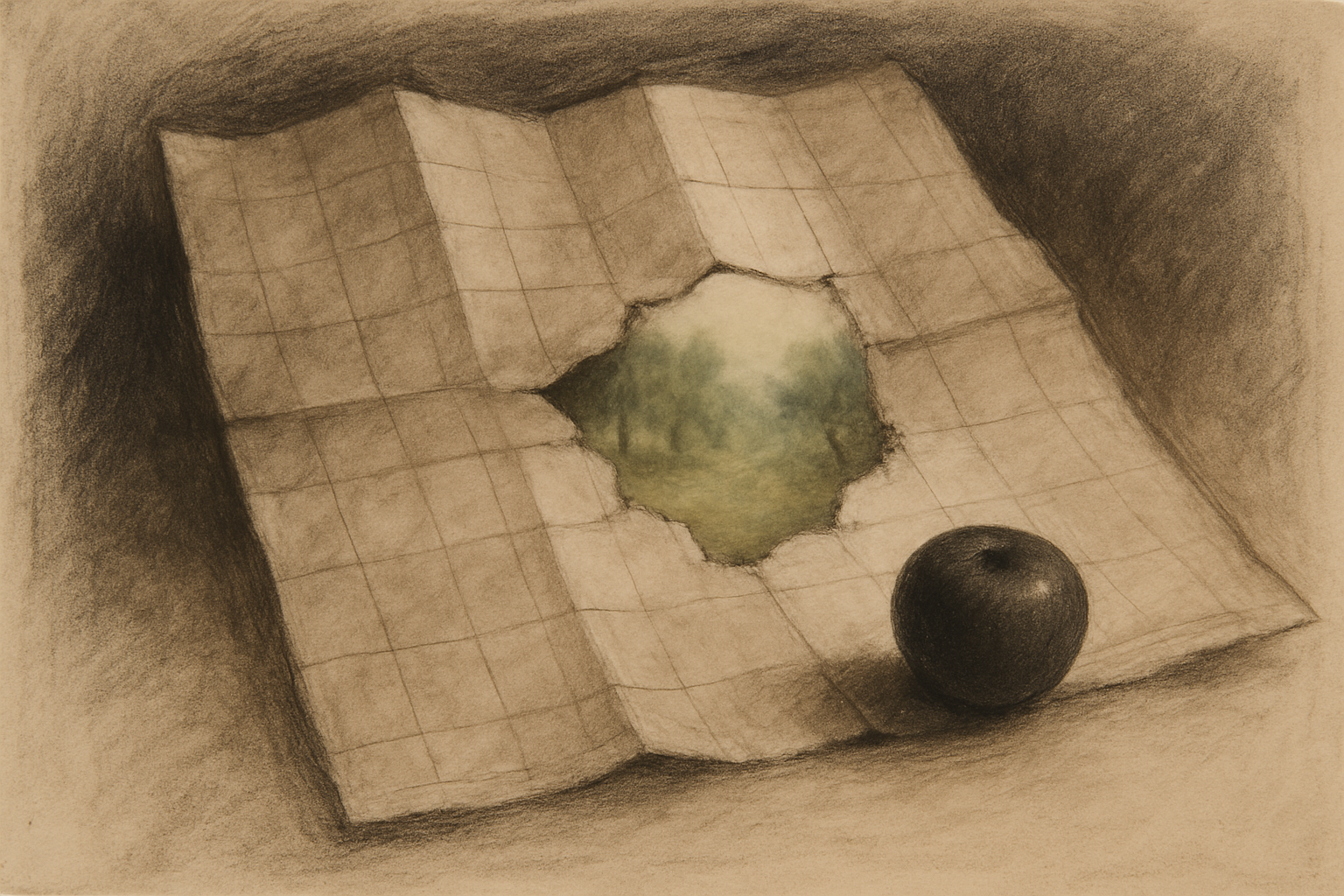
The trick is when we take that knowledge, and here I'm using "knowledge" as a reference to mental understanding, and we treat it as more real than it is. When it becomes a true thing rather than just a map.
Do you mean that as a belief?
That's exactly what a belief is. If you say, "I am me and I have to go to work," that's functional and it has a place. But when that becomes closer to an absolute reality, rather than just a map of how this mystery moves and unfolds, then we are believing in a representation, in an interpretation.
The map mistaken for reality
A belief is a collapsing into an interpretation. The mind provides a map; the map is an interpretation. When we take that interpretation to be the reality, it starts to reinforce the illusion of solidification: "This is the reality, I am a body, this is what I am," more than this open mystery. That's a sign we are buying into the map as reality, and it is experienced as a contraction. You could say that's the Christian original sin: biting from the fruit of knowledge and falling from the garden.
It also gave me the sense that if there's a person who needs to go to work, that introduces the concept of time. Something "over there" rather than something "over here" gives rise to the spaciousness of time, space, and matter.
Exactly. That's how those constructs are built in our experience, and it's very practical and useful. Again, the trick is when we begin to live as though that is the reality. The perception, the sensations, everything experienced directly through present awareness becomes a background afterthought, while the mental interpretation becomes the foreground. The more we do that, the more we collapse into what ultimately doesn't feel good.
Necessary development, necessary suffering
This is really about an unnecessary collapsing and contracting. Yet in a sense it is necessary for everything else to exist. It is necessary for a child to learn how to create a map. There's going to be an unavoidable identification. So after a process, we start to move beyond that mode of functioning. As Jesus said, "Be as a child." It's similar to that, but it's actually a transcending of that form of functioning.
The difference between a newborn and somebody who has to some degree awakened is that a newborn cannot operate with a map.
Right, like stepping out of the way of moving vehicles, or going to the toilet by yourself. It would be a messy world.
We see this in the animal world. Animals can develop a map to some degree, but I don't believe they have developed enough to transcend it. That process seems more available in humans because it requires a further development to be able to disidentify.
I bring in the animal world because we're talking about newborns, who are closer to a state of pure being and perception. There is a world where that can be sufficient functioning, but something further is available to us. This transcending doesn't point to attaining or achieving. There's a side to it that is much more about allowing and letting go.
I often think that the difference between dogs and humans is that things happen to both, but dogs don't have a story about it. Dogs have the inability to construct a story. Humans have the ability of story-making, storytelling, and also story-believing, which is when the story becomes more real than raw experience.
Is that where the line "Suffer the little children to come unto me" comes from? I've always thought that was about the empty, open child: as you grow older you suffer, and at the end you return to nothing. What you're saying about the difference between a newborn and a slightly awakened person resonates with that. There's a path of suffering from newborn to death. Before I came to any kind of spiritual understanding, I would have thought that verse was about children who died young and went to God. I had a very different way of looking at it. How I see it now is quite changed.
The beauty of the fall
My perspective is that there is a need to eat from the fruit of knowledge, to fall from heaven. It's not only a need; it's a want. There is something very beautiful in the falling from the garden. There's a deep desire and longing in us to experience that. But at some point suffering grows, and it becomes sufficient for us to want to return home. Since we're in the biblical frame, the story of the prodigal son is exactly that, to me.
It's interesting about the Bible. "As thou shalt give, so thou shalt receive." There are lots of things that never used to mean anything to me, and I'm not a religious person at all, but they come to mind now and I think: give love, receive love. There's only one thing if giving and receiving are the same. There's a oneness about it. I'd never thought of the Bible as such a practical tool before.
I'm having the same experience. I've never been religious, and yet all religions have things that speak to me.
The heaven that Jesus pointed to is the one that's already here. The fiction tends to be pointing to it after death, by following some rules in a book. That's the other problem.
I can't really say it's the same heaven he was pointing to, but it seems a lot like it. It's hard to know, because it's so mysterious that no description can touch it. Someone else describing it always carries an unknown layer of interpretation. It may not be found in the description of heaven; it's more in the recognition of what suffering is, and of what is here in the absence of suffering.
It seems indescribable. An empty flow, just being, beyond words.
---
I don't know if I have that mastery yet, because whenever I'm going through something, there's no grounding for me.
Two sides that complement each other
I understand that, and that's why I'm saying there is work for you to do. We've talked about therapy and other ways you can work on that. But I want to highlight that there's another aspect. What I'm saying is, at best, I'd expect it to be trickling in the back of your mind, like a seed that starts to open up questions. It's not something for you to fully grasp now. It could be that over a year of touching on it, it starts to trickle and create little aha moments. I just wanted to highlight that there are two sides, and one side alone won't work. They complement each other.
These meetings, this space, your guided meditation: I'm grateful for it. I think it's really powerful. During the meditation, when you were talking about the leap of faith, suddenly these words came to me out of nowhere: "Why does anything need to change?" I guess it was intuition, but it brought me to tears. I felt the taste of how unbelievably relaxing that is. It wasn't believing it, but just as you were saying, just the doubt, just "what if actually nothing has to change."
Nothing has to change
What I felt was that the space started to open and identification started to loosen. It was as if all identification was in relation to that idea. Every attachment to the mask, to the maps, at the same time. That's exactly the definition of identification.
When I look at it from that open place, it's "my God, what a relief," and how mysterious everything is. Then from the mind's point of view, it's "how can I live all the time absolutely not knowing anything, with everything being mysterious?" But I know that's just the mind. I'm grateful, and I wanted to share that.
That's beautiful. You did it.