Staying Present with What Overwhelms
Permanecer presente con lo que nos abruma
A student describes how deepening practice has made it harder to suppress difficult emotions and memories, and asks how to bring past experience into the present moment without becoming completely absorbed by it.
Staying Present with What Overwhelms
A student describes how deepening practice has made it harder to suppress difficult emotions and memories, and asks how to bring past experience into the present moment without becoming completely absorbed by it.
For a while now, I've been noticing how the more I'm on this path, the less I can suppress things. They're simply there, and the fewer escape routes I have. I just have to be with what is, and that entails a lot of interactions with people, emotions, all of it. There are two sides to this. I find that I'm clearer and clearer, and most of the time it's obvious that it's nobody's fault, and that's wonderful. But on the other hand, sometimes I get so overwhelmed that it feels like more than I can handle. It feels like an inevitable part of this process of coming closer to what's true, what's real for me.
I do have a specific question. You mentioned something about bringing memories into the present. What I notice is that I'm either lost in the memories or I'm here, and maybe memories are filtering through, but I don't know how to be with both in a way that's conducive. Could you be more specific about what you meant?
Words are just words, and at best they're pointing to something.
But the first part of what you were talking about is very much what's needed. When things get overwhelming, it's because we haven't journeyed with them enough, and so it's a matter of balance. You find the concept of balance in many forms of Buddhist teaching: the middle way. Balance is not something that is acquired or attained, because the second you're in balance and you've attained it, you fall off. In a sense, it's a movement. That's why the metaphors of the tightrope walker or the surfer are so applicable.
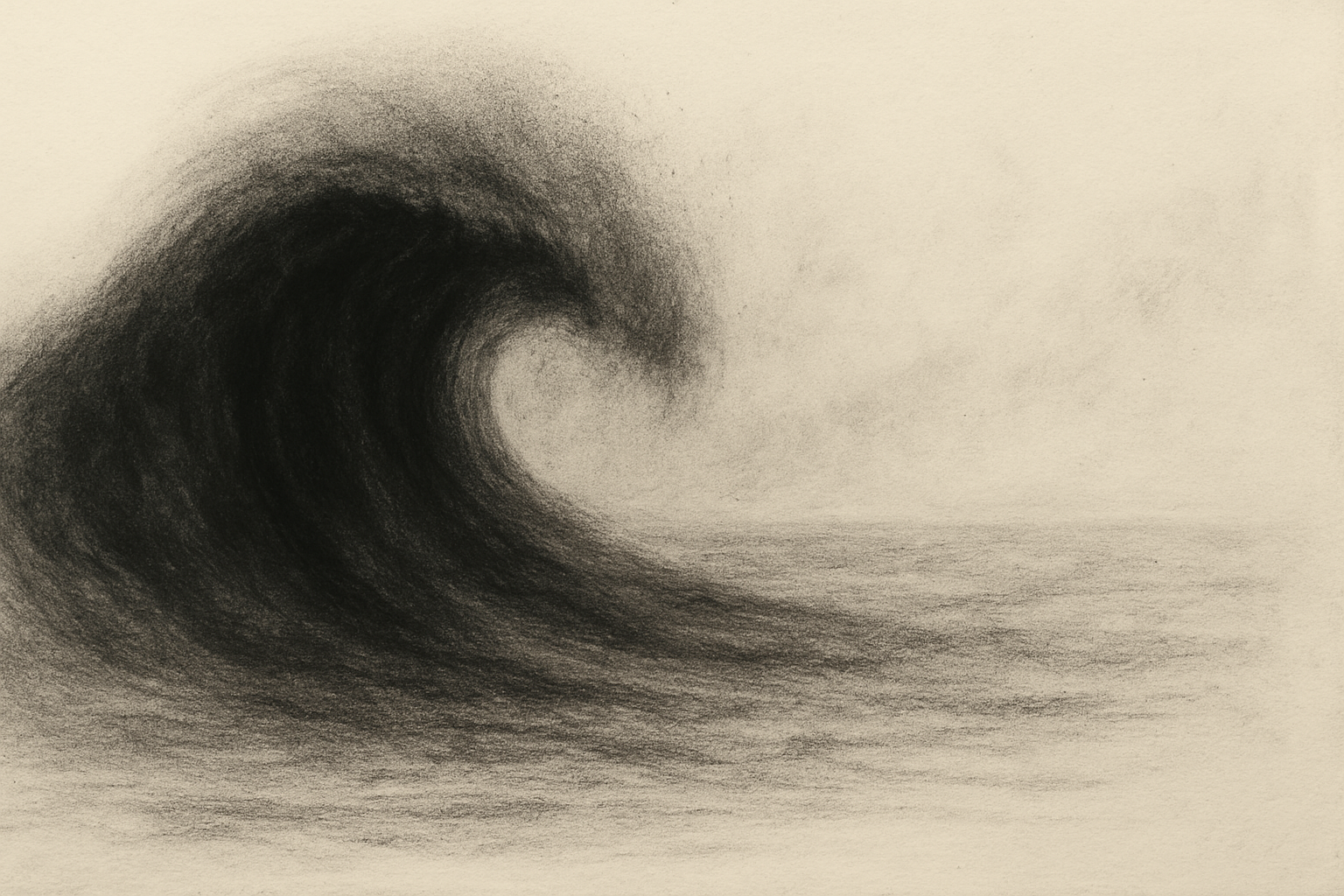
The wave we haven't learned to ride
When something that we haven't yet been able to be with, be in touch with, and learn to surf throws us off balance, it's usually because it was simply too much for us. It was too much when we were very young, and then we managed to develop and function, but we hadn't yet learned to journey with those aspects of our experience. It's going to be certain kinds of feelings, emotions, and sensations that certain experiences have produced.
So it's not necessarily the memory of something that overwhelms us; it's the sensations and feelings that the memory evokes. There are many practices addressing this, and that's one of the main focuses of therapy.
The goal is to be able to go into all of those aspects of our experience and relate to them in a more direct, centered way, to be able to touch them. What happens is that we develop mechanisms to put difficult material away so we can cope. But it doesn't go away. That's why it can overwhelm us when things open up: it comes in full force, and we haven't learned how to be with it. In a sense, it's something we learn progressively, first with small waves, then bigger waves, then bigger waves still.
Full absorption in the mental world
Now, to your question about what I meant in the meditation. There are many ways I can talk about this, but the point is: what you're describing is that we tend to be completely taken by the mind. We go into full absorption; all of our experience becomes the mental world, the world of thought. It could be past, it could be future, but it's going to have this movie-like, storytelling quality. It involves myself as a character and others as characters, events and situations. We get fully immersed to the point where the experience of this present moment is almost forgotten, to the point where we lose the sense of the balance of reality: that the experience of thinking is happening within another experience.
The experience of a body, the breath, the room we're in right now: the world of thought is happening within that. And the experience of raw, direct sensation and perception is more fundamental. That's why the basic practice of paying attention to the breath exists: to create space and come out of thinking.
Holding the story from within this moment
In the meditation I was guiding, I was intentionally bringing in the story, bringing in memories, bringing in even imagination around the stories others might have, the stories our ancestors might have had, to really bring all of that in fully. But the key is to keep the sense that all of it is happening inside this present moment, where I am, experiencing through being in this body, with this current situation.
Because what tends to happen is exactly what you're describing. We either push away the past, the memories, the things that are too difficult, and focus on what we're doing now, or we get fully immersed in thought. There is a kind of balance where we can stay anchored in this present moment and from there be able to touch everything that is in the world of the psyche, of memory, of thought. That balance is going to help integrate, because if our body and mind are in that balanced place, going into memories and holding them from this moment, our body-mind is going to be able to integrate that better. That's where there can be a kind of alignment that you could call healing.
What's been coming up for me more and more, just as you speak, is that I've done a lot of that work. What's arising these days is that my nervous system was, I believe, damaged back then, and a lot of that is coming up for me physically, emotionally, and even cognitively. It affects my ability sometimes to even think clearly. I hear this voice in me, and I think I need to heed it, which is to look more deeply into the trauma and the damage to the nervous system. It feels like there's almost a locomotive inside me. It's volcanic. These practices are right, and I've employed them to the best of my ability. But somewhere there's a wall, and I think the wall is the actual physiology, along with the healing of the trauma. That seems to be the one stone I haven't turned over.
The brain can change
One thing I would say is: take the notion of "damaged" with a big grain of salt. There's a lot of recent evidence that neurological damage can change and can heal. It was once believed that the brain was set at a certain point in life, but there is now considerable evidence that the brain changes throughout life.
I've heard about that. There's a book about the flexible brain or something similar. That's why I would want to work on it, because I understand that it's useful. I don't feel like it's over, and I feel like there has been healing over the years. But when I say "damaged," I mean there are actual physiological problems. I see issues with my body, and I realize where it all stems from. It's clearly trauma.
Rebalancing through the body
That can really start to shift as you, in the metaphor of surfing or the tightrope, get up and fall, get up and fall, getting more and more in touch with what is overwhelming you or throwing you off, and bringing it into the present moment.
If a memory or feeling is fully taking you away and the present moment is disappearing, use your willpower to bring a lot of attention onto current sensation and perception. What are you seeing? And from there, bring what overwhelms you into this moment.
It's going to require this kind of will, because it's a balancing act. Your whole body-mind has been accustomed to getting thrown off. The pattern is either to shut down and repress, or to get overwhelmed. The balancing now is learning how to be present, be in touch with current sensation, and let in what overwhelms you, what pulls you away. It's a gradual process. Your whole system is going to learn to rebalance and reconnect, because your actual physical body will have to change: neurons will have to develop, reconnect, and make different connections. It's a process that doesn't happen in one go. It requires, in a sense, matter to shift.
When we are physically surfing, our muscles have to develop and gain strength. It's that kind of thing. There is a certain muscle of attention that the body is also involved in, and the body has to adapt to letting the energies of certain feelings and emotions run through without clamping up. It's all like a practice.
So if it becomes too much, lean toward the body, the breath, and what you're seeing, with the understanding that the images and memories exist in a dimension that is not the same as the room, your body, the couch.
Thank you.