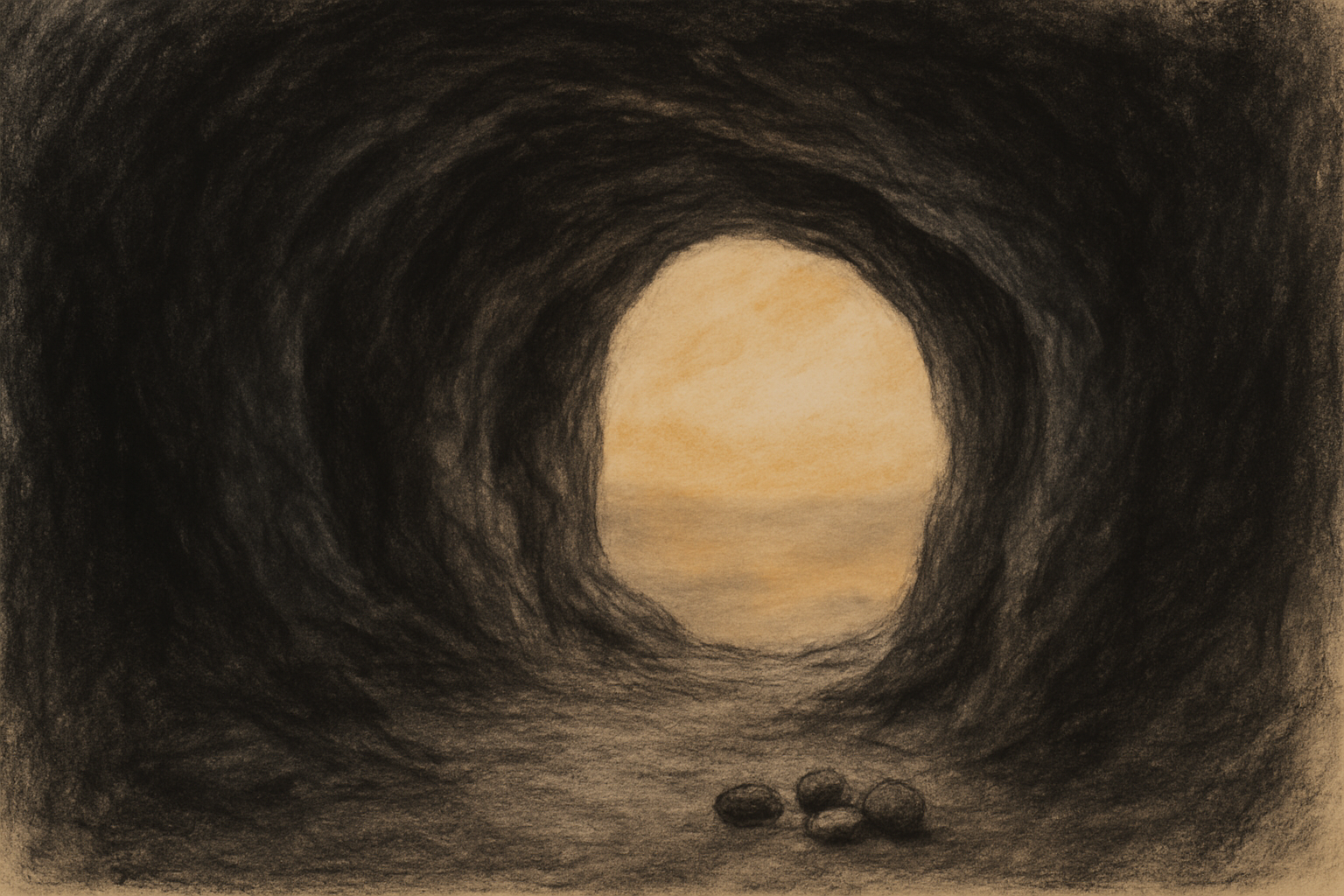
The Cave You Chose
La cueva que elegiste
A student revisits childhood memories of loneliness and discovers that what she always interpreted as painful isolation was also a refuge she created for herself, opening the question of what she truly wants now.
The Cave You Chose
A student revisits childhood memories of loneliness and discovers that what she always interpreted as painful isolation was also a refuge she created for herself, opening the question of what she truly wants now.
Today's meditation was different. It was hard for me to bring up memories that don't necessarily want to be here right now. But when I finally visited some of them, I realized something very strange. For the first time, I could read a story I've been telling myself the other way around.
I have regularly told myself that the thing I'm most afraid of is being alone, that the sense of solitude and isolation is terrifying. But actually, when I was revisiting my past, those thoughts from childhood that felt so difficult, what I thought was painful was that I've always been alone. But not alone. I've always been with myself.
I have these memories of sitting under the Christmas tree with my entire family, and for the first time it was as if the story wasn't written the same way anymore. It was written the other way around. And then, interestingly, the pain in anything from the past actually has to do with others, not with me being alone.
At the same time, it was a difficult exercise, because all I kept feeling was: what does any of this matter? What I really want to be looking at is what's behind the experience. There was a sense of disengagement with the past, the future, the stories. It's not very clear to me. It was a different experience today.
Withdrawal as defense
I'm hearing two things. The first is your relationship to loneliness, to being alone.
What happens when we're children and we have a painful upbringing is that a form of defense develops, which is to withdraw. We can withdraw physically, but we can also withdraw psychologically. It's a way of pulling away from experience and from our reality as a way to manage and cope. Sometimes withdrawing physically from a situation is the right thing to do, but often we become habituated to withdrawing and isolating as a form of defense.
That has consequences. Not that it has a cost or a price, exactly, but if you drink a glass of whiskey, you're going to get a little tipsy. If you withdraw, you're going to feel alone. There's an aloneness and a loneliness that is natural and human, but there are aspects of it that can be self-created.
Somehow, as you started talking, I started feeling very moved. I think that was the experience: realizing how the sense of aloneness, in a way, is safe.
Yes. Because you withdraw to your inner cave, and it's protected by your making of this inner world.
The story read backwards
This is so surprising to me, given the story I've been telling all this time about how afraid I am to be alone, the fear, all the sensations that come with it. But today I realized that in reality, I think I'm more afraid of the other thing: the pain that comes with opening up.
Exactly. You can see it as a very natural, beautiful journey. If there are bad vibes at home, I can leave the house, go to my room, or go into my own inner world as a way to navigate and manage what is really difficult. Then I'm in a new situation that I need to deal with: the way I'm managing difficulties is by withdrawing. And so naturally I will feel afraid of being alone.
But if you start to look at the whole narrative, you see: I'm in the forest because I walked over there. I'm missing being with people, the city is over there, but I walked from there to here. It's not about blaming yourself or finding guilt. It's about seeing: I chose this, and it had a reason. Who I was then, which I'm not now, made those choices for a reason. Now I can look at that and I'm free to choose something else. For example, you look at that and realize, "Actually, what I'm more afraid of is going back and feeling the pain, taking the risk of opening up." And then you have the opportunity of a free choice.
Maybe that's where it comes to in the end. It doesn't mean I necessarily want to jump from one to the opposite. The choice to be alone is also a choice, but as a choice, not as an imposition.
Yes, but it's only a choice if it's really, really what you want.
It's very confusing today. It's confusing to resolve this, because today it really felt like I am content, and not content. There is this sense of not being alone. There is this being with myself. And the reality is that I can think of a past that is far behind, but I can also think of a past that is not too far behind, and it still hurts.
These things are not mutually exclusive. The freedom is to see that all of these are potential experiences. For example, why don't you stand up right now, walk around the room, and sit back again? Just have fun with me. Walk around the room and come back.
You never left
Can I leave the computer?
Yes, without the computer. Just walk around.
So now you've moved, walked around, and sat back down. Did you go anywhere?
No.
What changed? What happened?
I understand the question, but what did change? I was in front of the camera, then I was not in front of the camera.
But for you, did you go anywhere?
I'm always with myself. How could I go anywhere?
Exactly. You're always here, now.
Yes. I feel exactly like "here and now" moves with me. It doesn't move, but here and now is always where I am in my experience.
I want to validate that. When you said that when you were young, sitting under the Christmas tree, you were with yourself, that's true. You have always been with yourself. You cannot not be with yourself.
Maybe that's the first time I see that image of the little girl under the Christmas tree from this perspective. That image has been loaded with solitude for years and years. And that's my point: the solitude is not the pain. The pain is what happened that put her there.
Two sides of loneliness
Yes, what put her there, but also the choices you made then, to the degree that you had the ability to withdraw. Sometimes situations put you in places. Parents force you, they lock you in your room. But other times, you are in a place, something is happening that you don't like, and you leave, or you go under the Christmas tree. I don't know exactly what happened then, but I want to ground this in the sense that there was something in you that, within the limited understanding of reality available to you at the time, made a certain choice. It's not you now. It's what happened then.
Yes, I can follow what you're saying.
It was a way to cope with what was happening, and there was a feeling of loneliness. The memory became a kind of ground for this story of loneliness. But everything has two sides. One side is that you suffered this loneliness. The other is that you created loneliness as your inner cave, a safe place to withdraw into. What this work is about is to see this, to see what is true and what is real, and to feel into it fully.
Maybe what I'm feeling today is that it's very obvious. I absolutely agree with you: this loneliness was created as a cave, a place to withdraw and feel safe. But maybe just because today it's so clear, it's also okay to be there. It's perfectly valid to choose that, in a way.
One hundred percent. That's why I was saying there was a choice made by that girl who, in her understanding as a child, made the choice that felt the best.
But even today, that's my whole point. If I understand that the heaviness of solitude can fade away, what remains is obvious: I can taste this loneliness or solitude from an understanding that this is simply what I choose to be in today.
Exactly. And today it's the same. I would add: it's okay to choose everything that you're experiencing and choosing. At the deepest level, we are choosing everything. Everything is embraced. And you can also look into what you really want, because it has to do with creating and co-creating. Right now, you're experiencing loneliness, you're choosing loneliness, and it's totally okay. And then: what do I want? That's where the movement begins, what comes next. That's why I said it's a free choice.
What do you want?
It might change tomorrow, because during the meditation I was...
I'm talking about now. Where you are now. If you're feeling loneliness now, you're choosing that, and it's perfectly okay. And then: what do you want, in terms of movement forward?
Right now, I don't want the pain.
The pain is loneliness.
No, no. The loneliness is safe. The pain is from abandonment, or relationship.
Would what you want change if you knew that no matter how much pain happens, you would be okay?
Yes.
Okay. So considering that, what do you want? What does your heart long for? What's your deepest desire? What do you want to create? What does the universe, through you, want to live now? And nothing is a commitment. Anything you say can change the second after.
The moment you said, "Would what you want change, knowing that no matter the pain, you will be okay?" what I first felt was: yes. Life. Aliveness. The pulse of it.
And what forms, what stories do you imagine being able to experience?
I'm not ready to commit today. I revisited something I wrote before in response to this same question, and somehow today it's different. Today has more to do with the openness to life and the world, the openness to curiosity, not necessarily to human relationship.
What comes to mind for me right now is being in the Himalayas.
To be honest, I was picturing something like that. Out there in the world, somewhere.
Always tune in to all the dimensions. You can use your whole body and mind as an instrument to dream, to envision, to imagine. Then work with what comes, with what seems most alive, most exciting, most true, most deep. Listen to that, because that is how the universe through you is speaking.
Right now, that question brought more images of adventuring than anything else. Out there.