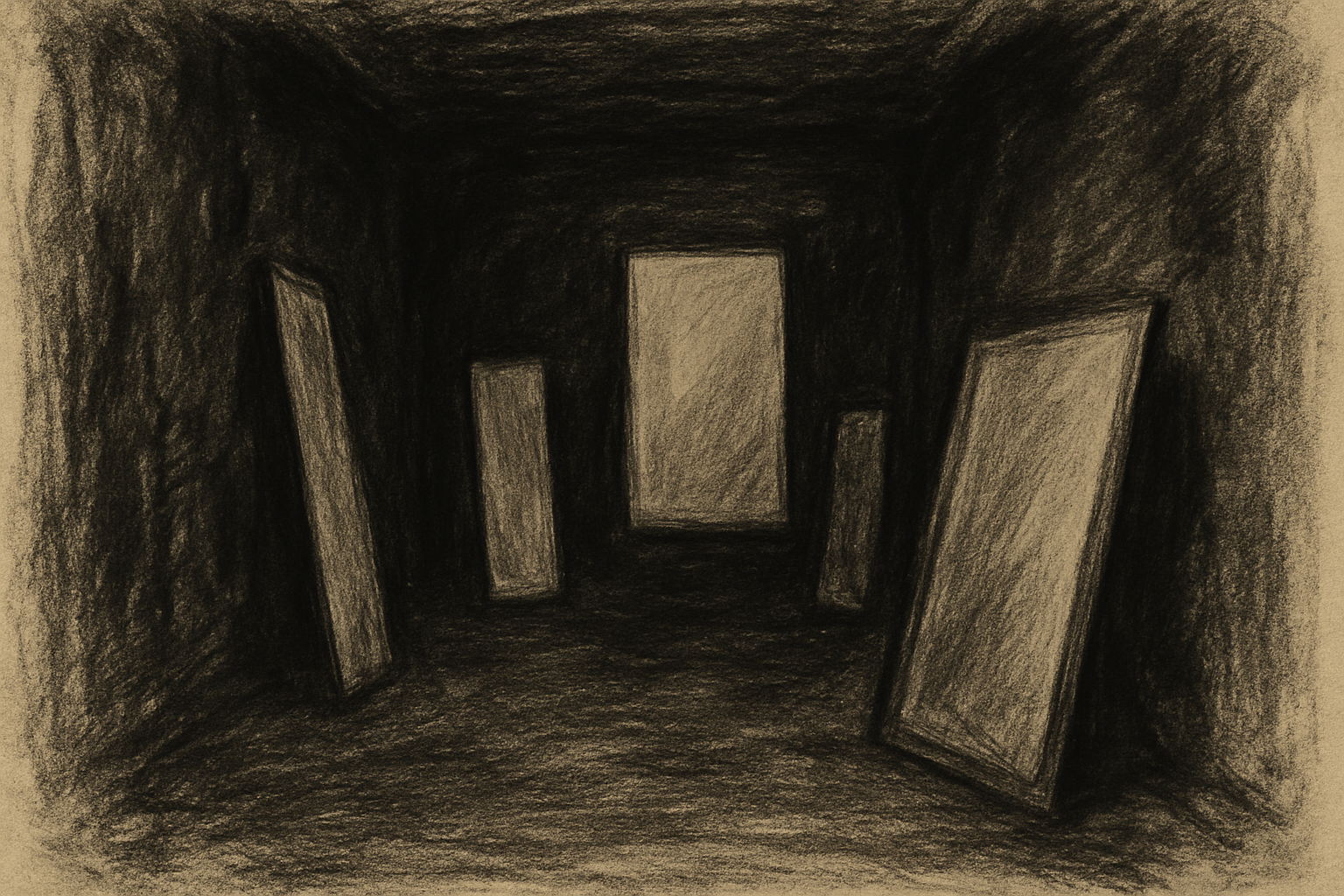
The Room Full of Mirrors
La habitación llena de espejos
A student describes a pattern of avoiding meditation despite knowing its benefits, caught between the desire to practice and the fear of what arises when practice deepens. The teacher suggests a radically honest approach: instead of forcing discipline, examine what you truly want and don't want.
The Room Full of Mirrors
A student describes a pattern of avoiding meditation despite knowing its benefits, caught between the desire to practice and the fear of what arises when practice deepens. The teacher suggests a radically honest approach: instead of forcing discipline, examine what you truly want and don't want.
I feel like I'm in this room full of mirrors. I see myself, and then it's like, "Oh, that's myself seeing myself seeing myself seeing myself." And all of that is just my thinking seeing myself.
Exactly. It's all the reflective nature of the mind. And most of the time, we're not seeing ourselves.
I identify with a lot of what you're saying. There are two books I've enjoyed from the Tibetan tradition, very much in an open awareness style, similar to this kind of sitting. They talk about addiction to thought, and about boredom, so much boredom in meditation, but then on the other side of boredom there's something interesting. They capture that ninety-nine percent of the time when the brain is really going, and then you skip past it a little. They capture the neuroticism and the avoidant thinking really well.
This is somewhat related: I used to have a pretty steady meditation practice, and lately I just don't do it. It's frustrating. When I come to this sit, and I go to a sit on Friday, there's a period afterward where reality bubbles up more often. Being present, not lost in neurotic thought. I wouldn't call it stillness exactly, but being in touch with something that bubbles up with much greater frequency if I engage in a regular sitting practice. I guarantee today will be a lot better than yesterday because of the sit this morning.
But it's frustrating because it seems senseless to constantly avoid this thing that is so helpful. And then on the other side, when I start to meditate more regularly, the ride gets a little scary. Reality is bubbling up more, and there's more contact with presence, but then there's some fear and strange emotions that come up to the point where they get a little overwhelming. I feel like I'm caught between a hot and a cold place, and lately I just avoid the meditation altogether. Do you have any thoughts?
I understand the frustration, and I would recommend not staying just in the frustration.
The story behind the frustration
What I mean is that there may be an inaccurate interpretation creating that frustration. Let me know if this resonates: the interpretation is, "I want to do this, but I don't know why I'm not doing it." That bubbles up frustration because you're trying to push something that's not moving, and you don't really know why.
I would flip that. Just pretend that you don't want to do it, and look for the reasons why. The expression would be something like, "It looks like I don't want to do it," or, "A big part of me, the winning part, the bigger part of me, doesn't want to do it." That could open the door to seeing more clearly and transparently what's actually happening.
Inner integrity
I call this inner integrity. It's also clarity, but it's almost like being able to tell yourself your inner truth. This is an infinite process; it keeps getting more and more clarified over time. If you can say, "Looks like I don't want to do this. There's a part of me that wants to, but it seems to be losing to the bigger part," then you can begin to see what's really going on. You've already described part of the "why," because you mentioned fear and what can come up.
I would say, for example: "I don't want to do it because it requires facing some fear, facing some discomfort that I just don't want to face right now. So I get distracted." Then it becomes more about internal transparency: what you're doing, what you're choosing, consciously aware of the distraction. You're not pretending you're not afraid.
I'm putting myself in your shoes here, imagining how it might be for you. I'm not claiming I know your exact experience. But this is how I'd recommend you work with it. No shame. Just look at exactly what's happening. It will also require a process of not identifying with what you see, because that's where shame comes up: identification with "I'm supposed to be the person who has the discipline to do this, and I don't." You can't let go of that idea because you're attached to it. But you're not the one who is disciplined, and you're not the one who is not disciplined.
I see what you're getting at. In essence, the hypothesis here is that I'm in active denial of another experience that doesn't want to do this. If I continue to deny it, I'm missing a whole chunk of my own experience, and it doesn't actually change the circumstance either. So this hypothesis of "No, I really don't want to do this" is a way of allowing that part to speak. There's an element of "don't want to," an element of "want to," and probably a "just don't give a shit" in there too. Just let them all speak.
Letting go of having a position
Yes, and if you really let go of the attachment to having a position, you can see more clearly what's happening. It might be that you just don't want to, and that's the deeper, truer want. It might be that there's an attachment to an idea of being this honorable person doing the right thing, which is to meditate, and you actually don't really want to. All of this can be clarified in your own looking internally.
When you see everything very clearly, the energies will start to shift. The ones that aren't that real will dissipate, and your true desire, your true wanting, will start to come forward. That's the exploration I recommend. There's another approach, which is committing to a discipline, but I think in your case the better path is pursuing more internal clarity about what you're really feeling and wanting.
The committing-to-a-discipline approach has been my main technique in life for getting things done, and that's exhausted. I get up and run six days a week, but that approach is failing here.
That's exactly why I'm thinking discipline is not the way right now.
What I'm thinking as you say this is that by not engaging the other side of me that doesn't want to do this, by not giving it an honest look, by not pulling back and watching the whole play of things, I'm almost preventing these parts from mixing together and sorting themselves out, as you described. Whether that ends with meditation or not, I guess I have to be open to it.
Exploring fear with curiosity
You don't even have to call it meditation. Think of it as exploring this fear from a place of curiosity about you and your life and what's happening. It's the explorer's perspective, the journey of, "Oh, I wonder what's here. What happens if I directly face and touch and become intimate with this experience?" Think of it like a wine or a whiskey that you've tasted but found a little strong. I'm telling you it's actually quite good. Try it a few times, and you'll acquire the taste.
The top dog and the underdog
Question (second student): This is really aligned with what the teacher is saying. There's a concept from gestalt therapy called the top dog and the underdog. It's a dynamic balance; one never ultimately wins. The underdog is the one that's more self-indulgent, or fearful, or whatever. It just doesn't do what you want it to do. The top dog is the one that disciplines, that can be critical and hardcore.
The underdog tends to win a lot of the time. If you have a really strong top dog, as you probably do because you run six days a week, at a certain point it tips the balance and creates a stronger underdog, because the top dog is too mean, too harsh. As these two get polarized, you become less able to do what you really want to do. You want to bring them toward the middle. One strategy would be to sit right after your run, literally right after. The other would be to do something much shorter, like five minutes.
Question (first student): The first one would be great for a younger man, but after I'm done running I have to stretch a lot. But I like the top dog and underdog framing. The top dog is out of control sometimes. He needs a chill pill. He's obnoxious.
The ceiling you can't push past
Ultimately, it's about being able to have a direct, intimate experience with the flavor of experience we are not wanting to touch. For everybody, and at different times it will change, there's going to be a certain quality to it: a certain kind of pain or a certain kind of fear where it's just, "No, I'm not going there."
No matter how much practice of this and that you do, if you don't go there, it's always going to be the ceiling.