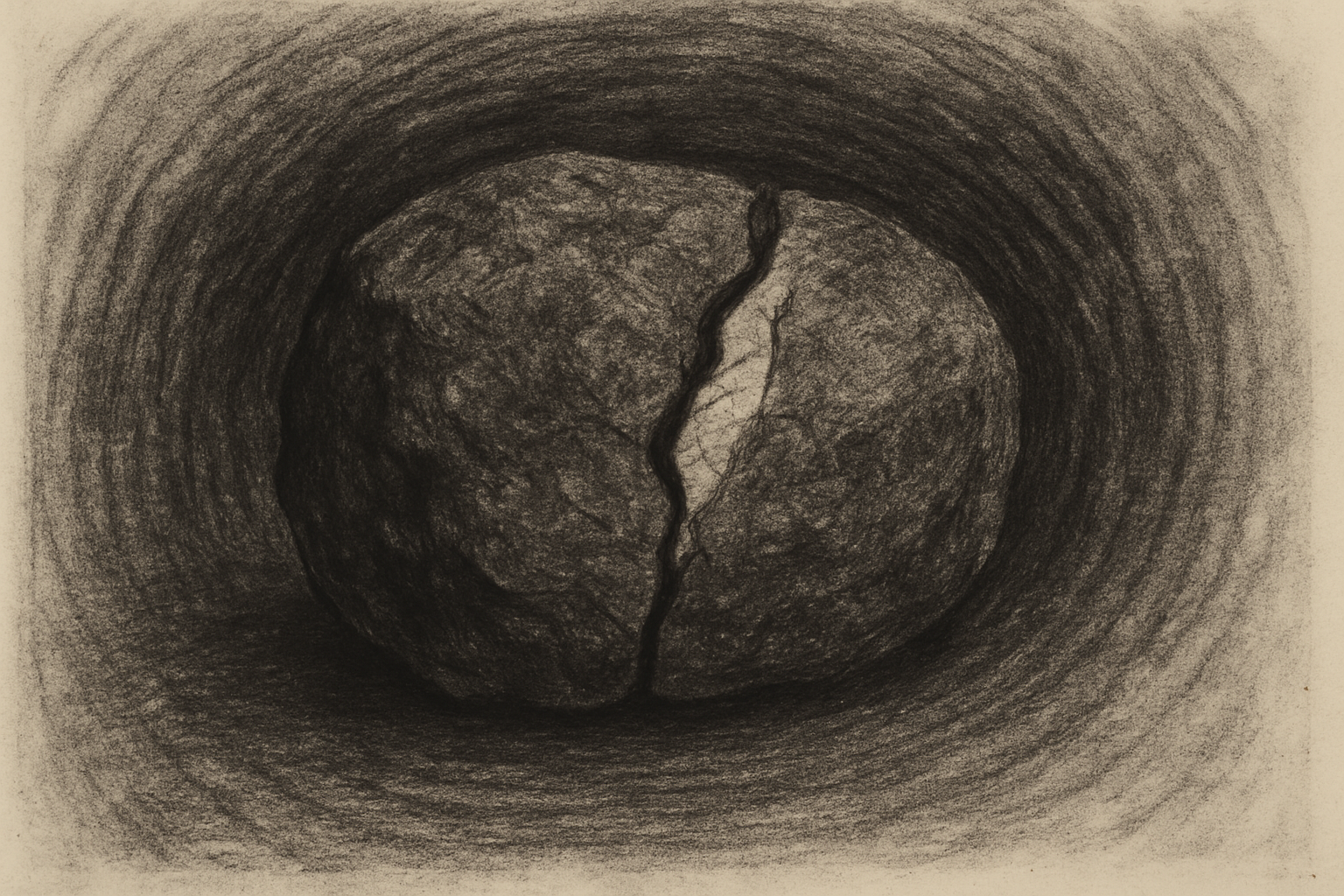
The End of Peace Is Identification
El Fin de la Paz Es la Identificación
A question about why recognizing that peace is already present can release suffering, and how this relates to identification and the willingness to face fundamental pain.
The End of Peace Is Identification
A question about why recognizing that peace is already present can release suffering, and how this relates to identification and the willingness to face fundamental pain.
One quick question: does this have to do with identification? It's been powerful for me recently when I'm feeling something I'm rejecting, or maybe not realizing I'm rejecting, or when something is uncomfortable, to recognize that peace is already there, that nothing needs to change, that nothing needs to happen. Why does that release something? I think it has to do with identification, but I don't see it very clearly.
If that works, it works because it points to something that is actually there, and you recognize it. If you are surrounded by drinkable water and you're thirsty and you think there's no water, and then somebody says, "There's water around you," you're going to look more closely and realize there's water. It's literally that straightforward. But it might not always work. That kind of pointing might not work if you are really, really convinced there's no water. You might be looking at the water and thinking it's not drinkable.
So that is applicable no matter what you're feeling, no matter what you're going through?
Yes, it's always present.
Identification as the one problem
And it has to do with identity because, basically, everything we're talking about comes down to one problem: the belief that you know what you are. To "know what I am," to "know what 'I' is," is a belief. In your example, you're not feeling well and you're not aware of there being some form of well-being or peace, because the denial of that well-being and peace supports the identity. It supports the belief that what you are is XYZ.
So if I'm telling you, no matter what you're experiencing, to look for the possibility that there is well-being and peace, even in the experience of pain or discomfort or stress, that puts you on a path where the question becomes: do I hold on to the belief of what I am, or do I take the risk of undermining that, dropping it, and considering the fact that there is well-being and peace?
These are mutually exclusive. You cannot know what you are and be at peace, and you cannot be at peace and know what you are. They are in complete opposition. Knowing what you are is the end of peace.
The numbing of suffering
But then what commonly happens is that we create a whole way of numbing the absence of that peace, numbing the appearance of pain and suffering. And so those who are not feeling that they fit in, those who are suffering, are actually closer to the possibility of waking up.
Can you say that again? If you're suffering, you're closer to waking up, and knowing what you are is the end of peace?
When we attach to an object, which is what I'm talking about with identification, "knowing what I am" (knowing in the sense of the Fall from the Garden, eating from the fruit of knowledge, now knowing what I am, what things are), we define what we are. And the only way to define it is by it being a thing. A thing is always going to be a mental construct. If we bring in psychology, it's going to be ego. So instead of ego being a part of me, the way my hand is a part of me, ego becomes "I."
But ego is a mental construct. Ego is a process of thought, a movement of thought. And instead of experiencing that process as a functioning, the way my body and my hand function as parts of me, that whole image becomes what I am. There is a forgetting of that beingness which a newborn baby knows but doesn't know consciously. The baby just is that.
Peace and identification cannot coexist
In that identification with thought, there is the loss of peace, because you are identified with something that begins and ends and is always changing. There is always going to be a restlessness. Freedom, liberation, peace: these are the ending of identifying with something. You cannot be identified and have peace, because identification is the ending of peace. They are mutually exclusive.
When we identify, that is the beginning of a useful and valuable process, the journey of becoming limited in order to eventually know our true nature consciously. That process naturally brings suffering, which is the knowing that what I am will end. But it's a false knowing, an illusion. It's true only in the sense that what I think I am will end.
Why suffering brings you closer
But then why are you closer to waking up?
Because for many people, that reality is so difficult that we put on top of it a whole process of denial. We project the problem onto things that can be fixed and solved. We put it in time: "It's going to be better." Some people do this so well that they're not aware of a profound underlying suffering. They're aware of, "Oh, there's a problem now. I fixed it. Now I'm good for a while." There is a numbing of that restless not-okayness. And if they're very able to succeed in that strategy, they might never become aware that something was in a state of suffering all along.
Those who are aware of that suffering, when it becomes more and more your daily experience, you are closer to the truth. You are seeing that you're identified with something that will end, and you're experiencing the reality of that rather than denying and numbing it. Then it could happen spontaneously that that identification breaks (it has happened for some), or it can happen through an intentional process of looking at this directly.
The direction of inquiry
But then the inquiry still has to be about what the truth is, not about "how do I get out of this suffering." Unless "how do I get out of this suffering" is "what is the truth."
Yes, because "how do I get out of this suffering" could lead you to listen to so many directions that are available everywhere, telling you, for example, to make more money.
That's so difficult, though. In the moment, when you're in so much pain, all you want is for the pain to end. To inquire instead takes intense focus.
It's important to discern: if you're in a lot of pain from something that isn't related to this essential suffering I'm talking about, if you cut your hand, you should probably go put a bandage on or go to a doctor. But if it's not that, then the discernment matters. What is it that I just resolved? Was it something I could fix, something that isn't of this essential, fundamental sense of "something's not okay, something's wrong no matter what, nothing I do helps, something is missing"?
That sense of "I am essentially not okay, something is really not okay at a deep, deep level": the more you work through the surface issues, the more you come to that fundamental not-okayness. The inquiry, "What am I? Who am I?", is one way that brings you to that. But also, to inquire into the essence of that which is feeling not okay. To really get close to it. I always say the direction is toward fear and pain, because by not wanting to relate to fear and pain, we create the whole process of repressing, numbing, and finding strategies to cope. Going through and undoing this identification is going to bring up fear and pain. But it's specific and different for each person, what the fundamental fear is.