Beauty in Destruction
Belleza en la destrucción
A question about how to find beauty in what is not beautiful, including suffering, war, and destruction, and how that relates to meditation practice.
Beauty in Destruction
A question about how to find beauty in what is not beautiful, including suffering, war, and destruction, and how that relates to meditation practice.
In the meditation, you spoke about noticing what is beautiful and then noticing what is not beautiful. When you said that, lots of things popped into mind: destruction of life, war, things like that. What would you be pointing to around being with what is beautiful through what is not beautiful?
Yes, that makes a lot of sense. And of course I'm very aware of what the question is pointing to. There are naturally many things I can say. I don't want to be in pain, and I don't want anybody else to be in pain. But I'm pointing to something that is, in a sense, deeper or higher, something that doesn't contradict the preference of life over death.
A love for life in its totality
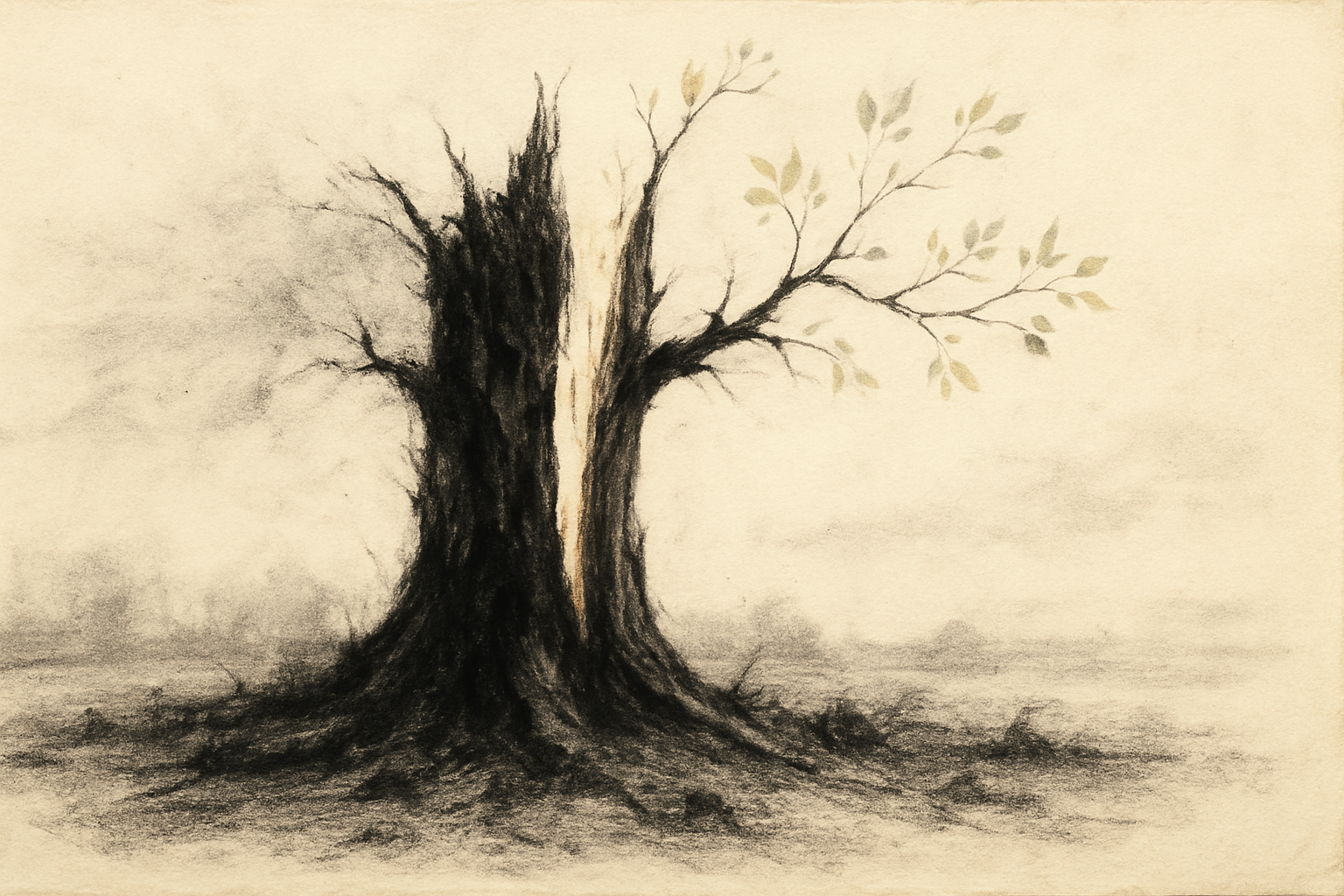
Beauty is a word that can be understood and used in many ways. I'm pointing to something that is a kind of love for life in its totality. By seeing that death is part of life, because without death there wouldn't be life, there is a deeper sense of beauty. For example, if you can see that life is only precious because there is death, that this is one of the key aspects of why it is so precious, then you see the beauty in death. But it's not a preference. It's not beauty in the sense of "I choose that." It is a beauty in which something can relax around that pushing against it.
I'm not talking about the free choice in our lives to choose what we prefer, what we are drawn to find more beautiful or more loving, what our heart longs for most. At its deepest, that longing will be life in service to life: in favor of life, against war, against pain, against unnecessary suffering.
The constant rejection in the psyche
But there is something in our constant functioning, in our psyche, that is rejecting part of our reality. It does that in ways such as saying something is scary. It all has to do with a sense of ending, with death, and the pain we imagine that will bring. So it's about fear and pain. If I were to say that fear and pain disappear from reality and existence, you can imagine there would always be peace and well-being. That really makes it clear that fear and pain is the issue at hand.
What I'm pointing to is that there is something deeper in us that can recognize this beauty in existence. If I were to say it more bluntly, though imprecisely: it is divinity loving its creation. And that includes destruction. But it doesn't negate the process of learning, the preference to be in service of life and freedom, and not in unnecessary pain and suffering.
Destruction as the ground of growth
In fact, if there wasn't destruction, there wouldn't be a process of learning. If there wasn't fear and pain, there wouldn't be a process of exploring how to make life more beautiful and loving. There is a beauty in the fact that, from the perspective of creation itself, it is perfectly created so that destruction enables growth. If something wouldn't end, it would lose a deep aspect of its beauty.
Think of this moment, right now. It has never happened before, and it never will happen again. Think of the whole universe and how we are here, the universe in the position that it is right now, which includes us, here, now. It has never been this way before, never exactly this way, and never will be again. We can be probabilistic and say the chances of it recurring are vanishingly low. And that makes this moment, to me, incredibly beautiful and precious. But it is because of that nature that at every moment, that moment is dying. It is already gone, never to be experienced or seen or lived like that again.
When I see my partner at any moment, say in the morning, and I give her a hug, that instant will never happen again. Even if I hug her every morning, it is not the same. And there is a sense of loss as well, because that moment is gone. For me, it is so magical that this reality is this way.
While you were saying that, I was looking out the window. Our place looks onto an alley, and there was this feather floating upward a long, long way, straight up. The universe is so miraculous. When you think you know the laws, or what's going to happen, then something like that.
Yes, exactly. I often wish I were more of a poet, to be able to communicate what I mean. When a question like this comes up, it's the realm of poetry.
Seeing beauty without condoning harm
I understand the struggle. The sense that to see beauty in destruction puts us in a position where there is a fear that we are, in a sense, accepting or condoning it. But that is not what is happening. You can fully see the beauty I'm talking about and still say no to unethical behavior. In a way, it actually frees you to be more able to risk your life in service to that.
Starting with the smaller things
In the meditation, it might be helpful to start with the smaller things we don't like. I'm not talking about food preferences. I'm talking about noticing certain patterns where there is an almost irrational "no" to something, a sense of "I cannot see beauty in that." It will seem more clearly irrational with the smaller things. The one you brought up is a big one, and it is also difficult to communicate. It is something that can eventually be realized, but it's not where it matters most to begin.
For example, when I was young, I would look at myself in the mirror and be very displeased. There was a very strong emotional reaction. Over time, there was a process in me of noticing this constant projection of a lack of beauty in myself. It could be physical appearance, my thoughts, my abilities or lack thereof. That whole process is probably the best place to start, depending on where each of us is. It's going to highlight a choice we're making. And it's actually a free choice, this disliking of something. It is free because if we decide to like something in ourselves, it will bring a certain responsibility that we are choosing not to take on.
I'll share a personal example. It was in service to my shyness, in service to my hiding, in service to not taking risks in relationships, to hold a belief that I wasn't attractive. That was purely a choice made in freedom.
Noticing freedom, not forcing change
So do you suggest an attempt to override that choice if there's a better one? If you can see that it's not a choice that's helping you?
No. Usually I would say: just notice it's a choice. You are totally free to keep choosing it. I actually often say, take your time, enjoy it, because otherwise it's just more internal struggle. It's really about seeing our natural freedom. And again, there is a beauty even in choosing something more limited. I have a very visceral knowing of how I chose very deep contraction and suffering. I can't fully explain why, but I know in part it's because I wanted to see how it tasted. There is a very deep, profound curiosity: what is it like to suffer like that?
On one level, if it's dark, it's dark. But on another level, it was very real, and it was important to just empathize and understand. But you're happy now. You seem very serious today, but you're actually very happy and very light most of the time.
Oh, yes.