The House Built on Memory
La Casa Construida sobre la Memoria
A student describes observing how memory, future projection, and fantasy interweave during meditation. The teacher explores how our entire sense of identity is constructed from thought and memory, and what lies beyond that construction.
The House Built on Memory
A student describes observing how memory, future projection, and fantasy interweave during meditation. The teacher explores how our entire sense of identity is constructed from thought and memory, and what lies beyond that construction.
I can relate very much to what was just said. That is my experience, and it usually is like that in all meditations, but today I was particularly able to watch and observe it more closely. I very much like to observe memory. I think it was the first time I put the focus on that in a meditation, so thank you. One of the things I could observe is something very strange: memory and future seem to arise at the same time, as though they are very related. It was really interesting to observe that, along with how memory and fantasy are also connected, which is all part of the thought process. I was surprised to see how much space it occupies.
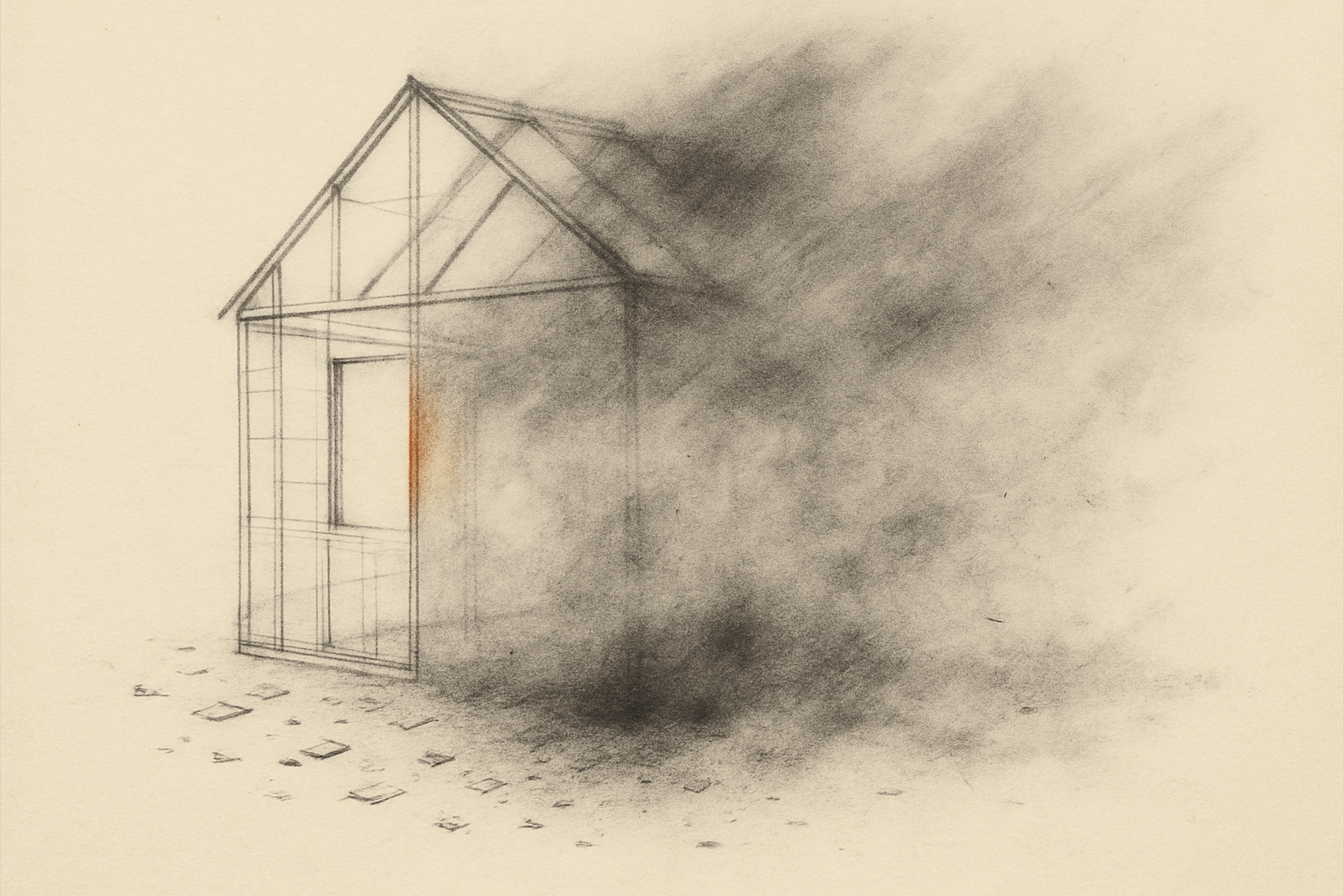
Yes, and in fact a metaphor came to me: the house built on foundations of memory. Because if you don't have memory, you don't have time. You don't have future. It points to the original experience of a newborn before we learn to think.
In no way am I invalidating thought. Thought and memory are very useful and practical. The problem is, as you said, we don't realize that we start living in a world where all of our attention is focused and narrowed down into a world built on memory. Memory is the foundation. That's why it's simple to focus on just that one thing: if you cannot use memory, everything else goes. It's an easy way to make a catalog. This is based on memory; this is not. That way you can start peeling apart the experience.
The infinite world that is narrow
The world of memory is an infinite world: infinite imagination of the future, of the past. But it's an infinite world that is narrow. We can live in that, or we can live in what's beyond it. What's beyond includes the world of memory and thought, but what happens is that experience is always veiled and filtered by memory.
The key is just to know: what is what? What of what we're experiencing is based on memory, and what is not? It may seem like there's nothing there if I remove memory, but actually what remains is very vast. It's spacious and mysterious. It has presence, an infinite curiosity, a quality of truly not knowing what's behind the door, even if it's the door to my own house. In a sense, when you open it, you see for the first time.
That reminds me of something I heard recently: someone was looking at a flower blooming and said, "Try to look at it without naming it." It seems like a similar concept.
Yes, it's the same. All of the naming: when you hear a sound and you think "the sound of a car," what happens is we experience the sound, but it's completely immersed in the image of a car. We don't experience the sound directly. It's experienced as the mental image, "the sound of a car."
The more we notice this, the more that process can start to become optional. It goes into the background, and the direct experience of the sound becomes more in the foreground.
Why we cling to the world of memory
The question would be: why are we doing this? It's because in the world of memory, we can define very clearly what and who we are. We can become very attached to that. If we leave the world of memory, we enter the unknown of what we are. There can be difficult sensations and feelings in that shift, because in a sense what we believe we are has to end.
I mention this because it can be noticed, when we start doing this exploration, that there is a pull towards memory, a pull towards thought. What's driving that has to do with "who am I?" It has to do with an attachment to being something that I know and that I can represent conceptually, and it's always based on memory.
It can be very subtle. Even when we hear a sound, there's a sense that there's a sound over there and something here perceiving the sound. But that which is experienced as "perceiving the sound" is also based on memory, is also thought. There is a construct of a localized me inside here that is also a very subtle image of me. There isn't even an experience of distance without thought. It's literally no time, no space.
I seem to be oscillating or struggling. On one hand, there's curiosity about seeing what's going on, which happens quite a bit in meditation: really trying to see for real what's happening, what I am, how this mind works. On the other hand, there seems to be this idea that something has to happen, that I just have to see it, and that it's so obvious, but I'm not yet seeing it. I don't know how to say it another way.
I had an experience the other day meditating on Sunday. I was realizing, as you were describing, that everything is thought. Suddenly I was in a place where all the ideas of me, my body, everything was thought, and there was suddenly a feeling of, how do you say, vertigo. Like: I'm not all this. What am I? Where am I?
And maybe it mixes with the fact that a lot of the time, when I'm paying attention to sensation, what's there is pretty intense.
I don't know exactly what the question is, but it goes around that.
The free fall of losing identity
There is a part of this process that requires the body to change. Biologically, things need to be rearranged. When you have the experience of vertigo, metaphorically it's as if you're free falling. You're falling from the world of identity and thought.
As a metaphor: if you're in orbit around the planet, you see astronauts floating. They're actually free falling. From the perspective of physics, orbit is a constant free fall. But it stabilizes to a point where their biology no longer experiences the vertigo of free falling.
The mind adapts. The body adapts. When you have that experience, there's a moment, a shift, a vertigo. You enter a free fall, and then what happens is a return to the identity of the mind. But the more you see that, the more you enter this free fall, and the free fall will start feeling more natural and less like a free fall.
The thought that "something needs to happen"
Now look at the more subtle aspects. You were talking about something needing to happen, this idea that you need to see something. Notice how much of that is thought. The idea that there's a shift, a realization, a transformation: all of that is based on thought and memory. So what is here now if you cannot access that world? You see it, you know it, that's what it is, you put it aside. What's here now? Who needs to realize what?
The sense that there is a "thing" that needs to realize or see some other thing: what is that based on? It's another thought. Just keep seeing at the more subtle level: it's thought. And the more you see it's thought, the more you lose the ability to hold on to it. We can hold on to thought because we make it a thing. In the world of thought, a thought is an object, a real thing. We make ourselves a thing.
Reification: turning thought into solid objects
The process is called reification. You turn something that belongs to the world of thinking into a real object. Then you call that "I," and therefore every other mental object becomes equally real. There's a me and a that, a multiplicity of objects, but all of those are mental constructs. The more you see they are mental, the more you see that they're actually like an ocean of waves that come and go. The substance of it is one field of moving energies, and the solidity starts to break down. It was never solid. It appears to be, and we choose to make it that because we need to buy into the solidity of it in order to function in that world as if it is reality.
You can start to notice that sound and thought and sensation and perception are not separate. They're all a fluid substance without any separate qualities, without any sense of "here is a thing that is a thought, here is a thing that is a sensation." It's as if the identification gives it the sense of solidity.
The body as anchor for identity
In a sense, it's a choice to believe that a concept of "I" is what I really am. With that as a foundation, everything else becomes a real thing, as real as I can make that "I" to be. This is why identity is so attached to the body, because the body is what seems to be the most permanent thing in our experience. There is an image of the body, conceptually. When I think of a hand, I rarely experience only the sensation. I have the image, the memory of what my hand is, what it does, what it's done in the past. The same goes for the whole construct of the body.
On that we attach all of our memories. That creates this person that is a real thing, and the sense is that this person is real beyond the world of thought. It's not seen as thought. It's seen as "this is what I am, and this is real." Then that person becomes more real than the body. It becomes the foundation of what I am. We're more involved in the mental construct, and therefore everything else that we think of in relationship to this person becomes as real as we make this construct to be. Now we're very attached to the mental construct of what we are, and very attached to the story, the past and the future, that preserves this construct in a state that is comfortable.