The Freedom to Choose Identification
La libertad de elegir la identificación
A question about what identification really is, where it originates, and why consciousness would freely choose to limit itself.
The Freedom to Choose Identification
A question about what identification really is, where it originates, and why consciousness would freely choose to limit itself.
Some things you said made me think about identification. What exactly is an identification? It seems to be something: you just now called it a choice, but at the beginning you called it a mechanism. It sounds like a mechanism outside of the mind, or outside the work of the mind, as if something says, "This thought and this concept, I am that," and objectifies it, gives it solidity. But the fact that it's something outside our mind makes it so mysterious, as if I don't have any control over it.
You have the sense that you have no control if it's outside your mind, because you think you are limited to your mind. But it's actually the other way around. The mind creates objects. It doesn't create identification, and it doesn't perform identification. Consciousness does. Consciousness, awareness, being.
When I say it's the only choice we make, I mean that we, as our being, can choose to be limited, to experience ourselves as limitation, or not. When consciousness chooses to experience itself as limited, it uses the mind. The mind is constantly creating objects, and it can create the object which is the concept of "I."
To identify with an image, you said? Where does it find the image, the object, the concept to identify with?
The mind. Those only exist in the mind. That's why you think you are limited by the mind, and that any choice happening beyond the mind is happening by something or somebody else that's not you, something you have no control over. But it's actually you choosing that.
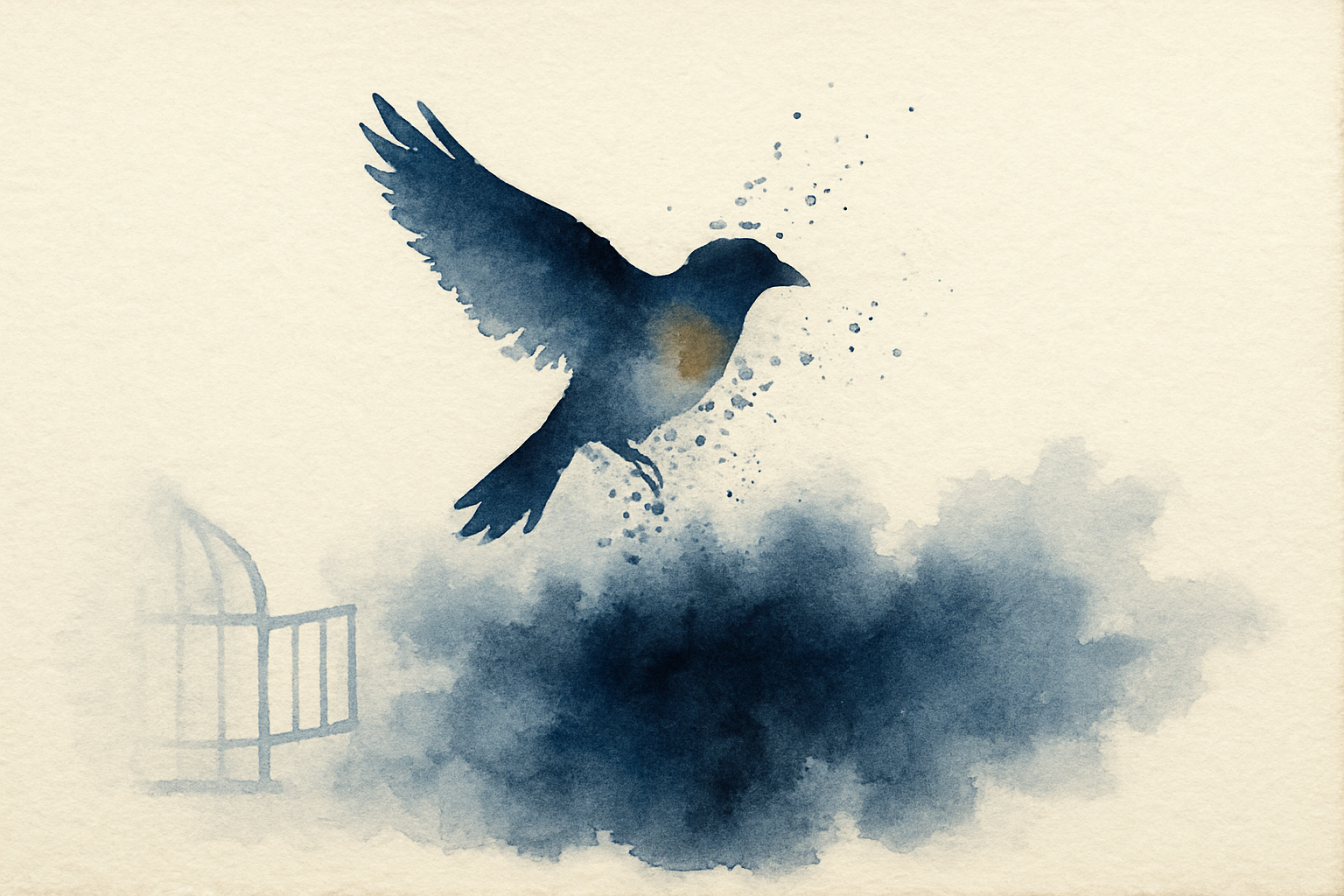
The cage we build and forget
It's like building a little cage, putting yourself in it, closing the door, and asking, "Help! Get me out!" And you forget that you made that movement. That's the veil. That's why recognition or realization has also been described as a remembering, a remembering of our true nature. It's not an achieving or an attaining. It can be described as an attainment, but that's a little misleading, because nothing new is created or produced.
So I should take your word that it's a constant, moment-to-moment choosing to identify with something that I am doing consciously?
Exactly. In a sense, you do it consciously, and then you forget you do, or you hide it from yourself. You veil it from yourself.
Then the question may arise: "Well, why would I do that?" And I would respond with a question in return: Why are you doing that? What are you gaining? Because to me, as I said, it's the only choice we make, and it's a free choice. We are free to choose it.
What came to me is the adventure. The adventure of being a separate entity, the struggles, all of that.
Yes. It's a roller coaster of suffering.
Could I have the adventure without being identified, too? Or not?
The thrill of finitude
Yes, but something is lost. Suffering, maybe. But if you say "just the suffering," then the question becomes: why would I choose it only for the suffering? Suffering is one side of the coin. You've named the other side in your experience: adventure. There is a thrill in the perspective that what we are will end. And that is very different from the thrill of knowing that a part of what we are will end, but "I" cannot end.
So I should take your hypothesis, or rather your word, as a hypothesis: that I'm choosing identification until I see it really clearly for myself.
Yes. Because if it becomes a belief, it does no good. Just take it as a "what if" and look into that possibility in your experience.
Gains and losses
And the question "Why am I choosing this?" could be useful, because it all has to do with a balance of gains and losses. That's why it is very commonly said that we don't wake up until it's the thing we want the most. There's nothing wrong with that, but it really is like that. And it doesn't have to be conscious. We don't have to necessarily be consciously wanting it the most.
People who wake up spontaneously, who never even knew there was such a possibility, still, deeply in their being, they were done with identification. They were done. You see very commonly these stories where the suffering was just so intense, and they didn't know there was another way, and then it was spontaneously realized. A very famous contemporary teacher writes and talks about it very specifically that way. He had no idea. He had never meditated. And it took him years to actually realize what had happened, when he started going to meditation teachers and spiritual groups and learned about it.
And in fact, waking up can be very commonly desired consciously but unconsciously rejected. It could be what I think I want the most, while actually I'm running away from it.
So to see why you're doing that, what you're gaining, matters. First, you could see: "Actually, I'm enjoying this. It's not as bad as I sometimes think it is." Or you could see: "Really, there isn't a lot left for me here."
I don't think waking up can happen until we've really exhausted our desire to experience identification. And I truly see it as a beautiful, free choice. Take as many lives as you need, in the metaphor or reality of reincarnation. Take all the time you want.
Usually, once we've heard about this process and this reality, if we have any trust in it being real (because a lot of people hear about this and think it's nonsense), but for those who have some sense of trust or for whom it resonates that there is something real here, it's often a back and forth. When things get really hard, we come back to this work. Things get a bit better, and we drift away. That's totally fine.
What does the universe want as you?
That's why the question I proposed to you was: What does the universe want as you? Because maybe it is to remain identified. And it's not a curse; it's a choice. It's not imposed on you. I tell you, waking up is experienced as loss. A lot of loss, plus the emotional ups and downs of repressed material. Our emotional body can surface, which is pain and fear. But in waking up itself, there is a deep sense of loss.
I feel that a little bit, like when I was talking last time. A kind of caring for them, or for me. Loving that, too.
Yes. And we can never imagine what it really will be. That sense of loss: what we think we're losing isn't really what we're losing. But it's still experienced as a loss. As we're getting close to it, we anticipate it with an image and ideas of how it's going to be and what is being lost. And that anticipation never matches the true reality of it.
The crossing
Think of the film that was brought up last week, The Truman Show. In a sense, that's perfect. First he has to sail out of that island across the ocean and face the fear and the pain: the pain of the father he lost and the fear of dying. Then he reaches the wall, and he can anticipate and imagine what life beyond the wall will be, what he is losing or giving up. He can project what it could be on the other side, but there's no way to know until the crossing. And it really is that it doesn't happen until there's just nothing left for him there.
I emphasize this because I have a deep respect for that process. As much as I'm here pointing to the possibility and trying to point to the ways in which it can be seen, I have a deep respect for that which in all of us is free to choose otherwise.
Did you experience this getting fed up? Did you feel it was something you always had, or was it a process that reached a climax?
The back and forth
It was a back and forth. I would come to that edge. I came to that edge very young, and I ran as far as I could in the opposite direction. Then I came back to it, and I ran. Then I came back to it, and I ran. There was this wanting, this longing, and then tasting it, and my whole being would say, "This is the last thing I want." And then the experience would flip to, "That's the only thing I want." So there was a lot of back and forth until a kind of climax.
Then all of that just unraveled. There was no doing on my part, because the way to describe it is just seeing through. And then something is seen that cannot be unseen. If you see that there are no objects in the universe, and the objects in the mind are only concepts, not real objects, just more flow, then you have no possibility of identifying. In that seeing, when it's seen fully, deeply, completely, the surrendering just happens.
I can't even say with certainty that it happened because it was the thing I wanted the most at that point. That's an interpretation. But I do remember the process of getting close to it, running away, getting close, running away, until the running away was just burnt out. The energy to escape was simply exhausted.
At first it really felt like I was surrendered, as if the energy I had to escape was taken away from me. And it had been a very creative process, because what I would do to escape was, in a sense, try to create a life in a specific way. The only difference was the sense of wanting to believe that I was the source of that creating, that the creative spark was personal. What I saw is that which I thought I was, was itself a part of the creation.
Thank you. And I just want to ask: do you ever regret the journey?
No. Not at all. Not in a million years or lifetimes. I speak with respect for the freedom of choosing to remain identified, but I also very highly recommend the journey. It's very worth it.
The farther from home, the richer the return
I love the way Osho has spoken about this. He says: "The farther away you are from home, the richer the journey back." I read that when I was quite young, and it gave me a sense of freedom to just explore the world of being me. Because no matter how far you could go, the further you went, the richer the journey back. It's a little similar to the prodigal son story in the Bible. The son who leaves and makes a mess is the one who is more deeply embraced by the father.
In a sense, that's the tantric path, the path of devotion and immersion in experience. My teacher, when asked what type of teacher he was, would say, "If I have to say one thing, I would say I'm tantric." He was very pro-life, pro-intensity. Explore any passion you have. Keep it in check with being ethical and being a good person, but take the freedom to be you and live as passionately and radically as you can. If you do that, you will exhaust all of the energies in you that desire that, and the return home will happen naturally.
That's partly why the question "What does the universe want as you?" is meant to invoke a kind of forgetting about the spiritual process, about waking up and getting somewhere. Do I want to explore life as a musician, a composer, an entrepreneur? Do I want to take a sabbatical and travel the world, or raise a family? What's my deepest longing and desire in this life? And if there isn't much of a strong answer and what I'm drawn to is to sit and meditate, then that's it.
Toward fear, with discernment
But make sure you're not repressing out of fear. The tantric path moves toward fear, not only in introspection but in outward life. Toward fear, with discernment, meaning: don't jump in front of a bus because it's scary. But is there something you've been longing to do all your life that scares you? Something you longed for as a young adult or a child, and now it's become, "Well, no, that's not too serious, or not real, or not possible," with all these ifs and buts? There doesn't have to be any of that. It's just important to really exhaust that longing. And it really can be anything, whatever you can imagine.
For me, it was quite simple. It was to be close to my teacher. That had something beyond the process of learning and meditation. It was just the love of him and being close to him, and a deep romantic relationship. The rest were bonuses: making music, traveling.
When you said earlier about choosing identification, the thing I thought of was the excitement of the journey. Is that what you're talking about now?
Yes.