The Fist and the Fear of Dissolving
El puño y el miedo a disolverse
A question arises about whether resistance to suffering is itself part of the same self-referential loop, prompting the teacher to illustrate how contraction creates a sense of self and why releasing it feels threatening.
The Fist and the Fear of Dissolving
A question arises about whether resistance to suffering is itself part of the same self-referential loop, prompting the teacher to illustrate how contraction creates a sense of self and why releasing it feels threatening.
I have a quick question about suffering. That's also something included in what you were saying: it's already happening. And the resistance to that is also self-referential, loopy in some way. Something about it seemed strange. I just wanted to point that out.
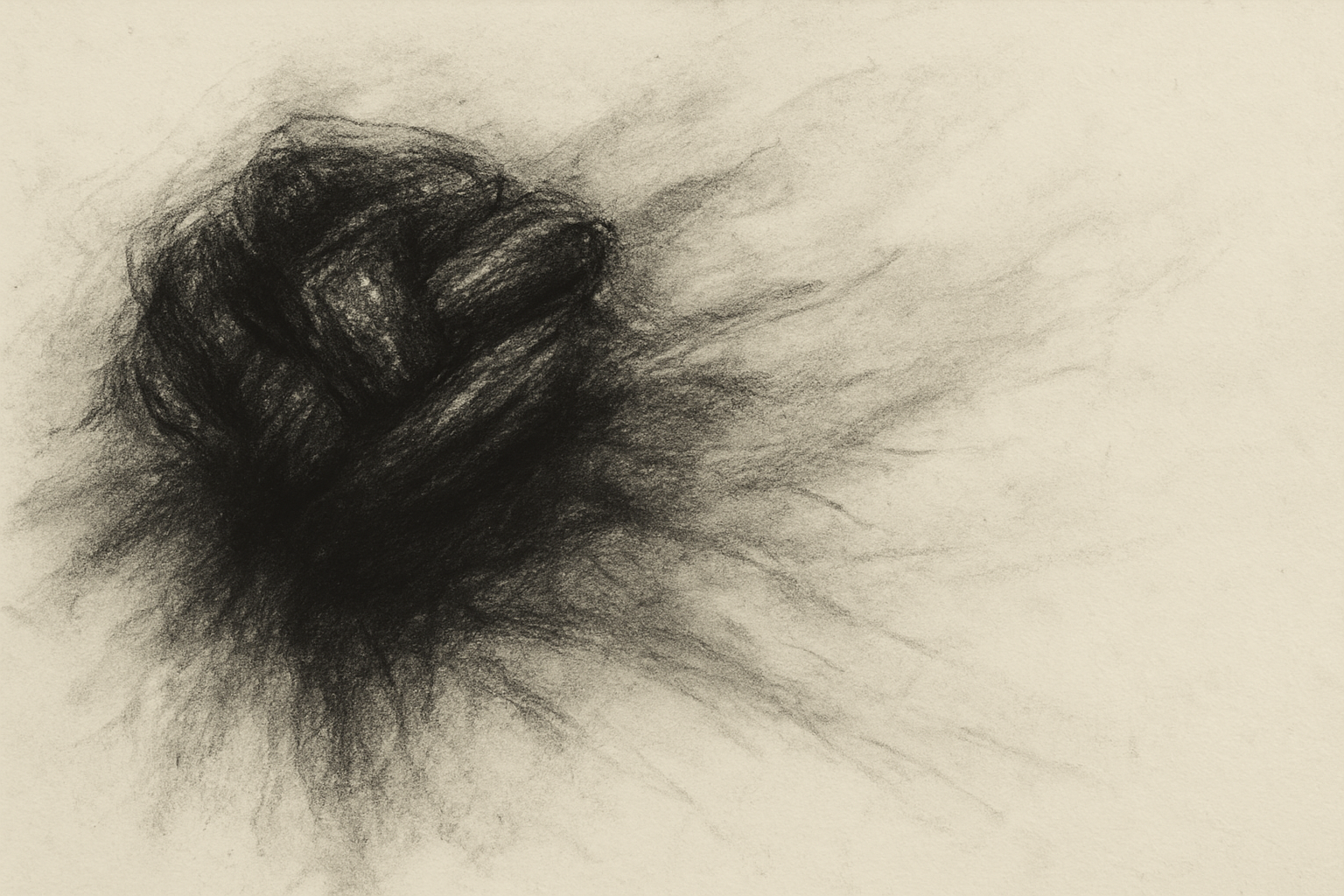
One way to point to that is with the example of creating a fist. When you create a fist and apply pressure, it creates sensation. That sensation can feel intimately connected to a sense of "me," because it has a stability in time.
Why we anchor in the body
Subjectively, there isn't anything I can actually refer to as "me" that is stable. Experience is always an infinite motion of coming and going: sensations, thoughts, images, sounds. There is nothing stable that can be referred to as "me." One of the things we do is anchor it in sensations in the body, because the body has some form of stability. But if you really pay attention, the body is a constant flow of coming and going sensations. There isn't anything stable in the body either.
Contraction as a survival strategy
If you create a fist, if you contract, then that can start to feel somewhat stable and permanent. But after a while, since you've been doing it since you were two, it starts to feel uncomfortable. The minute you begin to release, the intense sensation that you were identifying as "me" starts to go away, because you no longer have that gripping pressure in your hand. When that happens, it feels like we dissolve, and it is very scary.
So the reaction of the body-mind, as soon as things get a little too dissolved, is to contract again.
The dynamic nature of suffering
"Suffering" is a word that points to a process that is actually quite dynamic and constantly changing. It doesn't have one flavor. At its root, you could say it is a resistance to what's happening. But the way that resistance takes shape is a constant flow of discomforts, desires, needs, worries, and emotions. It all has to do with creating something I can stabilize as "me."
Then you find yourself between a rock and a hard place: if I release, I face fear; if I keep contracting, I face more discomfort, pressure, and distress. So we live our lives trying to find the limit of how much we can contract, for how long, and then come back to releasing. That whole process is addictive. The addiction is ultimately preserving a sense of self.
What "self" means here
By "self," I will be specific. I mean: limited, separate, autonomous, located. Those are the qualities of what I am referring to. That I am limited, that I begin and end in time and space. "Located" means I begin and end in space. I'm not there; I'm here. So there is a location, which means limitation. We identify with a body, so I am limited to my body. I appeared into this world when the body appeared, and I will disappear when the body disappears. Also limited in time: I began and I will end. And that I am autonomous, that I have agency born by myself, from myself, and none other. All of these are the beliefs or attributes we hold, which together constitute the false sense of self.