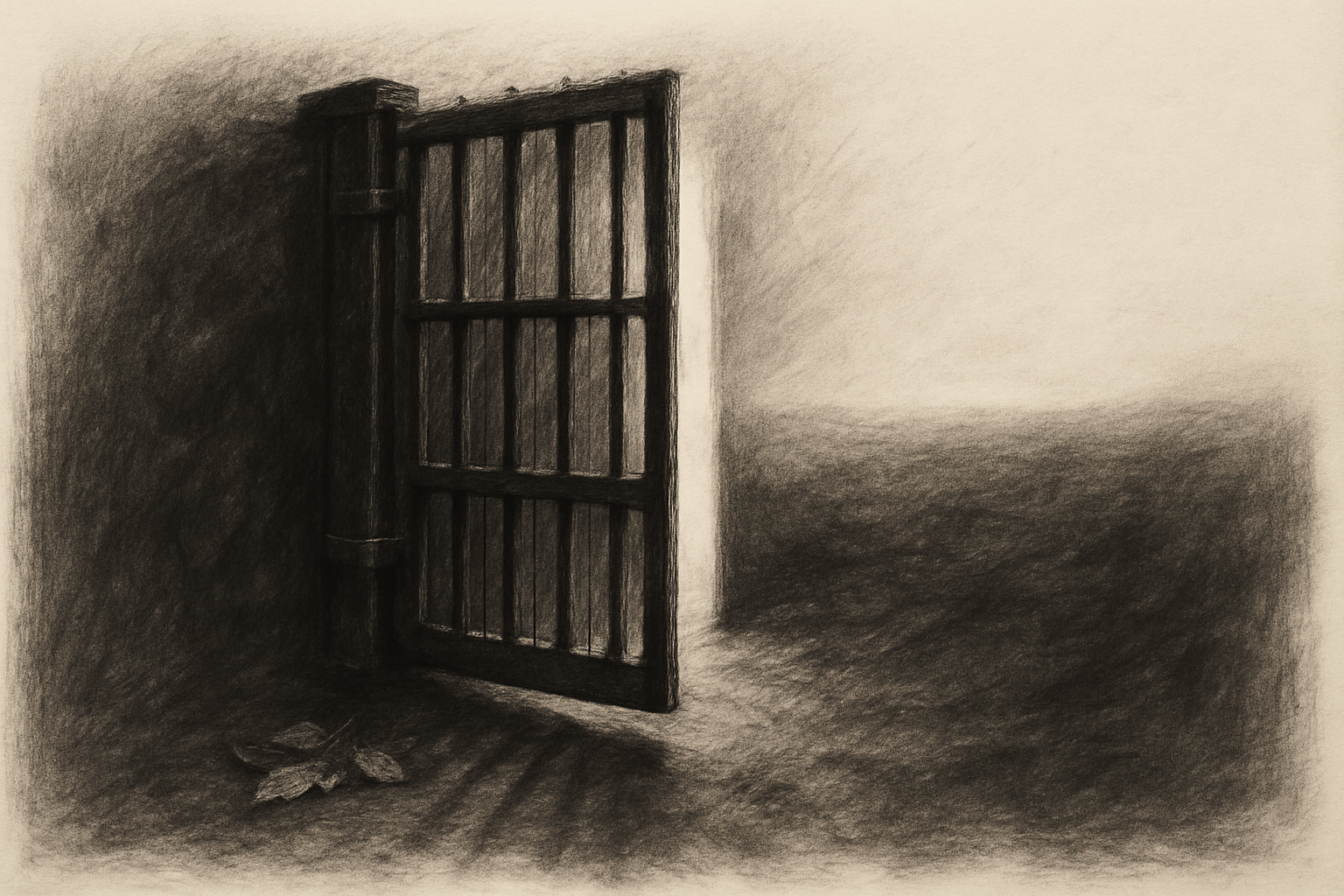
The Guardians of the Gate
Los Guardianes de la Puerta
A student reflects on the teacher's point that all conflict arises from hope, leading to an exploration of why the present moment feels so elusive, and what it costs us to finally face it.
The Guardians of the Gate
A student reflects on the teacher's point that all conflict arises from hope, leading to an exploration of why the present moment feels so elusive, and what it costs us to finally face it.
It's funny how the hour seems to become shorter and shorter the more we get together here. What really spoke to me during this meditation was when you said something to the effect that all conflict arises from the hope of something. Was that what you said?
I don't remember the exact words, but the idea is this: the hope that something will be better, that you will get somewhere, is what creates the conflict with what is now. They are two sides of one coin, feeding this pushing away of the current experience. It is the belief that something different is needed, and the hope that there is a way to get it. That keeps our experience limited to a narrow part: the mental, emotional layer. We never get to truly live what the experience of the present moment really is.
There is this superficial experiencing that feels dissatisfying. There is a subtle sense that something is missing from the current experience. It might be experienced in different ways, but at its root it is a deep sense that something is lacking, something is not okay.
The shallow read
That sense is an interpretation, a belief, a shallow read on the present moment. And from there, because of the hope that things can be different, we construct a future we are trying to get to. It could be on a large scale, or it could be very subtle. For example, it could be the sense that "if only my mind stopped doing what it's doing right now," or "if only my back stopped hurting," then I will be okay in the next second or the next minute. That keeps our attention in a narrow, mental-emotional band of experience. Even the sensations of the body are perceived in a shallow way. The interpretation is quick and narrow.
The work of every successful meditation or spiritual practice is to begin to reverse that, to help us question that mechanism so we can start to experience, or even test, what the current experience is actually like. At first it will likely be more uncomfortable, because that shallow read is an addictive process. It helps us not feel certain things in the present moment that we are afraid of, or that are painful.
What if it is already here?
The direction can work differently for different people. One way is more exploratory: what if what you are looking for is actually in the present moment, always? That question is going to challenge the whole mechanism of where your attention goes, if you commit to exploring it. Another approach is purely faith-based: simply know that what you are looking for is always present in the present moment. But I prefer to leave it to you to explore.
It will likely become more uncomfortable at first. You will face fears and pains you had not faced before. Those are the guardians of the gate. The gate to where? The gate to the present moment, which is nowhere special. It is always here. It is always reality. The present moment is not a "thing" among many. It is not that there is the past, the future, and then the present. There is only the present. So the guardians of the gate are the guardians of reality itself: what always is, and what is beyond our mind, beyond our interpretation.
The addictive loop
When the mind functions in this addictive way, which is very normal and very few people do not function this way, it is constantly energizing the narrative that something is not okay now, constructing a timeline, and working toward how to fix the problem. That form of functioning reinforces the sense that something is not okay. It is an addiction because whenever we arrive at the destination, we realize we did not get what we wanted, and we reinvent a new problem.
After this exploration, we come to realize that what I am looking for is actually present always. From there I can still create, using mind, using time, but not from the interpretation that something is wrong and missing. Instead, I act from the experience and the knowing that full, deep satisfaction is present now, and only now. Never in mind, never in hope. This shift is a challenging one. We can do it in baby steps, going back and forth. For some people, there is a very dramatic seeing of it, and things can become very intense.
I understand theoretically what you are talking about. But the present moment is ever-changing, and I feel like to function in this world I am always having to reflect on what just happened and imagine what is going to happen next. So how can I always stay in the present moment if I need to use the past and the future to function?
Where is the past?
Where is the past? In thoughts. And where are thoughts? In the mind. And where is the mind? The only place anything is: here and now.
I am not saying "don't think" or "don't use the mind." Using memory, using imagination of the future, the memory of the past: the only place any of that exists is now. What I am giving you is philosophical, intellectual. I am pointing to something, offering a map upgrade.
What you are describing is a very common worry, a fear. You may not be voicing it exactly this way, so reflect and see if I am wrong, but it is a common fear: "If I let go of this addictive process, I won't be able to function." What I propose is that you will probably function better, from a deeper place.
But at first it is like riding a bicycle. You have to think about it, figure it out, fall on the ground. Or like driving a car. Once you have learned, do you have to contemplate every action? It becomes a flow. It is a deeper place because it is a flow coming from that which contains time, that which contains thought, past and future. This is different from the perspective that is limited in time, coming from the past and heading toward a future. If you look closely, that linear perspective is only real in the mental map.
Time is only experienced now. The past and the future are only experienced now. There is no way to experience anything of the past or the future outside of the present moment. You can see that it is only in thought that they exist.
I feel like the present is like this pinhole.
That is exactly the perspective from the mind. The mind creates an infinite timeline with an infinitely long past and an infinitely long future, and "I" am this tiny dot, this pinhole, moving along that timeline. That perspective is real, it is a real place, but it is very small. It is mental. The mind is infinite, but it is of a much lesser infinity than reality. Anyone with a mathematical understanding will know there are different sizes of infinity, and some contain others.
I'm on the other side of that understanding.
It takes time for all of us. It is a movement. The more you move in the direction of the present moment, the more you realize. As you go through the fears and pains that come up, the guardians of that gate, you start to recognize something much vaster, much more at peace, much more stable. You can recognize that it is without beginning and end, not only in time but in space. There is a lot of peace there, because you can also recognize that where you are is the present moment, which cannot come and cannot go.
You are not the mind
The mind is always anxious and uneasy, and we live in that unease when we believe that what we are is mind. It is just a little trick of hypnosis. You can see that what you are is actually that which is experiencing mind. This is easier to start with as a philosophical pointer, but through practice you can have moments of gaps in thought. Then you can realize: mind was gone, and I am still here. So I cannot be mind. It has to be experiential; you have to have the experience for yourself. The more you have those glimpses, the more you start to convert the philosophy into your reality. You realize the philosophy was just trying to describe and point to something that then becomes your natural experience.
You are already having this shift. If you could talk to yourself two years ago, you would see that you already understand and see much more in your current experience than you did then.
It amazes me how much of what we talk about after the meditation is basically the same thing repeated over and over. We just have different questions, but it is all the same thing. You are so patient.
It is always the same answer. And it is not patience for me. It is a passion for this, and I understand how difficult it is, having had my own journey. So it is not an effort. When you discover the most valuable thing, you want to share it with those who are interested.
One of the reasons being in the now sometimes seems so difficult, from my own experience, is because it comes with pain and suffering as well. Of course you don't want to feel those, so you would rather not be in that moment. But the discovery of being with the pain in the moment is a jumping point, maybe. Could you tell something about this, perhaps your own discovery, and how you got to that point?
Conscious suffering
That is what I was referring to as the guardians at the gate: fear and pain. You can consider it conscious suffering. Whether through being taught or through your own experience, you recognize that this is the way forward, and we start to mature in the way in which we suffer. That has to do with how we contact our current experience.
An immature way of suffering is unconscious, reactive. Parenting, ideally, supports and contains that process so that we feel safe in the experience of fear and pain. At some point, as we keep maturing, we are able to create that safety within ourselves: the sense that I can touch pain, I can touch fear, and I am okay. That is a learning process. Some describe it as a muscle, because it requires changes in our physiology and nervous system. The energies of pain and fear, all kinds of pains (not just physical but emotional), all kinds of fears: there are correlations of energy moving in the body, and the body needs to adjust to be able to flow with that. That is where you can consider it a practice.
It is conscious suffering because there is an intentionality to it. When you go to the gym, you are consciously suffering. Your body is in pain, or you are doing a cardio exercise that is uncomfortable, but there is a gain in that. We know that, and we know and feel the healthy aspect of it.
The teacher's own path
In my experience, I can describe it briefly or at more length. I was very unhappy, very young. It got worse, and as a teenager things became very dark. I became suicidal. My life was very privileged. Everything externally was a lot better than for most, but something was very wrong for me subjectively.
I met my teacher then. I was very lucky, and there was some synchronicity in that I was ready for it. But the encounter felt as though I could have lived a thousand lives to have it. It was that tremendous. Through him I learned a great deal. A lot, if not most, of what I talk about here comes from him. I have had other teachers since, but a process of conscious suffering began there.
The night I met him, the day before I had had another dark night. Every time I would go to sleep, I would have a very difficult night and would not sleep. That night, after meeting him, I felt okay. Two nights earlier I had been planning suicide. Now I had met this man, and I felt I just had to see where it led. He was pointing to something. There was an opening of trust: there is something I do not know that he knows, something of a value I have not tasted. But I tasted it in the meeting with him. We had a contact of attention and eye contact, and I felt something I had never felt before. It was a current that felt okay, so far beyond anything I had known, and it was inside of me through that meeting.
That was twenty-five years ago. There followed a long process of torturous conscious suffering. In my case it was very challenging. For others it has been faster, shorter, but for me it was very difficult. I also had a lot of physical pain. But it does not have to be that way. It is very personal. He actually told me that at the beginning: "For you, I have a sense that your process is going to involve a lot of physical pain, unfortunately." He was right, and I think that is more uncommon. What is common is that you have to face everything you do not want to face: what you experience as scary, what you experience as painful.
In those twenty-five years, did you have to deal with childhood traumas? Did you have to go through those, or did you skip dealing with them?
No skipping. I tried, but it did not work out. I think a lot of the physical pain had to do with the resistance to trauma, trying to push through it by skipping it. About fifteen years ago I had a very strong energetic opening, a kind of kundalini opening, and I ended up going to the hospital many times in a few weeks from the physical pain. But after that, all of the trauma came up. I did a lot of work, with the support of therapy, going into very deep trauma: terrors and pains, terrors and pains.
I also had something that may not be as common: memories from past lives with a lot of trauma and pain. That was actually the most powerful part of what I experienced as healing. To me, though it is very speculative, it explained why I was born into a family where there was nothing particularly problematic and yet I had so much suffering. I do not interpret that as proof of past lives, and I do not really care whether they exist or not. It is not what matters.
But yes, a lot of trauma work. Dharma work is really all about being able to stay present and touch the sensations. I know how it is to go through it, though I have less experience guiding people through it.
It is interesting that it is also about how you understand and relate to what was behind it, or why it happened to you.