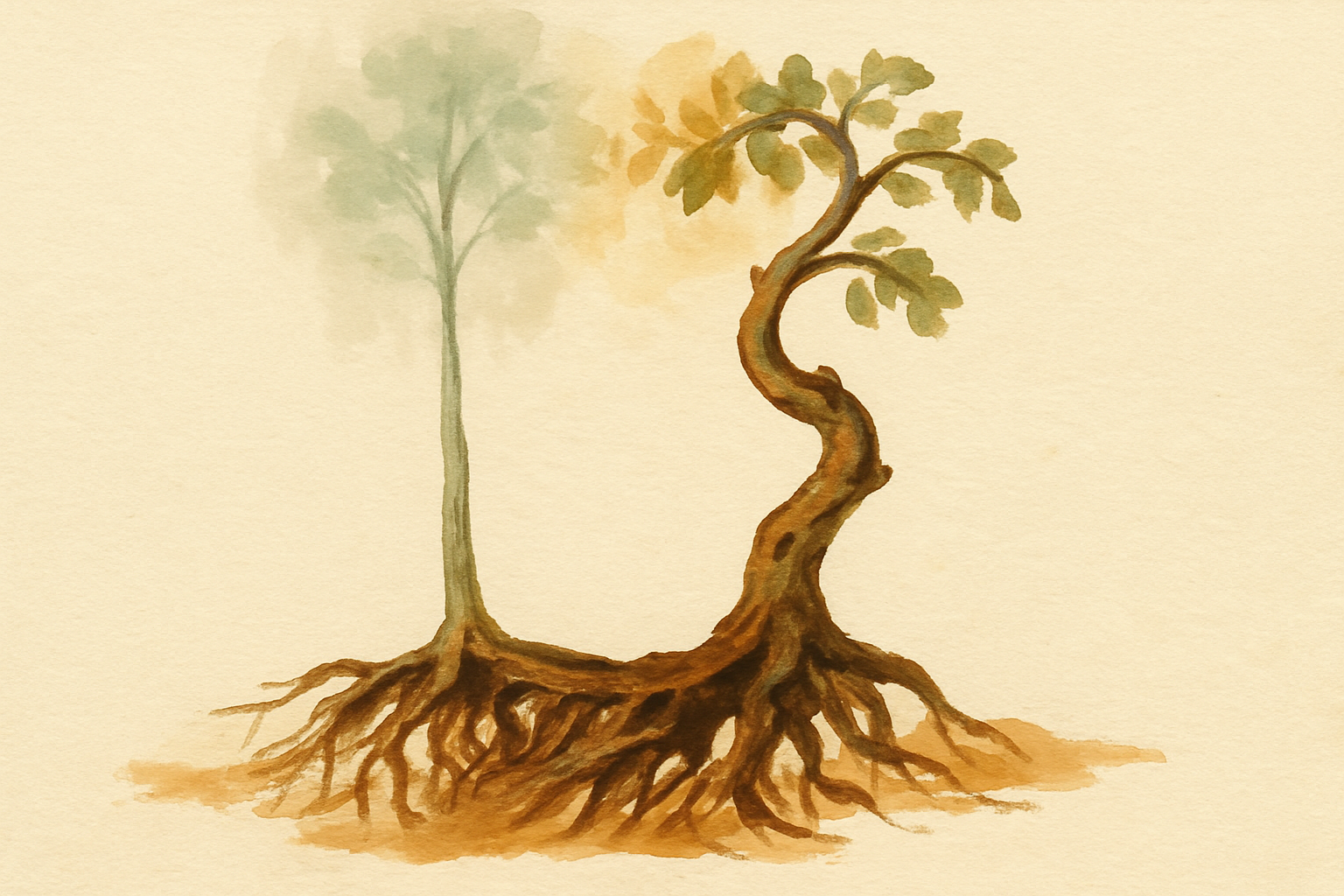
The Wall Between You and What You Truly Want
El muro entre tú y lo que verdaderamente deseas
A question about why being present is so difficult when it brings pain, leading into a wide-ranging exploration of conscious suffering, trauma, the illusion of the separate self, and reconnecting with deeper desire.
The Wall Between You and What You Truly Want
A question about why being present is so difficult when it brings pain, leading into a wide-ranging exploration of conscious suffering, trauma, the illusion of the separate self, and reconnecting with deeper desire.
One of the things I've noticed in my own experience is that being in the now sometimes seems so difficult because it comes with pain and suffering as well. Of course, you don't want to feel those, so you'd rather not be in that moment. But the discovery of being with the pain in the moment is a jumping point, maybe. Can you tell something about this, maybe your own discovery too, and how you got to that point?
Yes. This is what I was referring to as the guardians at the gate: fear and pain. You can consider it conscious suffering. Whether you understand through being taught or through experience, you recognize that this is the way you start to mature in how you suffer. And that has to do with how you contact your current experience.
The role of safety in meeting pain
An immature way of relating to pain requires containment and support. Parenting, ideally, is the job of supporting that process and containing it so that we feel safe in the experience of fear and pain. At some point, as we keep maturing, we become able to create that safety within ourselves: the sense that I can touch pain, I can touch fear, and I'm okay.
That's a learning process. Some describe it as a muscle, because it actually requires changes in our physiology and nervous system. The energies of pain and fear, all kinds of pain (not just physical but emotional), all kinds of fear: there are correlations of energy moving in the body, and the body needs to adjust to be able to flow with that. So that's where you can consider it a practice.
That's conscious suffering, because there's an intentionality to it. When you go to the gym, you're consciously suffering. Your body is in pain, or you're doing a cardio exercise and it's uncomfortable, but there's a gain in that. We know and feel the healthy aspect of it.
A personal account
In my experience, I can describe it briefly or at more length, but I was very unhappy, very young. It got worse, and as a teenager things became very dark. I became suicidal. My life was very privileged. Everything externally was a lot better than for most, but something was very wrong for me subjectively.
Then I met my teacher. I was very lucky, and there was also some synchronicity in that I was ready for it. I feel like I could have lived a thousand lives to have that encounter. It was that tremendous.
Through him I learned a lot, if not most, of what I talk about here. I've had other teachers since, but a process of conscious suffering started there. The night I met him, everything shifted. The day before, I had been through another dark night, as I often would. Every time I went to sleep, I would have a very difficult night and would not sleep at all. That night, after meeting him, I felt okay. Two nights earlier I had been planning suicide, and now I had met this man and felt I just had to see where it goes. He was pointing to something.
There was an opening of trust: a sense that there's something I don't know, that he knows, that has a value I have not tasted. But I tasted it in the meeting with him. We had a contact of attention and eye contact, and I felt something I had never felt before. It was a current that was simply beyond anything I had known, and it was inside of me through that meeting.
That was twenty-five years ago. There followed a long process of torturous conscious suffering. In my case, for others it was faster, shorter, but for me it was very challenging. I also had a lot of physical pain. But it doesn't have to be that. It's very personal. He actually told me that. He said, "For you, I'm having a sense that your process is going to involve a lot of physical pain, unfortunately." He was right, and I think that's more uncommon. What is common is that you have to face everything you don't want to face: what you experience as scary, what you experience as painful.
In those twenty-five years, did you have to deal with childhood traumas? Did you have to go through those, or did you skip dealing with them?
No skipping. I tried, but it didn't work out. I think a lot of the physical pain had to do with all the resistance to trauma and trying to push through it by skipping it.
About fifteen years ago I had a very strong energetic opening, what some call a kundalini opening. I ended up going to the hospital many times in the span of a few weeks from the physical pain. But after that, all of the trauma came up, and I did a lot of work with the support of therapy to go into very deep trauma: terrors and pains, terrors and pains.
I also had, and this may not be as common, memories from past lives carrying a lot of trauma and pain. That was actually the most powerful of what I experienced as healing. To me, although it is very speculative, it explained why I was born into a family where there wasn't anything that problematic and yet I had so much suffering. Still, I don't interpret that as proof of past lives. I don't really care about whether there are or there aren't, because it's not what matters.
But yes, a lot of trauma work. Dharma work is really all about being able to stay present and touch the sensations.
Waking up and growing up
What matters is also not to take from this conversation the idea that until all trauma is worked through, only then will you awaken. That's what the mind will do.
The best way I can describe it is that there are two processes. You can call one "waking up" and another "growing up." Growing up has to do with maturing as human beings, and processing trauma is a requirement for growing up. But growing up is an infinite process. It will never end. Waking up can happen before a lot of the growing up, and then these go hand in hand. There's a limit to how much you can grow up without waking up, and waking up also has stages. One can wake up to a certain deeper stage and then work on integrating that and growing up with that newer insight.
It is more common than not for people who do wake up very deeply to still have a lot of growing up to do. Historically and in the present, among teachers who have woken up, there is often a great deal of growing up that can still happen.
When you feel like your character is behind a wall, that's the only way I can describe it. Who you feel that you are and who you project into the world is a bit different. So actually, who you think that you are: is that also an illusory idea?
Let's clarify what we mean by illusion, because we need to make sure we're talking about the same thing. Before I say yes, how would you describe illusion in that sense?
A kind of made-up story, I suppose. A story of the mind rather than what is originally there. Or maybe it's like an expression that isn't there but feels like it wants to be there.
An expression of a personality? Of life?
It's almost hard to define or put your finger on, but there's a sense that something is not expressed.
The illusory self and what lies beneath it
I think we're talking about a few things. One is the notion or idea of what you are, which you're saying is possibly stories, more of the mind. Then there is something around a longing or a desire to express yourself in some way. And you describe the wall as creating a friction between that desire to manifest or express yourself and the idea of who you are.
I said yes to your question about illusion, and I would still say yes after hearing your description. But it's important to say a bit more.
What is illusory is this: if I ask the question "Who am I?" or "What am I?" and the answer comes as something I can only know through thought, then that is illusory. Normally, in response to the question "What am I?", what appears is a mental construct, and it feels real. It doesn't feel like a mental construct. It isn't experienced as a mental construct. It is experienced as "I am this; this is what I am." That's what's often described as illusion, because what we are isn't that.
But it doesn't mean that the construct, that imagination, that narrative or story, disappears. It has a function. What happens is that it's no longer experienced as "I."
The universe living as you
That's one aspect of what you bring up. Another is that there is a desire to live something. I'm intuiting into what you're describing, so it might not be correct, but there's a desire of something you want to live, and there are stories, beliefs, conditionings that are creating friction. You're not able to live your life as you wish. Does that resonate?
Yeah.
I often ask a question that I should probably write something about, because I find myself saying it a lot: What does the universe want to live as you?
It's very specific, because "you" is what you experience as: the narrative, the stories, your past conditionings. What makes you different from anyone else? There's a difference. But we are all the universe. It is impossible to separate you from the universe. It's impossible to separate this body-mind from the universe. There is no separation, from any angle. You could talk to a quantum physicist, you could talk to a mystic; only those who don't really know will say you could separate.
But what in some spiritual circles is described as "body-mind" is different from person to person. When we believe we are only and exclusively body-mind, we operate under the assumptions and limitations of that.
So the question: What does the universe want to live as you? Because the universe wants to live as the mockingbird out there, in some way. How is that expressed? It's expressed as the mockingbird doing everything it's doing at every moment. The whole universe is needed for that mockingbird to do exactly what it's doing at every moment. And because the mockingbird doesn't have a belief in its separation, it's also not obstructing the universe's desire.
But we humans have both the privilege and the curse of having gone through what one of my teachers describes as the first miracle: the creation of separation. In psychology, you would talk about it as ego. A human child, if everything goes well, will develop an ego and will then believe it is only the ego, exclusively, nothing more.
But what was it before there was an ego? It was something. So what happens when an ego appears? Does what it was before now die and become limited to ego? No. What we were before simply identifies. The instant we were born, we did not have ego, but we were. When the mind develops an ego, there is the attachment: "I am this and only this."
As we grow up, we still operate under that belief system, and at some point it creates friction with life. We can resist that friction, or we can learn to mature and wake up, which is to see that we are not ego, not body-mind. A more accurate way to say it is that we're not only ego, and in fact ego is a very small part of what we are. It's so small compared to what we are that it's more accurate to say we're not that. We don't become something more when we realize what we are. We just see that we were so contracted into such a limited sense of self.
Desire without obstruction
So the question remains: What does the universe want to live as you? And don't contemplate this by making the universe into a god out there. It's not you talking to a divine entity, which would be more of a mental process. You can see and know what the universe wants as your own desire.
For the mockingbird, who has no obstruction and no illusion, when the universe desires to sing as a mockingbird, it sings, and the mockingbird experiences that as the sudden urge to sing. It comes from the deepest part of the mockingbird. But it's the whole universe singing. The blood flowing is from the universe. There's just a complete unified energy.
What has happened to us as humans, when we identify and contract, is that we lose touch with those deeper desires. It's not a black-and-white cut that then we break. It's more of a flow. At times in our lives we take some risk and move from something deeper. At times we don't. The more we are contracted and identified, the more we push away the true desire.
The true desire is always new, always creative, always mysterious. It is always pro-life in the sense that it comes from something very vast. It could be creativity in the sense of painting or making music. It could be a romantic desire. It could be for cooking, for working, for anything. It could be for just sitting and looking at a tree.
What you truly want is often what scares you
What you're describing, the narrative and the belief in what you are that feels like a wall, is there because there's been, or there is, a need for breaking through into a deeper part of you. You will know it as the question: What do you truly want?
Usually what we truly want is scary, because it comes from a place that doesn't care about ego. It comes from a place where ego is a leaf blowing in the wind. If we're attached to and identified with ego, that deeper desire is going to feel like a threat. One of my teachers used to say, "Society is a conspiracy for ego protection." Everybody is working hard to protect their own and everybody else's ego. That's what we can begin to break free from.
You can notice what these desires are, for example, by noticing something that's very scary but, if you discern carefully, the fear is irrational. It feels like death, but it's only crossing the street or going to talk to somebody. The experience is just too much, so much so that we actually forget what we want. We are so out of touch with that deeper desire.