The Door That Keeps Knocking
La puerta que sigue tocando
A student shares how a television scene about displaced grief opened a window into unresolved loss, leading to a wider conversation about emotional work, presence, and the belief that something is missing.
The Door That Keeps Knocking
A student shares how a television scene about displaced grief opened a window into unresolved loss, leading to a wider conversation about emotional work, presence, and the belief that something is missing.
I want to thank everyone for being here today and thank our teacher for guiding us and providing this time and space to connect with all of you.
What came up for me today was a memory of an episode from a television show about the British monarchy. It's about a young prince who had just lost his mother. He's grieving, but it's not evident because he's trying to continue on as before. He's not really handling everything that's coming up for him during this time of grieving.
There's one part where you don't see him sad or grieving at all, but he gets really emotional with his father. His father is deeply concerned because the boy isn't giving himself the space to feel everything; he just wants life to continue as if nothing had happened. His father urges him to take the time, to look at what's going on inside. And he explodes. He gets furious with his father, and his reasons seem really displaced.
Fortunately, he has a grandfather who recognizes what's happening, perhaps because he's seen it through a different lens. The grandfather has a heart-to-heart talk with his grandson and says, in essence, "Maybe your anger with your father is misplaced, because the person you're truly angry with is the one you feel you're not allowed to be angry with: your mother."
Something in that moment just really clicked for me. Something about being a child trying to navigate your way in the world, about how your parents or caregivers present situations you simply have to accept in order to survive, in order to accommodate non-ideal circumstances. And nothing is ever ideal. I've repressed so many emotions and feelings.
The invitation to speak personally
I have a question for you, and we've talked about this recently. I just want to reflect back: when we share and the language we use is abstract or general, such as saying "we," it distances you from what's personal. If you shift to "I," it becomes more personal, more vulnerable. You're saying "we," but perhaps that doesn't include other people here, in the sense that they might have a different experience. I understand the habit of using "we," and I often do it too, but it's different when sharing something personal. I'm inviting you to share in a way that's specifically about you.
You're right that you're talking about the show and how it affected you. I'm curious about you. When something clicked, what was that? How did it feel? How is it now?
I saw a part of myself I didn't realize was there. I could see myself in that young prince.
I've had two major losses in my life: first my mother, then my father. I had very complicated relationships with both of them. After each of them passed, both times my world was flipped upside down. So chaotic. Trying to make sense of it all has been really, really overwhelming. I've had a lot of time to grieve, but it's still in progress. I've had some counseling in the past. I obviously still need more. But I just wanted to share that if I weren't doing this work once a week here with all of you, I probably wouldn't have been reminded that there's still so much I need to deal with. I felt it was important to share.
Also, because I'm a parent with a nine-year-old son, I wonder what kinds of things he's repressing because he can't get angry at me. It puts a light on so many things I haven't thought of. I'm curious how all of this relates to each other, and whether you can bring some clarity to the situation for me.
Two sides of the work
There are two aspects to this. The first is what you're talking about specifically. The more it becomes really clear to you that this emotional work is necessary, and the more it becomes urgent, the better. When we do this kind of work in meditation, things come up. It opens certain doors for what is hidden. So in a sense there are two sides of the work. One is working with what's coming up and going deeper into the emotional and psychological work. But as we go deeper, we clear what needs clearing.
With regard to your son, the best thing you can do for him is to do this work within yourself. Because as you clear that, he will feel it. Even if it's something you're doing privately somewhere else, when you come into his presence having cleared more, he will feel it. He will know, not in a thinking-knowing way. It's energetic. He will feel it. It will open the door for him to be angry at you, for example, if that's what he's been unable to express, and many other things that will surprise you. As you become more integrated, more healed within yourself, that is going to affect him powerfully.
So in a sense the urgency is the work with you, but the reason it's urgent is your son. The sooner the better, because he is still developing, and there's another decade where his relationship with his mother is alive, present, and affecting him. Not that it ever stops, but it's far more powerful in the early years. So the trigger for that urgency is that you're a mother and it's your responsibility to roll up your sleeves. And this actually applies to every single parent.
Presence and the noise of unresolved emotion
The other aspect, which I think is your question about how this all relates: what I'm pointing to here, and it's not one thing but it is a repeated message, a sense of direction, is that where we want to go is now. You don't heal by going to past stories. You can bring past stories into now, but you don't heal by contemplating or moving toward some imagined future. The process is always deeper into what is happening now. What will ultimately be the most healing is something that can happen only now. That's why the message is, in a sense, very repetitive. I can use all kinds of language, all kinds of techniques, more or less successful ways of talking about one thing: presence. One word for it is presence. Other words are consciousness, beingness, truth, love, heart. But all of those point to different perspectives that help us realize something that is already here.
The more that recognition happens, the more everything else falls into place. Psychological traumas and challenges just work themselves out. The right therapist appears, or the availability of working with a therapist appears. All of this happens synchronistically as we deepen in this sense of presence. That's why I focus on presence more than on emotional work, though I do highlight that work as important.
Ultimately, it's this presence that you will recognize more and more in yourself. You will relate to your son from that place, and he will feel it. Especially young children: they feel it. It's like night and day when a parent is present.
So are you saying that a lot of the pent-up emotions and feelings I'm ignoring are a distraction from being in the present?
Yes. You can come to a point where you get stuck, and this is very common. You're trying to work on being more present, but something just won't give in. There's something that keeps this distraction in place, a kind of obstacle. That obstacle is psychological and emotional. It's a noise.
Definitely. It's really loud.
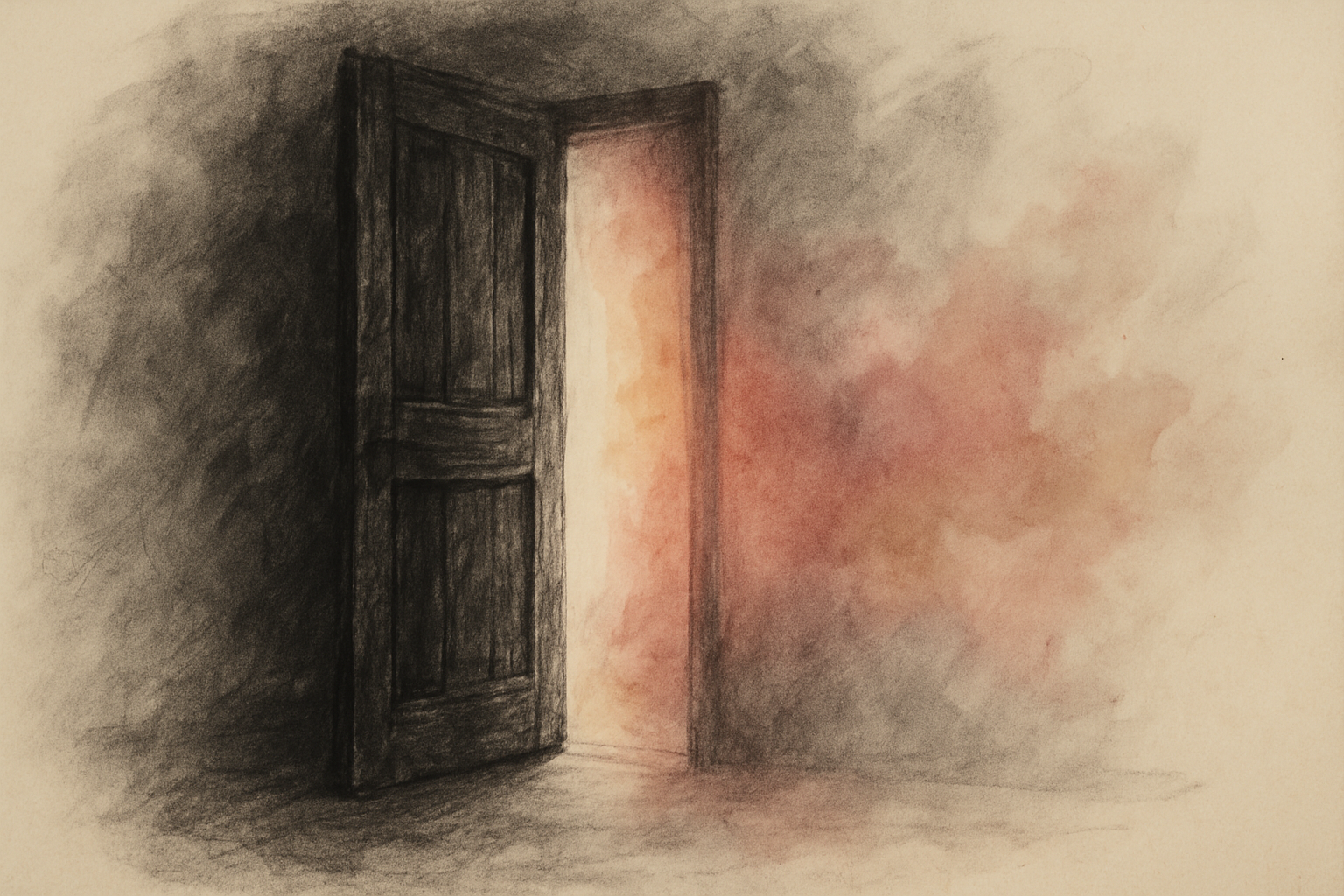
It gets loud because there's an urgency. It starts knocking on your door, and you're trying to be more present by pushing it away. Now you get stuck. You can't be more present, and you can't deal with the noise because it's too painful, too difficult, too scary. You get stuck. And if you're lucky, it'll bring more pressure. It'll scream more loudly, because it's calling you to open that door and face it. Grieving, for example.
Yes, I've been trying to be more present and it's just this.
You'll come to a point where that just doesn't work. The strategies for being present will stop working because they will be in service of avoiding. And that's an exact contradiction, because you can't be present if you're avoiding something that is present, which is pain and fear.
I thought for the longest time that I'd dealt with a lot of the grieving because I've gone to numerous sessions and therapists.
I'll just simplify by saying there's more. And don't ever think it'll be done.
Grief changes form
Right.
What happens is it just becomes easier to process whatever comes up whenever it comes up. But it's never done, because as long as you're alive, there's going to be fear and pain. What can happen is we learn to swim into it, to dance with it, to flow with it instead of fighting and resisting. Then it becomes, in a sense, lighter depending on the intensity. But it's not work that gets finished.
The grieving never goes away. You just relate to it differently.
Yes. And it will change texture, color, form. It will go from scary agony into sadness, for example. Maybe a sweet, joyful aspect will come up in relationship to your parents.
Thank you.
You're welcome.
I could share my experience briefly. I grew up in a dysfunctional family. At age nine, I knew I was in trouble. At seventeen, I started my work, including transcendental meditation, which was popular at the time. For thirty years I really worked on my traumas, on and off. I believe you have to work on those to understand what's holding you back, because those ingrained thoughts are so strong that they pull you into anger or fear.
I understood that. I understood the value of therapy, and it became my specialty. I could explain very clearly what I do, how I do it, where it connects to. I was very clever about it.
Four years ago I went through another series of events. Of course I had the tools; my expertise kicked in. I knew how I'd handled things before. I'd always seen it as an onion: you peel and peel and peel. At some point in my thirties, I actually gained a lot of freedom around what love is, and I released what I'd believed love to be. It was amazing. But then other things came up around self-worth and self-value, and my tools stopped working.
I'll give you a metaphor. Imagine you're on the beach. You want to go for a swim or a sail. You've done all your preparation: your charts, your food, your swim gear. But you cannot leave the beach. That's how I felt. Sailing or swimming is the now, what you actually want to do, and I was stuck on the beach. I knew I wanted to be on that boat or in the water, but all this preparation in the mind wasn't helping me.
I read The Power of Now twenty years ago. I understood it at some level, but not at a very deep level. That's where I realized: yes, you have to work on what keeps you from the now, but there is a point where the only power is in the now. And in order to get there, I realized I had to use my senses, because I was living in my mind and transmitting that to my thirteen-year-old child as well.
Then I realized the simplest things: sounds, sensations, movement. How does one bring oneself into the present? Even that question is a kind of mind trap. But the body knows. The body understands what now is: when you stop and look at a little bug, or a flower, or a child. That's when I started shifting my attention from the big solver, the big understander of traumas, to just getting into the water. I just want to swim now. That's my experience. I'm still learning it.
The trap of arriving
Are you interested in some reflection on that?
Sure, please.
I asked because you didn't ask a question specifically, and I don't want to speak uninvited.
What I'm hearing is that there's a trap, a sense that "I will work on this and get somewhere," that by doing psychological or emotional work I will get to the present. Even the language in The Power of Now, which I think is one of the most extraordinary books, can get a little misinterpreted, because it was written in a particular moment in time. Everything put into words and concepts can have something missing, because there's always another side. This sense of "you just need to come to the now, come to presence, there's power in the now, so just get to the now" can be very misleading.
Because there is no such thing as "not now."
This can be understood intellectually. Of course there's only now. But if you really see it, if it's not intellectual, if you genuinely see that there is no such thing that is not now, then there's no such thing as distraction from the now. The mind will have no power to create the sense that you're not here.
So for you, I would suggest looking at subtle beliefs you might hold about the present, about now. Having done so much work, there's likely an underlying set of assumptions or beliefs that are actually there in service of the distraction, the project of getting somewhere. If there's any sense that there's some work to do in order to finally get there, that's a false assumption.
True.
Then it becomes really subtle. What is it about what's happening now that I don't like?
Sometimes, how can you like the now when you're suffering in it? You don't want to be a part of it.
But then you have to look more closely. What is that suffering?
Right now, if I have one practice I'm trying to learn, and maybe you can speak to this: I find it very valuable to explore that place in the now where you don't want to be, where there's suffering. You have to keep it here in your heart, still be conscious or aware of it. A practice of keeping it without changing it, without interpreting it, just observing it, just being aware of it. That feeling of guilt or fear or anger, that upsetness, right here, right now. How do I just make a space for it among everything else that's going on? That's the practice for me.
Nothing needs to be done with what is already present
It's always going to come down to assumptions and beliefs. Look at the sense that you need to make space for what's present and you can't. That's an overcomplication, and it's a sign that thinking and beliefs are operating. Because what is coming up is already present. You don't need to do anything with it.
This sense that there's an activity that needs to be done is a subtle strategy. In a sense, you're asking me for a strategy update, a way to improve your strategy for dealing with the problem so that it can finally be gotten rid of. What I'm saying is actually in the other direction: there is no strategy. Nothing will work. There is no hope for that approach.
But that's an end result, isn't it? To be in that state of mind, even though it's in the present, you come to it, you mature into it. Even though we know there is nothing else but now, the knowingness of that is somewhat an arrival.
It's not.
Unless you're on psilocybin or some peyote.
Those are states. Those are changes in experience, and when that happens, because of the contrast, we can perceive something different. It can help us undo some beliefs. But what I'm talking about is not a state. It's not an arrival. It's really hard to describe precisely because of that. It's not an arrival because it's not something that ever went away. When I say it's already here, I'm being very literal. You can't arrive at it. There's literally nowhere to go. All of the energy that goes into the strategy of arriving at something, of finally getting it, all of that is the avoiding.
Can you explain your personal experience? There must have been some shift, many shifts.
There were many shifts and decades of very different, intense, powerful experiences. But if I were to distill it, it's the seeing that there was never something in me, something I was, that suffered. It was the seeing of an illusion. And it's exactly what I'm talking about, in that there's just nothing that can be done to create this, because it's already here. What was in the way was just a belief: the belief that something was missing. But it was a belief that created a sense of reality. I lived completely focused and obsessed with that reality based on that belief.
And then, in a sense, you could say that experientially, it popped. In that popping there was an immense amount of terror and pain, and then bliss. When it finally popped, there was just an outpouring of immense bliss. My partner, who was next to me, fell into that bliss herself. She felt a current coming from it; if she were here now she would speak about it.
Then that intensity just stabilized. Instead of the really intense outpouring, it became very gentle and stable. But it really has to do with the belief of what I am. There used to be a sense of "I am something, I am this person," located here in this body. That just dissolved. Yet even the experience itself can become a distraction, because before that, I was also searching for experiences, thinking that having shifts and experiences would finally get me to arrive somewhere.
Thank you for sharing your experience.
My pleasure.