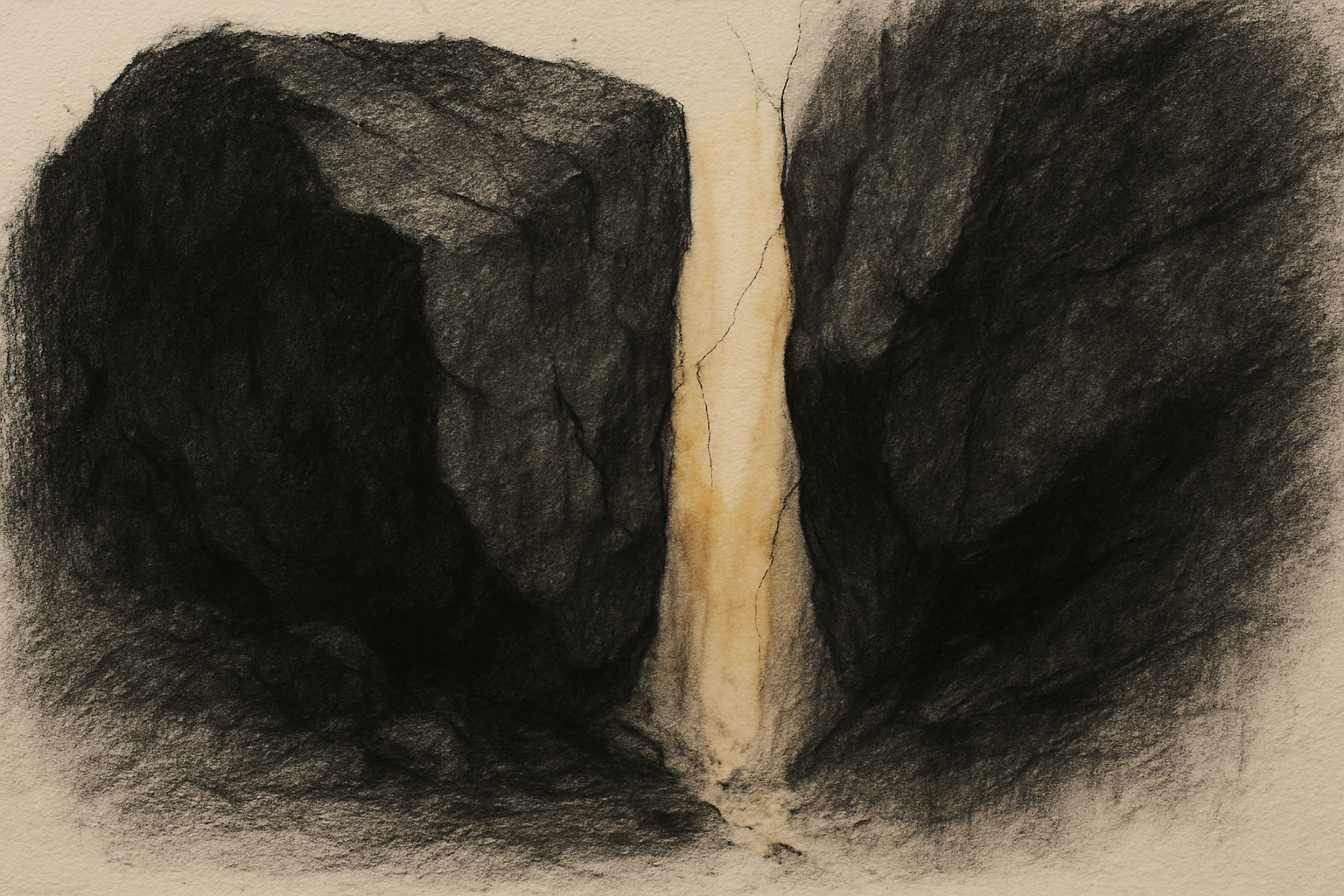
Between a Rock and a Hard Place
Entre la espada y la pared
A student shares the fear of losing everything through awakening, and the teacher explores how the desire to hold on and the call to let go create an inevitable, necessary tension.
Between a Rock and a Hard Place
A student shares the fear of losing everything through awakening, and the teacher explores how the desire to hold on and the call to let go create an inevitable, necessary tension.
I've been watching nondual videos on YouTube, and I saw one the other day about "the cost of waking up." I didn't want to click on it, and I didn't click on it. Even coming to the group today, I had been looking forward to it for a while, but this morning I thought, "I don't want to come, because I don't want to lose everything."
I saw someone in a video writing something like, "You can't want this," because they were talking about losing everything, losing control. And then I saw another teacher saying she doesn't have control over her future, and I thought, "I don't want that."
It happens all the time. I get dragged into suffering, usually about other people or being very critical of my own life. In those moments I think, "I don't want to live like this anymore. I don't want to live with this person that I am, this story I'm living in." I feel trapped. I want to change, to be better, to suffer less. But then there's also this resistance.
The inner battle
What you're talking about is pretty much everybody's experience once they start finding out about the work of waking up. Up until something is completely released, there is an inner battle. That inner battle is between a desire for things to be different and that which is already so.
What we are, what reality already is, is already what it is. There is something that has to do with a choice, and it's a choice I respect very much. I fully respect the choice of wanting to live in a way that is usually called illusion or ignorance. Those words have a negative connotation, but I call it the adventure. I respect that choice because I made that choice very wholeheartedly. I didn't know I was making a choice. I didn't know it was fully my choice.
When someone says she doesn't control her future, nobody does. You don't control your future either. We can enter into a choice that creates a certain kind of reality, what is called illusion. But if I could, I would find words to remove all of the negative connotations from how it's described, because it's a very valid choice. We make it until we just don't want to anymore.
In my experience, it is a free choice and a beautiful choice. It is to live in a certain way that allows for a certain kind of intensity, which is what suffering is. But there is also another aspect, which is why we choose to suffer.
Seeing how much you don't want it
What happens is that we can come to a point where we realize we don't want to let go of that. And that's actually a really big breakthrough: to know ourselves to a degree where we come into this recognition that we don't want to wake up. Or, put differently, there is an aspect in us, a part of us, an energy, a degree to which we don't want it. To believe that we want to wake up is itself illusion. Because if we did, we would be awake. It's as simple as that. If we truly, fully wanted to wake up, we would be awake, because that's our natural state.
If we're honest with ourselves, we will know that we suffer. And if we are even more honest, we will start to see that we are attached to suffering. We will see that we want it, not for the suffering itself, but because of the world that it creates. Suffering is just the side effect. We don't choose suffering for suffering's sake. It is simply the consequence of a choice.
So usually what I say in this kind of conversation is: just choose that for as long as you want, but also keep noticing, keep seeing. Because what this requires, as you said, is not something we want. Once we've seen through it, we realize that what we've wanted is always here. But it's a matter of layers. I'm talking about seeing more and more deeply. First we can see we suffer. Then we can see we are attached to something and don't want to let go of it, even if the consequence is suffering. The process of letting go can be very painful. In fact, it's probably the most painful thing you can go through, and scary as well.
Usually the carrot offered in these conversations is: "You will realize your true nature; everything you've wanted is already here." But you cannot live as if that is your truth if it's just a story, if it's a belief in my words. That would be a disservice to yourself. So when I say those words, I'm pointing to something, because it creates a kind of clash internally with what our normal experience is, which is obviously, "What I'm wanting and what I'm needing is not here." It is so obvious. And I know how that was. I remember that.
But to me, the most obvious thing is that what we wanted is always here. It's as obvious to me as the fact that you need to drink water when you're thirsty. But I also know that when we are living in that way of, "I know what I am and I know what I want," then what I'm talking about is veiled. It's right in front of you, but it's veiled.
What you think you want
Are you saying that before realization, you can't really know what you want because it's veiled?
Before realization, you think you know what you want. And it might be constantly changing. There's an underlying sense which is pretty clear, but it moves and changes because it's actually an illusion. It's a self-hypnosis. It's something we create that seems real. The "I" in that way seems real. Then what the "I" wants and needs seems real. It seems that I know what I am and I know what I'm needing, even if that's constantly changing.
The core of it is the sense that what I am has certain attributes, and that creates the possibility of that world. These attributes are: what I am is dependent on this body; this body, as "I," begins and ends; the choices made by myself originate only in me; their source is my own self, which is separate from other aspects of reality.
Are you saying the source is separate from me?
It's hard to describe, but it's the sense that I am making my own choices. You are making your own choices. Are our sources different? I mean it in the sense of, right now, what is operating, where the energy of it is coming from, where the choices are originating from.
I think I understand. For me right now, it could be something like "I need to make more money," and that's unique to me as a person, where somebody else's wants are dependent on their life situation.
When you say "I need to make money," which is true at the operational level, the "I" that it's pointing to is just an image. It's just thoughts. "I need to make more money" becomes less important or dramatic when that is seen. It can still be at the very top of the list, the most important thing, but it's no longer creating the intensity of the story.
That's what is lost. There's a certain aspect of the drama of life that we love, that is beautiful. Once you taste something else, you'd rather not have it anymore. But there is a beauty to it. That's why we love movies.
Wanting to keep some and let go of the rest
It seemed to me that after a certain teacher I knew woke up, his life was still a grand adventure. But I want to secure that for myself. I see myself thinking, "I want to keep doing this path, but I want to keep this and this." At the same time, before, I didn't really have any other way except to go forward on this path because I was suffering enough. This was the only thing that helped me. But now that I'm here, I'm like, "Oh, this is what's happening." I didn't even dig deep. Maybe it's just after years of looking, but I can see it now: I don't want to lose this. This teacher talked about sacrifice. He said something like, "The cost is big." Is this what he was talking about, the loss of my story?
I don't know what he was talking about specifically, but it's very likely. Because it is the loss of everything. It's the loss of what you think you are. But when I say "what you think you are," I'm trying to be careful with language. To be more accurate, I would say it's the loss of everything that you are.
In my mind, you're saying?
Yes. You don't really have the possibility right now to distinguish what you are from what you think you are. So if I say "what you think you are," it's actually not going to be interpreted correctly by you.
Because I have an image of what it would be like after. Like, I'm not going to care about people, I'm going to be detached.
You have all of these ideas. One thing I can say for sure: you cannot imagine this. It's impossible. It's literally impossible by definition.
I remember this teacher would say that, and I would think, "Oh, it's unimaginable, that's so great." And now I'm like, "Why did I think I wanted something when I didn't even know what it was?"
Part of you does want it. A deep part of you does. But as you showed today, and what I highlighted, is that it's a big realization to see how much you don't. Because that means you've gone deep enough to meet something that is the essential resistance.
Inner integrity
In this work and among people on this path, there's a lot of what I call a lack of inner integrity. There's outer integrity, which is towards other people and towards aspects of our world, nature. And then there's inner integrity, which is how we are with ourselves. For example, if somebody is teaching "this is the end of suffering," then I will tell myself I don't suffer anymore, and I will put a lot of energy into living and acting as if I don't.
Why would you do that?
Because then I create a sense that I am progressing on this spiritual path.
So it's a trick you play with yourself, but also to show other people that you're progressing.
Yes, for myself or others, for many reasons. The same as making a lot of money because it attracts people, or any kind of egoic drive.
What I try to point to is: yes, this is the end of suffering, but you have to go and look at your suffering fully, completely. You have to go straight into it and through it. If one starts to have a sense that suffering has ended, I will see through that. For oneself, it's a disservice. That's what I call a lack of inner integrity.
I'm highlighting that because what you're describing is the opposite. You're honest with yourself and honest with us. That's one of the most important requirements in this work, especially to be honest with yourself. The more honest you are with yourself, you won't be able to prevent waking up.
The point of no return
I know that too. That's why it feels like, okay, you said I can choose to continue living in illusion, or whatever the better word is. But I know this is inevitable now. I've pushed myself this far. If I stopped going to all the groups, stopped doing this meditation work, I don't even see that as a real choice, because I already know it's not real. But I want to pause. Can I pause? I already know it's not real, so I can't really enjoy it the same way as before.
You're right in that spot, and it's quite a breakthrough. I know it doesn't seem like a big deal, but it has to do with seeing something quite fundamental. Now you're stuck between a rock and a hard place. The call towards more illusion seems unreal and no longer very satisfying. The call towards waking up seems like a loss and a pain in the ass. So now what?
This is what I always go through. My suffering will start, and then I need the medicine, and it helps me feel better because it's truth. But then it's like, I can't have both.
You can't be asleep and awake at the same time.
I want the pleasure part of being me. I don't want the loss. But I also know I made the choice. I remember choosing many times to leave behind the old thing I knew, to try this and say yes to this, sometimes thinking I knew what it was, but also many times knowing I didn't know. I just wanted something else. So I can't really be mad at myself.
The cure you didn't want
You thought you were getting just some medicine to relieve the symptoms, and actually you found the cure. You didn't want the cure. You just wanted to alleviate the symptoms and stay safe. And now you're like, "I got the cure."
What you're describing is a very common process. It's rare in the world, but common among people who find the true cure. At first, if we actually come across a true teaching, we create ideas of what it's going to look like, and that's what motivates us. We're motivated by images and fantasies. That keeps us going because in the beginning it's hard. After a while, we've gone a little too far to go back. We've crossed the point of no return. Then we realize what we imagined it was going to give us is not real. Now, when we look at what we are letting go of, we don't want to. But we're still called to do it because we know it's not real. And what motivated us, we know that wasn't real either.
You're right in that kind of middle point. What I would say is: this is actually a good thing. Just keep going. Keep going, not towards anything, but looking. Keep looking. It is the end of everything that you can imagine. And even what you think you will lose is probably also not right. You also can't imagine what is going to be lost.
It's like operating blind. I'm afraid of losing my relationship, my family, my love for my dog, my desire to make money. So I picture myself being poor, being a zombie, not participating in life.
You can't imagine it. Neither in a positive sense nor in a negative sense. You can't imagine the good things or the bad things.
I feel like I'm just going to start suffering again, and that's what's going to push me out from between the rocks. That's how it's been.
That's exactly how it goes. New layers of suffering, more calls to looking more deeply.
What we're talking about now, looking at what I think I'm going to lose, that's a source of suffering. So I want to alleviate that. It's kind of a trick to get me out from between the rocks.
Imagining the future is just more resistance
Yes, but the imagining of what you're going to lose is also a way to energize your resistance. Because it's false. It's just more thoughts. It's just more pretending to know what it's like or what it's going to be like.
The best way to imagine what it's going to be like is exactly what is happening right now. It will be exactly like what is happening right now, at every moment.
What changes isn't at the level of experience. You could be sitting exactly how you are right now, with your life exactly as it is right now.
That sounds nice.
All of the problems you have right now, all of them, yes. What changes is a change at such a deep level you cannot imagine.
I keep thinking about the last few days. I remember this teacher promising us something like, "Just believe me, have faith in me that it's better." And every time I think about you and where you are now and how you talk to us, I think, why would you talk to us if you were leading me down a bad path? I at least trust in your love.
It really is about trust. When I say it's something I could never have imagined, it's not necessarily because it's just so wonderful. It literally cannot be imagined. It's beyond the faculty of imagination. It's beyond the faculty of thought. And I would never go back. No interest.
Are there people who realize and then want to go back? Like the character who wanted the steak in The Matrix? Or am I in that spot right now?
You're in that spot, yes. He wasn't realized.
That's a relief.
What actually changes
Notice: when I said things could be exactly as they are right now, you said, "Oh, that's nice." Why is it nice?
Because I get to keep what I know. I don't have to lose my family. I still have my things. I know I'm attached to things. I have familiarity, a sense of comfort, control, calm. I don't know if those are the right words. But when you said that, I didn't have a scary image.
Just watch when you scare yourself with images of what it would be like, because it's not going to be that either. You can't imagine the positive or the negative.
There will be shifts, possibly in your personality, and very likely in how you function. But everything that is the mind, the thoughts you have, the mind was doing its thing, and it will still be doing its thing.
What really dramatically shifts is very subtle and fundamental. It's that sense of "what I am." But nothing new appears. Our being already is. We just stop believing we're something that's just thought. We stop believing that we are just thought. But I can still think about myself. I can think about anything I thought about before. It just no longer confuses me about reality. When I think about myself, I don't experience that as what I am.
Think of an elephant. Do you feel, when you do that, that you are an elephant?
No. I can feel some of the elephant, but I don't feel that I am the elephant.
It's the same thing. I can think about myself, but it's like the elephant. It's just clearly an image. And because I'm not trying to constantly convince myself that I'm that, I'm not thinking about it much, only when there's some kind of need to plan, or in a conversation where there's the image of "I" and the image of "you." But the sense or experience of being is not that image. It used to be.
I don't fully understand what you're saying, but what I can say is that the way I think is very burdened. Things feel harder than they should be, because of the over-identification.
That's just how things are. It could be easier, but not before it's probably harder. Just keep looking, and notice beliefs and thoughts, especially about the future, about how things will end up in this process. Know that you cannot imagine it, neither positively nor negatively. Anything you conceive of it looking like, notice: it's just thoughts.
Thank you.
You're welcome. Thank you for sharing.