The Shell That Isn't There
La coraza que no existe
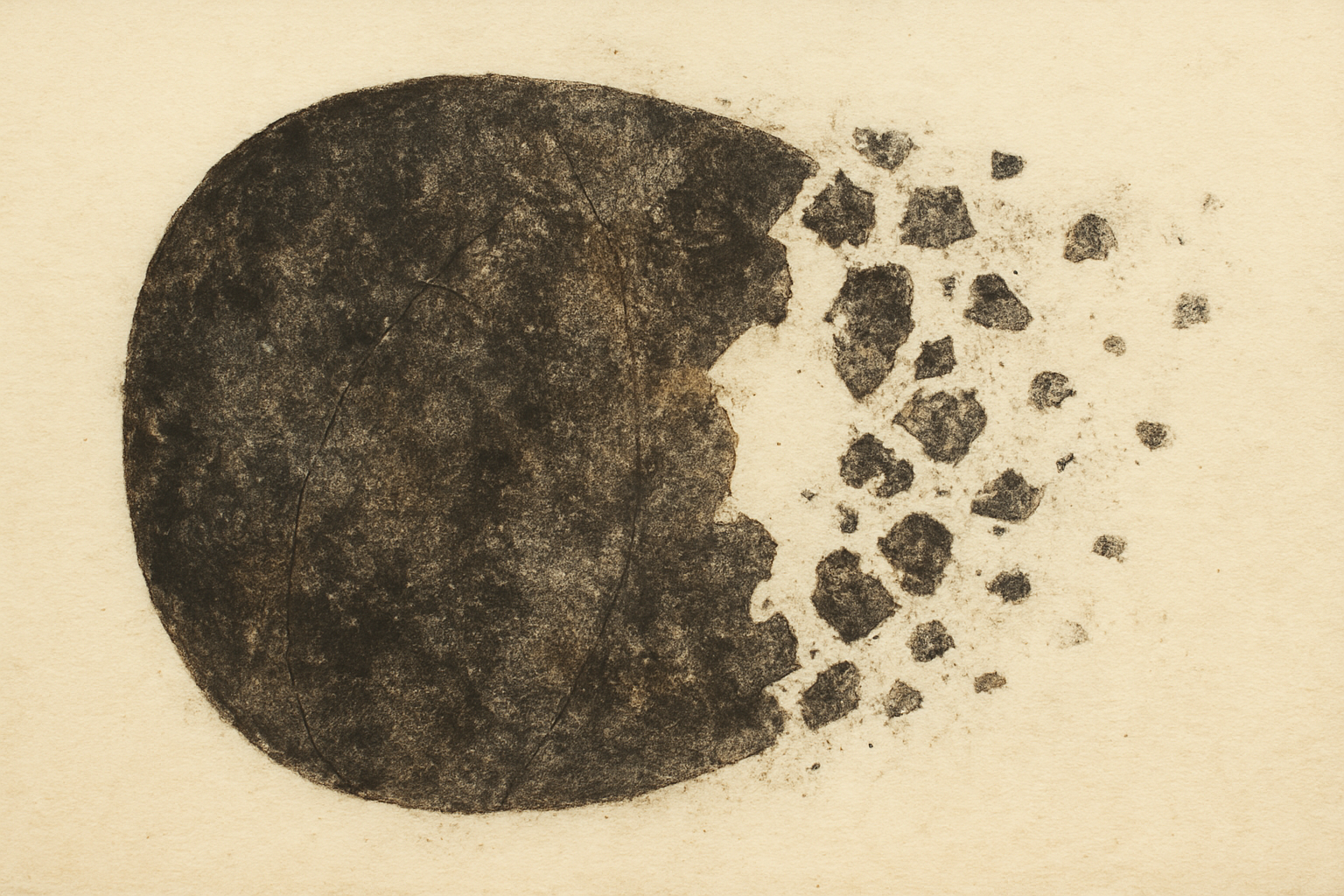
A student describes an intense sensation of being trapped inside a solid shell, and a feeling that something wants to break through it. The teacher explores how much of this "solidity" is actually thought, and how the way out is not to manipulate sensation but to recognize the interpretive layer for what it is.
The Shell That Isn't There
A student describes an intense sensation of being trapped inside a solid shell, and a feeling that something wants to break through it. The teacher explores how much of this "solidity" is actually thought, and how the way out is not to manipulate sensation but to recognize the interpretive layer for what it is.
I wanted to try to put into words what I was feeling in meditation. Sometimes there is a sense that has to do with solidity. There is a current, very intense to hold, as if it wants to explode open this shell that seems solid. The body actually has spasms, and the sensation is that it only seems like a separate current. I think it only seems like a separate current because of how I look at it. It's as if the gaze were too focused on thoughts, and that's what makes them solid, or makes a sensation of a shell that's solid. But the intuition of that is so free and ethereal and non-solid. So I guess my question is: is your sense of being like that, total non-solidity?
We have to be careful with words. It's really difficult to describe, so any description will be inaccurate.
The short answer is yes. A slightly longer answer is: yes, but it's not that different from how it was. What changes is the interpretation. Without that mental overlay of what you're describing as solidity, the experience of sensation is exactly the same. But without that interpretation, it's completely, purely an energetic experience.
When I used to do this, it was real, solid-matter fingers. Now it's purely made of sensation. It's empty. I would have to be a poet to describe it well.
The danger of imagining the goal
But don't expect something particular. What I was hearing in your sharing is also a sense that you're imagining something you're trying to get to, something that's going to give you a kind of release. And there's a subtle pushing, a subtle striving with the current experience. There's a subtle kind of manipulating.
The tricky thing, and it's paradoxical, is that there is such a thing as this shift. There's a kind of teaching that says, "You're already there." That's a valid pointer, but it's valid only if it's helpful. Because there is a shift that is a real shift, a realization of reality.
Some teachers only point to "there is only this," and they're emphatic that there's nothing other than this. That can be very powerful if you've been deeply involved in the opposite kind of teaching. But it's also problematic in that it starts to deny the potential of an actual shift, which is real and can happen.
So right now I'm walking that line with you. I don't want you to deny that possibility within yourself. But I can also sense that you're pushing for this release of the shell, pushing with this energy, because that's true: there is such a possibility. The trick is to notice how you might be imagining what it's like. Then there's going to be a narrative, and that narrative creates time. It creates a reality of a way to sense yourself in this body, in this moment, different from what it is now. You're overlaying that and then manipulating your current experience.
I can see there is imagination around that. But there's also a real sensation of something that wants to explode and break through a shell or something. And it's real.
Yes. And that's what I'm saying. I don't want to communicate anything that invalidates that in you. It is real. But look carefully at the sense, the imagining, of what it's like, what it should be like, and how it should happen. It's probably based on past experiences where there were shifts and senses of expansion, and that becomes a memory. You're trying to reproduce it, and that's all thought. That can become an addictive attempt to change states, to change what you're actually experiencing into an imagination of a memory of how it felt when it was better, when it was more released, or how you imagine it was for others who had a more profound release. That's all imagination.
One way to consider it: what you are, exactly how you are experiencing everything right now, does not need to change. What you're looking for does not require a change of state, a change in your sensations, or a change in perception in the body. And yet, there is such a shift possible. That keeps you right in the middle.
I understand what you're saying, but it's also strange, because it feels like a change. To stop feeling trapped in the shell, that would be a change.
But the feeling doesn't have to change either.
Okay.
What else can change?
It's even more subtle than that. I'm trying not to just tell you, because then it's only intellectual understanding. So: what else can change?
Stop thinking you are the shell. Stop believing you are the shell.
Contemplate the feeling of what you are not being constrained. It's more subtle than that. Do you have that experience right now?
Of what?
The solidity.
Not as much as a while ago, but yes.
Describe it.
It feels like a solidity in the body, and that I'm inside my body but not outside.
The role of thought in sensation
I'll point out one thing to start. Notice that in order to describe this experience, your eyesight is constantly going up. I can bet you're activating thought. If I asked you to get in touch with your breath and describe it, your gaze would likely stay level or go gently down. You wouldn't look up to describe your breath.
The contrast is this: the shell-like experience, if I spell it out, is an interpretation. By that I mean it's a thought process. Thought has four qualities or flavors. One is sound. Think of it like a mirage. We hear sounds; our minds understand sounds and can then imagine sounds. You can think of the sound of a car's exhaust as it accelerates. It's clearly an imagined sound based on memory. We hear our own voice, we hear others' voices, and so we learn to imagine inner dialogue, usually in the form of imagined sounds.
Same with images: we see things, then we can imagine based on what we see. It's the same process, but reflected in imagination. The other aspect has to do with sensations. We have feelings, sensations, and then we can imagine sensations. Emotions, I would say, are a mental activity, and the mind isn't an abstract thing; there's a brain, there's chemistry.
Are you saying that the shell is imagined? That it's thought?
Yes.
Oh. That is that, as well.
Yes. It doesn't have to stop. All you need to see is that it's not water. In your case, you're seeing water and you want it to stop being water. It's not water in the first place. It's a reflection of the sky. It's a mirage, in the metaphor of interpretation that makes something solid. There's a sensation, and then there's the mental reflection.
When we imagine the future, we create it based on memory. We create time in our mental world, and we can go very far: life when we're old, life on the other side of the planet, on another planet. But also, our mind is constantly mapping reality, overlaying that imagination. And it's useful, because we have to constantly create in our inner world the reality we're living in so we can navigate it. What happens is that this mental interpretation stops being recognized as interpretation. It becomes believed as reality. Then it's not actually very close to reality at all.
Sensation versus interpretation
Back to your sensation: your body is constantly producing sensations, and you experience them. You think you are relating directly to the sensation, knowing it directly, but you're actually interpreting. The way you're mapping the experience of your body is projecting onto it a shell-like sensation, a shell-like imagined experience. That becomes believed to be your true, direct, raw experience of your body. But whenever you had to describe it, you had to go into the world of thought, recreate the imagination, and project it onto your body again.
So you're saying that what seems solid, every time I feel solidity, it's the feeling part of thought, the imagination? I'm not being clear with my words.
You're talking about what is solid. What do you mean by solid?
A sensation. An inner sensation. But what I think I'm realizing, or what you're trying to say, is that that sensation is always thought.
There is a sensation, or a flow of sensations, and then there is an interpretation that is thought-based, creating this solid-like sense of a shell. The way out isn't a manipulation of the sensations. It's seeing the thought-like part of it purely as thought. That's going to shift the experience of it from "real" to imaginary, to interpretation.
If you notice, there's going to be a mix of bodily sensations and imaginary sensations. You need to sit with that and really clearly notice what's actually coming through the senses of touch and what is the interpretational, imaginary, mental side of it. Then you can discern: "Oh, that's thinking. Oh, that's sensation. That's thinking." It's going to be all mixed. As you recognize and see what they are, the thought-like aspect of the experience, which in the believing of it is interpreted as "that is my body, directly, the direct experience of my body," you will see: oh, it's not real in the sense of direct experience of the body. It's real as thought. Purely as thought.
I get it, I think. I'm amazed I hadn't realized how thought can be so difficult to distinguish from real sensation.
How deep the rabbit hole goes
The rabbit hole goes way deeper than that. That's what I'm pointing to when I say that a lot of what you're experiencing is actually thought, and you think it's real. A lot, like ninety-something percent. The sense of what we think is real that is actually thought is vast. That's what liberation, realization, is: the full, total seeing of that. You can no longer totally convince yourself it's other than thought. But then there's a process leading up to liberation, which is when, in your constant daily experience, you're no longer relating to it by trying to make it real. Before the total realization, there can be partial realization, which is what you're describing: seeing parts of it, parts of it, parts of it. "Oh, this part is thought. That part is thought." That's the more progressive approach to what you could call waking up.
What you can do now is stay with it and integrate it so that it becomes obvious to you. This is a practice where you can sit with those sensations, look at what this experience of the self is, and keep discerning: "That's thought. That's sensation. That's thought. That's sensation." The experience of the self doesn't have to stop or go away. It just becomes a thinner and thinner part of your experience, whereas at first it's right there, really real, very full-on, in the foreground.
Great, thanks.
Imagination in service of the self
I had something I wanted to mention. When you were talking, I was thinking about how when you're an adult hanging out with kids, everybody says, "These kids are so imaginative." But I'm starting to reformulate that. Maybe adult imaginations are actually more powerful, but they get harnessed, hitched to a plow. A kid's imagination is unassigned, allowed to roam, and then it gets put in service of the self, imagining the self all the time. It doesn't really get to roam as much.
That's beautiful. It's true. Kids' imagination is in service of play and fun, nothing productive. It's about enjoying the experience of the moment. Then it becomes in service of getting somewhere, very constrained, with tight constraints on what it's attempting to create, operating in a kind of virtual-reality modeling.
I think about my dad, who always talks about how imaginative kids are. But then he's imagining the university and his center and everything he's orchestrating there, all the time. Anytime he references his work, there's this whole construct that just erupts. But he doesn't think of it as imagination.
For me, the big distinction is between something done for its own sake, in service of playfulness and fun, versus when it's in service of getting something that's missing now. That's where it becomes problematic. But adult imagination is still very powerful and useful when it's in service of creating a good life, or a life for others, in service of humanity, in service of our own life. And as adults, we can still imagine with playfulness. But the real contrast is that in adults it becomes this very linear, time-based movement: coming from here, going to there, and I must get there in order to be okay, because I'm not okay now.
Where avoidance begins
That's what we started to do as kids when we experienced painful and scary things, because our young minds weren't ready to process that intense feeling of pain or fear. The imagined world became a way to dissociate from the fear and the pain. It became a way of not touching that fear and pain, keeping us numbed from it. That's why it becomes an addiction.
The only way out of that addiction is, first, to see that it is what it is, which is thought. Then inevitably you will have to face the fear and the pain. As that mechanism of avoiding weakens, as you see that it is thought, its hypnotic power will lessen. Then you'll be caught between two hard places. On one side, the imaginary world is not going to be satisfying; it's not going to work. On the other side, there's going to be fear and pain you still don't want to touch. In that place, the work is to keep going into the current experience, into the current sensation. Then all forms will arise: anxiety, feelings of shame, abandonment. All forms of fear and pain. As we learn to touch them, which are only sensations and thoughts, we will be healed, and we will be free from the need to be addicted to the imaginary.
I'm right there. It's very difficult. I feel solidarity with the earlier question.
I move into what I would call presence, and then there's a lot of difficulty there. Then I recognize that, well, it's not really fully present. There's some other lingering stuff. Like you were implying earlier, the stack of thought that you think is just a few thoughts, once they're gone it'll be clear, it'll be present. Then it's like, no, there's a whole continent of compacted sediment of thought, and you can't just wash it all away.
My daytime now is like this alternation: meditate, come to the moment, be present for the difficult things, be present for the good things, and then just disappear into reactivity, chasing squirrels like a dog. An hour and a half later: "Oh, I haven't been present at all." Maybe that's how it feels; maybe that's not true, which is a bunch of thinking too. And there's a return to the gradual process of eroding away. What will the Grand Canyon look like in two million years? It's pretty deep now, but it could get widened out.
That's a great description. How is your experience right now?
If I tune into it right now, the most prominent thing is tension and pain in the sternum, tightness of the throat. But there's other stuff going on: I feel the ground, warm sensations between my groin and my feet, what I see here in the kitchen. And I noticed just now that my shoulders are hunched. Should I rock them back? Should I let them relax on their own? That's a thought thing; that's a bunch of thinking. That's how it is right now.
What would you say is the most challenging or difficult part of the current experience?
One of two things that are difficult to disentangle. There's a collection of physical sensations that just aren't pleasant: posture, tightness here, pain in the sternum, tightness in these muscles. All of it makes this unpleasant sense of a contracted shell that is uncomfortable to be in. And then there's a desire to just rip out of that, to get away, to stop it. A sense of tension and struggle. The two are hard to disentangle.
Do you feel you're responsible for that?
Yes.
So you're kind of fighting yourself. Does that resonate?
Yeah.
Fighting yourself
The word "fighting," if it resonates, carries a feeling tone of anger.
Sure. I'm a very angry person, so sometimes it's not easy for me to notice anger, because low-grade anger has become normalized. It's just like peace for me.
Imagine, even if you're a scientific rationalist atheist, and then suddenly God appears and you think, "God is real." And God says, "I grant your wish. What do you want?"
Relaxation.
That's it? That's your one wish this life? I'm not saying that's wrong. I'm just saying: are you committed?
I want time to think about it.
Okay. Let's go with that for now. What is peace or relaxation? What do those words elicit in you right now, as you invoke them in order to ask this of God?
That's interesting. I guess, like, no pain at rest would be lovely. Or just okayness with what I have. And the ruminative mental churn: turn that off. That's probably the most important thing. And maybe it's related to the first.
When you say pain, you're referring to physical pain, this kind of tension in the body?
I've been a runner since about 1994, and I have some pretty serious injuries that follow me around. The last five or six years I've been dealing with chronic back pain, and it's life-changing.
In your tone, is there any sense of guilt or responsibility, in the sense of shame?
Disappointment.
With yourself.
Something like that.
Peace is completely possible
This peace that you are asking for: first of all, I want you to know it's completely possible for you in this life. Fully, completely possible. Don't let anything convince you otherwise. I guarantee that. I appreciate the directness you have about this.
It's a little uncomfortable when I hear that. It exposes the discomfort, the doubt and the fear. The doubt, the fear of that not being possible.
When a child falls very innocently and gets a big bang, the child is just so upset, and you know it was an accident. There was nothing the child is guilty or responsible for. Can you relate to that?
Yeah, of course.
Pure, innocent glee and playfulness, and then, boom. If they're a little older, they're going to start to get upset with themselves. But you know: you were just playing innocently and had an accident. You might try to bring a more mature understanding to the child who's going to get into this torment of self-blame.
Well, and more than that: it's part of the learning process. As an older brother, I'm like, "Okay, you screwed yourself up, but that's actually how this goes."
Innocence, not a learning project
I'm talking about something else, which is not the learning. It's the pure innocence. By contemplating that in a child, I'm trying to help you connect to it, and not turn it into a learning project. It's to invoke something that's already there: a heartfelt compassion with something painful that happens. Not turning it into a learning project, not a "beat myself up" project, and not the honorable position of "I did this, I'm learning, I'm going to do it differently." That position is seductive because it has a flavor of the honorable and the responsible. But it's actually not attuned to a certain part of reality, which is that there's an innocence.
You just banged your knee or something moving closer to the screen, and you said, "I'm in the process of creating more pain for myself." I know you were joking.
Well, there's truth in it.
Exactly.
I know what you're trying to point to. I'm not there right now, but when I imagine somebody hurting themselves innocently, or like when I coach people on a certain kind of activism, direct outreach on the street, and they talk to somebody and have a bad time, I feel the same thing. It's an adult, but it's the same childlike, "Oh, it didn't go well." But I think I have a real habit: when there's injury or pain or difficulty, whether it's a kid or an adult, I'm thinking, "There's a purpose for this. There's a reason. There's a silver lining." That's the habit. It's hard for me to look under it and see the sorrow, or the compassion underneath, because it's really covered by this habit of time-based thinking: "This is how this fits. This is part of an arc."
The project of becoming. Progress.
The project in second place
And so what I can say is: you don't have to throw that project out the window. You can keep it. But it's going to change if you want to get what you truly want. It's a choice for you to make. Am I ready to have my personal development, growth, achieving, whatever I want to call it, project? Am I ready for that to not be exactly what I want it to be? To put something above it in priority, instead of it being on top?
So that it's in service of something else? I'm not sure I follow. I mean, I've encountered these impulses to put everything in the name of progress or learning. Actually, my dad is someone who always does that.
I wonder where you learned it from.
It's alienating, but yeah.
That relationship with him is showing you a way. When it annoys you in him, you're seeing something you do with yourself. Because it's one step removed, you're able to see it more directly.
With him I register it as avoidance.
And would you think it might be something other than that with you?
When I observe it internally, there's an avoidant quality. But then I can't really relate to what you were saying earlier about setting something as a higher priority. When I see the avoidance, I try to look at what's being avoided and then just stop avoiding it. And here, the avoidance is avoidance of emotion.
Exactly. What I was saying has to do with a strategy that's at the top, the priority, what's ruling.
What I see him doing, and then I'm able to see in myself, less clearly: when he experiences a setback, he'll look for ways to reframe it as part of the learning project of progress, and then he'll dismiss it. He's not being present for his disappointment, his anger, his fear. I'm trying to see that in myself as well. But I felt like maybe you were saying something beyond that.
No. That's an aspect of what I'm saying. How you just described him: consider that it is a perfect description of how you are approaching things as well.
That's unquestionably true in my mind.
Unconditioned peace
So if we go back to peace: you described it as being okay with how things are. You described it in a few ways. For example, not having pain, but then also, well, being okay with the pain. Is that somewhat accurate?
The reduction in the mental churn, I guess.
What if your mind could be churning at a million miles an hour? What if you could have physical pain and tension and simultaneously be experiencing the deepest peace you can know, where it's unconditioned, not depending on what the mind is doing, not depending on the sensations in the body or the circumstances of your life? Does that sound like a description of what you would be asking for?
You described this earlier, and I've heard liberation described this way before: it's not that you stop having pain and it's not that you stop having churn at a million miles an hour. It's that you know you're the mountain and that's the weather. But the rational mind, when it hears that (probably not the rational mind, just the mind), steps in and says, "Well, there would have to be some kind of rearrangement of the relationship between awareness and the mind."
There will be a rearrangement. But you can't imagine it. Don't bother trying to figure out how it happens or will happen or how it works. The important thing is that you contemplate that something like that is possible, and that it's not in the future.
What happens when I contemplate that is actually helpful, because it shows that there's an ideology that expresses itself in opposition to it. The ideology of progress. There is the project: these things that I avoid, stop avoiding them. But then if I try to step into the moment and do a "just this" thing, it kicks up resistance. There's all this ideological objection, like, "That doesn't really make sense." I'm not sure I'm making sense right now.
What I'm pointing to is that your strategy, which is now chosen by default (which is what I meant by "priority number one"), the project of learning and becoming: I'm saying don't throw it out. But if it gets put in second place, so it's in service of something else, you will then more likely get what you want. But it's going to require, in a sense, going into what that project is in service of avoiding. That's what I'm talking about.
Trust. It's not blind faith. Just try a different strategy and see how it goes. It's a strategy where your anger is a door, your frustration is a door. Through that, you can touch your pain, your fear, your disappointment. It's going to call up a lot of emotion, a lot of grief. And you're safe.
The progress projects, the modernist in my mind, they come in and turn that into a project too.
I understand that. Put it in second place.
I'm trying.
Anger as a doorway
It's a process. But it's not for you to get anywhere in time, not in that sense. It's a process of deepening, in the way you can experience your current experience. Anger is a doorway because it's what is most immediately available as a feeling experience. Through that door you will touch fear and pain, and through learning to sit with fear and learning to grieve, to sit with pain. For men specifically, for some reason (I don't know for you, but I think it's very universal), shame is a very powerful emotion that we struggle to touch.
If you grew up in kindergarten, in certain environments, you're taught from the very beginning to display nothing but anger as a negative emotion. Shame is the worst because you're admitting weakness.
Exactly. What we can learn, and what this space, this group, is a space for, is that it's okay. It's totally okay. And in fact, we can learn that it's just a sensation that we can learn to touch and relate with.
My experience of that, when I dive into the fear, disappointment, grief (I'm less cognizant of shame, but regret, I suppose): when I'm there, it's so difficult. If I'm really with it, I'll ask myself what it means that it's difficult, and it's like: "I can't keep doing this. This is exhausting. If I keep doing this, something bad will happen. If I keep being present for these feelings, something bad will happen."
And what is that? How would you name that?
That's fear.
Touching fear directly
So relate to it. Touch the experience, the sensation, of fear, instead of jumping on the narrative train of fear. When you recognize it as fear, you can relate to the fear directly instead of following the orders of fear. When fear says, "Don't go here, bad things will happen, go this other way," if you believe that, you are obeying fear.
Fear is a fear. There's, like, if I'm too afraid, the anger could flare up, and that's not good for people around me or myself. It's biologically damaging to be in that state for a long period of time. I hear what you're saying. I agree with it. It's still difficult.
Oh, it's very difficult. I get it. The most difficult thing. But the most difficult thing is a sensation, a kind of experience that we can sit with. The way through is through this, because once you can fully touch the most difficult thing, you will know peace. You will actually realize it was always there. But I get it. I remember it feeling far away.
The whiskey metaphor
As a metaphor, consider where you are right now as part of a story. What's your favorite kind of hard liquor, if any?
It's been a very long time since I drank anything like that. What I used to do is take a big Gatorade bottle, pour off the top, and fill it with vodka. That was a great party drink because you're getting hydrated.
I'm trying to come up with a metaphor that works for you. I love whiskey. So imagine the best, most expensive whiskey ever. You have a bottle; there's one in the world. And you have a five-year-old child, and you offer the first taste.
It burns like hell. The kid is like, "This is nasty."
"This is the most horrible thing. Don't force me." That is a metaphor. This is where I'm offering you something which you call the most difficult thing, or really difficult, and I say: possibly the most difficult thing.
You're saying drink the whiskey.
I'm saying touch that which is the most difficult thing. By beginning with the anger and the grief and the regret, all of that, as a way to guide yourself through it at first, consider that you're tasting this nectar of the gods. You're just a little young to taste it right now. But as you get closer and closer to it, you will change. It will change you, and you will acquire a taste for something. There's going to be a sweetness and a freedom to it that will blossom into peace. I don't think anything else will satisfy you. Anything less.
Thank you.
You're very welcome. I hope I wasn't too direct.
No. It's just very hard to go there. I appreciate it, though.
My pleasure. Thank you all for coming. Have a lovely day.