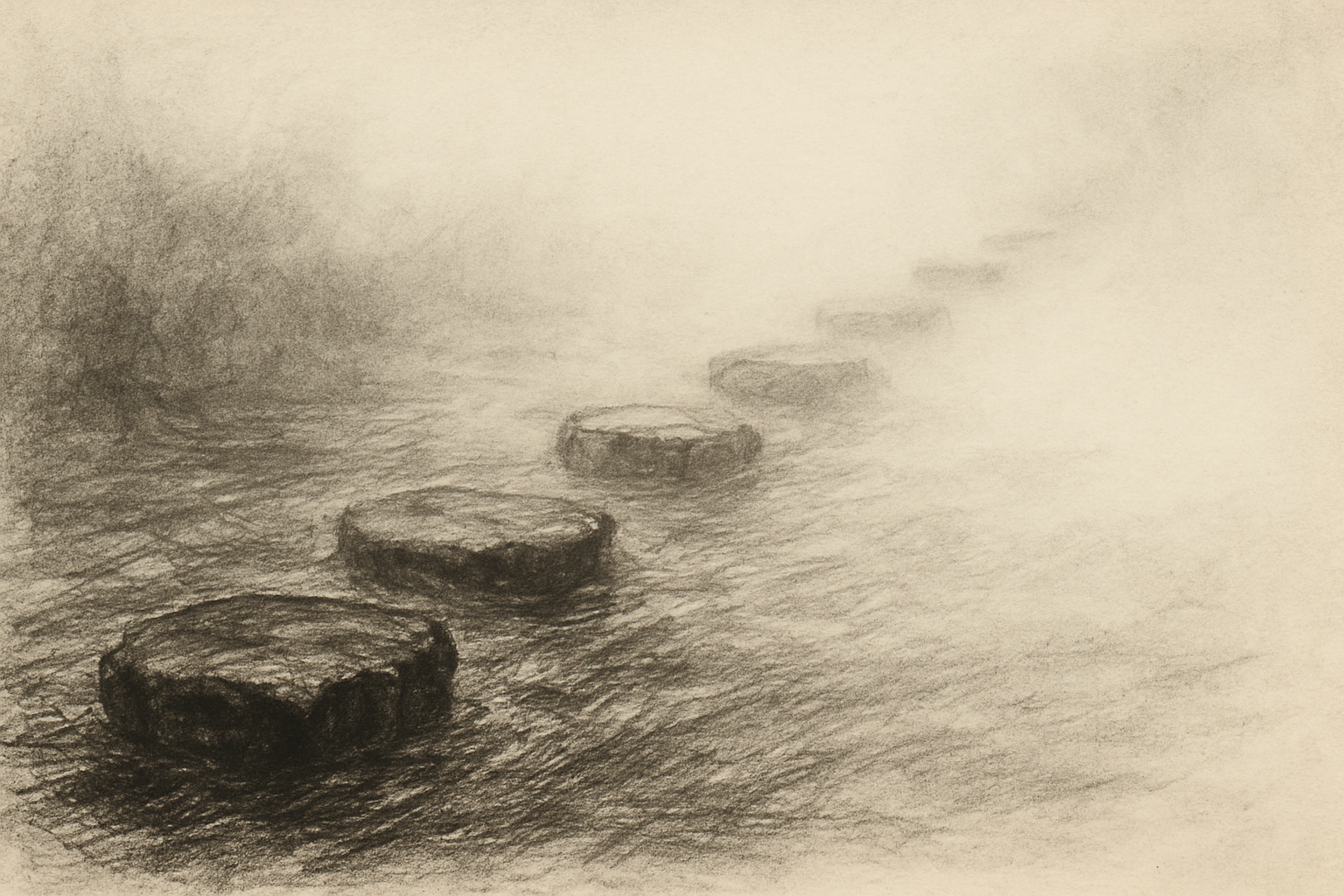
The Subtle Leaping Toward What Comes Next
El Sutil Salto Hacia Lo Que Viene Después
A question about the nature of resistance as separation, and the subtle, nearly invisible dissatisfaction that takes the form of constantly waiting for completion.
The Subtle Leaping Toward What Comes Next
A question about the nature of resistance as separation, and the subtle, nearly invisible dissatisfaction that takes the form of constantly waiting for completion.
Is it that the concept of resistance requires there to be two things, like me and a hostile thing, whether it's a person or a feeling? And that the misinterpretation is that there are two things in opposition to each other? The concept of resistance relies on there being a separation.
A separation, yes, and that makes something into two.
The box of blue beads
Imagine you have two boxes of beads. Let's play with the Matrix metaphor: red and blue. You look at the blue box, grab a blue bead, and say, "I don't want it. I don't want the blue bead." You grab another one. "I don't want it." And another. That's resistance, because there is something that is happening, and then there is this experience of, almost like a choice: "No, not this." As if you could say no to that which is already happening.
This is why I use the example of saying no to the sound of my voice. I'm going to keep talking, and you can't cover your ears. Say no to it, decide with all of your energy to deny the experience, and I keep talking. It's going to drive you mad. How much energy is that going to take? And this is how we live with everything we're experiencing. There's a "no," sometimes subtle and sometimes not, to something that's already happening. It's not going to happen; it's already happening. It is present in your awareness.
We believe that by saying no, which is what happens when you grab the blue bead and look at it and say, "I don't want it, it's not what I wanted, I wanted red," we can refuse what is already here.
Creating the experience and refusing it at the same time
That metaphor also points to something even more difficult to talk about, which has to do with the fact that we're actually creating the experience we're having and then saying no to it. We're creating the illusion that, at the same time we're creating the experience, we can struggle with it and create suffering, and then think the suffering is happening to us without our control. We're doing all of it.
The "we" I'm referring to is not the "we" you might think of as yourself. The "I" I'm referring to is the same "I" that you refer to as "I." There is not your "I" and my "I." But take this just as words, because it's very hard to describe. The important part right now is the experience of resistance and its nature.
I'm sure a few of you experience some humor in this, a recognition: I'm experiencing something, and that which is actually happening right now, I'm saying no to, as if there were any possibility of denying it or changing what is happening right now.
The drama is most of the pain
Even something simple: you kick a table and hurt your toe. What happens then? For me, there used to be a lot of cursing, and even hours later, "If only I had not done that." So much frustration and anger at myself. And that ended, from one day to the next.
But the insight is this: it was as if by creating all that drama, I had some control over the pain. Actually, the drama was ninety-eight percent of the pain. The direct physical sensation of pain, without the drama of "how horrible this is, how shitty this is," plus "how stupid I am, how dumb what I did, I can't believe it," and all the guilt and self-shaming: all of that was turning a sensation, which could simply be, "Wow, that's a really interesting sensation of pain," into suffering. That's a simple, obvious example, but this is happening constantly.
I remember it used to happen every waking minute of my life with anything that was happening. And if there wasn't anything happening, I was imagining it. I was expecting it. I was thinking about what could happen.
Surrender is something that happens to you
There's also this business of "surrendering." Nobody surrenders if they can avoid it. You only surrender when you literally can't do anything else. In that sense, surrendering is something that happens to you.
I know the metaphor from war, where you're the captain of the army and you make a choice. That's not what surrendering in this work is. It's more like acceptance. You cannot do it; it's going to happen to you. It's like being surrounded by thirty SWAT officers while you are untrained and unarmed, and they put you to the ground. That's when you surrender.
What happens in that moment is you get to see that that which surrenders, or is surrendered, isn't real.
There are many metaphors for this. I just mentioned the Matrix. In the film, it is very clearly depicted. Neo decides not to run. He turns to fight the agents. The agents represent fear. You think he's going to defeat them, and he does manage to fight one of them. But he's still trying to escape. Then he loses. They catch up to him and put three bullets through his chest. That's when he surrenders.
I have a question about something I noticed throughout the meditation. It may be related. Things have become so subtle in my experience. Right now nothing dramatic is happening in my life, so there's no big resistance to speak of. But as I was meditating today, I realized there's this subtle sensation, something like "this is not right," or "this is not the right experience." It's so subtle I couldn't even call it suffering. It's just a quiet discomfort.
As I was meditating, I was realizing how much of every breath contains that, and how much of it is a state of waiting, a kind of fake waiting: "It's not right now, but it will be next." A constant leaping toward completion. Because what is not happening right now is a complete satisfaction with what is.
During the meditation I was noticing: if I come back to my breath, and I know this sounds like "meditation 101, come back to your breath," the breath is the anchor to the present. But there is this subtle sensation. So my question is: is that a very subtle form of resistance, and is its form the illusion of "it's coming next"?
All hope is false hope
It's hope. I would say all hope is false hope. I'm distinguishing hope from faith or trust when I say that, because hope, to me, only exists in time.
Now, one thing: don't throw the baby out with the bathwater. What you're looking for, which is complete satisfaction, that's the baby. If that goes out, you can enter into nihilism. That longing for complete satisfaction should stay alive.
Sorry, what did you say should stay alive?
That looking for complete satisfaction. Whatever shape you're imagining it to be, it won't be that way. It's not going to come in the shape you imagine. That is always false and wrong. But know that there is something calling you that is true, deep, and worth listening to.
Where you're looking versus what you're looking for
Now, the hope is creating time. There's a sense that you're waiting for something to happen, and that tempts you to look for it in imagination. But you don't realize you're looking for it in imagination. You think you're looking for it in reality, which is in time. And it's not there. The subtle mix is: it's not where you're looking for it, but there is something you can find.
That resonates. In a way, I know what I'm talking about. I think you're right that I don't know exactly what it is. But I know, for example, when I was walking in the streets of Paris, that dissatisfaction wasn't there. I wasn't looking anywhere else for anything that was lacking. It was just right there. I wasn't even asking myself. But I also know there are many moments where it is there. During the meditation it was interesting because it was so obvious. It was like, "Stop leaping and just breathe." And in the breath there is the completion. But yes, I appreciate what you said, because there is in me a very subtle sense of dissatisfaction, a feeling that something is not complete.
You just need to clarify, more and more, the difference between thought and not-thought. When you see that more and more clearly, you will not be able to be tempted to find anything in thought. And then you will only look for it where it is, which is in what is not thought.
Hope as a lack of faith
I was thinking about hope as actually a lack of faith, because if you're hoping something will change, it means you don't have faith in the way things are.
Yes, that's coming close to it. I usually use the word "trust" because "faith" is so full of religious connotation. The way faith has been weaponized by Christianity and Islam, it becomes "you have to believe these scriptures." For me, faith and belief are opposites. But it's been weaponized as: "You must believe what I tell you to believe, and that is faith, because you have faith in me." If you truly have faith, why would you need to believe anything?
What I say, I always try to repeat: take this not as something to believe in, but as something to see. Find what it points to in yourself. Because if it becomes a belief, a concept, or a borrowed reality, it's very toxic, even if it comes from me or from any other teacher.