The Moon Is Always Up
La luna siempre está arriba
A student asks about maintaining a sense of stillness during busy, active life, and the teacher explores why stillness cannot be recreated by the mind, using the metaphor of a moon reflected in a lake to point toward direct recognition of our true nature.
The Moon Is Always Up
A student asks about maintaining a sense of stillness during busy, active life, and the teacher explores why stillness cannot be recreated by the mind, using the metaphor of a moon reflected in a lake to point toward direct recognition of our true nature.
I like this idea that that which is still is always still. I've heard sayings about stillness in motion and motion in stillness, and I feel like I've had moments of feeling and understanding that. Yet I find difficulty maintaining that sense of awareness when I get busy, social, caught up in problem-solving, or moving fast.
The biggest problem is that I'm using words, and you're referring to other phrases and words that point to this, but the words are actually quite wrong and inappropriate. There isn't actually anything that is "still." There aren't better words, because when I say "what moves moves, and there is something that remains still," it's actually not true. There isn't anything that stays still. Anything that we experience always moves. So when we hear those words, we're going to try to find the thing that is still, and it's impossible, because it doesn't exist.
There are infinite ways to try to point to it, some better, some worse, some more appropriate in the moment, some more tactful or intuitively fitting. The problem is that the mind can only look for more thought-things, objects, concepts. When we hear those words, those words go through the mind, and the mind is going to look for "what's the thing that is still?" It will look in the only place it knows: the world of thought. The mind cannot represent anything real outside of itself with anything other than more thought.
The mind trying to preserve stillness
Then the problem is this: you will have a taste of it. You will intuitively recognize, "Yes, there is something; I know what you're referring to," whether you've noticed it spontaneously or through practice. And then you're going to try to keep that stillness more permanently. The mind is going to do what it does: try to create something. It will use a memory, a representation of stillness, and try to recreate and preserve it. All of this is quite futile, but it's important to talk about so that it's clear what's happening.
A different way to point to it, given what you said about being busy and problem-solving: when there's a lot of movement and you're trying to find the stillness, preserve it, or recreate it, notice that it can't be done. The stillness I'm referring to is already there, always. The sense that it's gone is an illusion.
By trying to recreate it, do you mean recreating your mental model, or trying to recreate from a mental model the taste of that essence?
The moon and the lake
Yes, a taste of stillness that you experienced spontaneously in the past, or maybe through practice, but that is not naturally arising or coming into your awareness in the present.
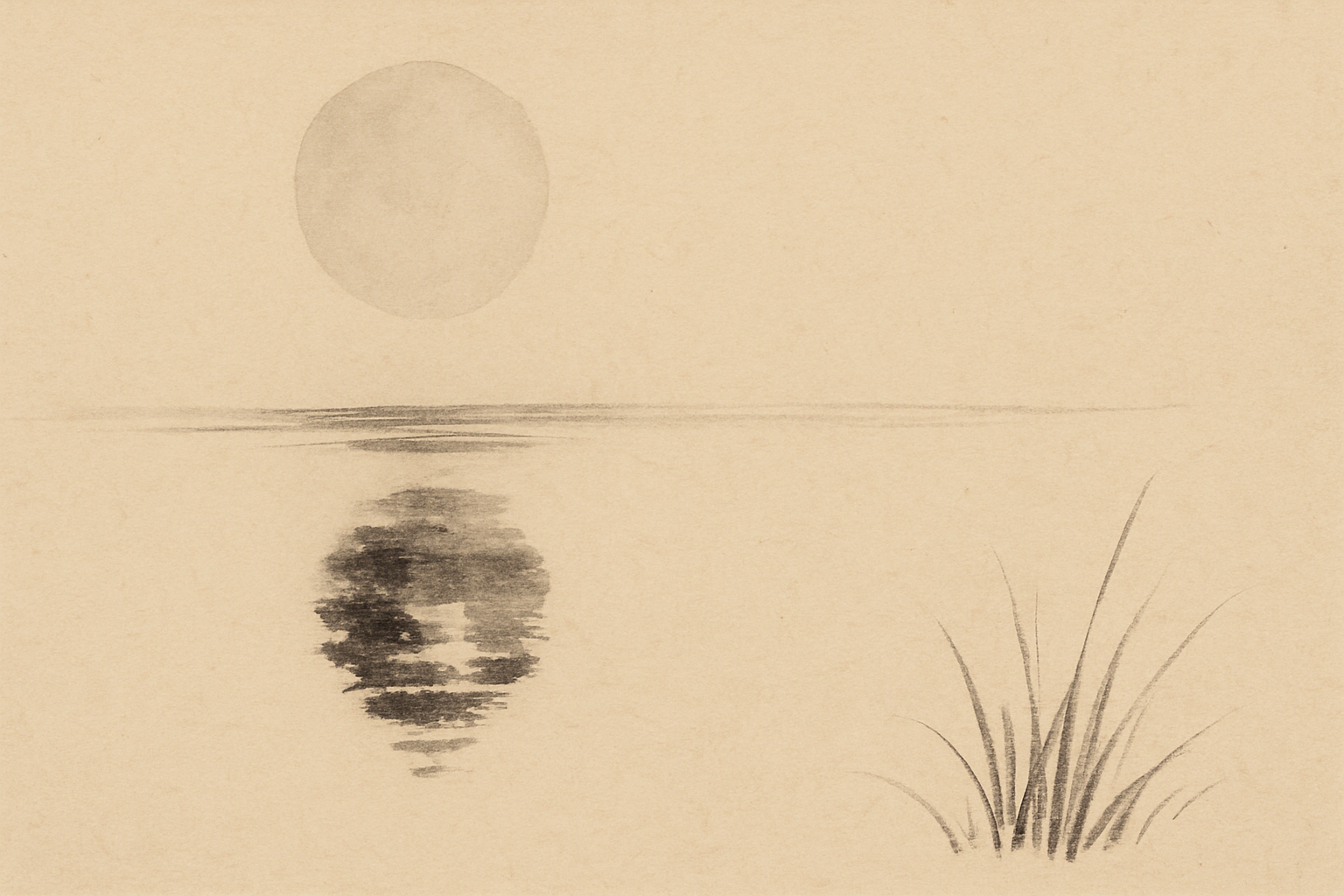
I'll use a metaphor. Imagine that I'm pointing to the moon. You look, but you look at a lake, and on the surface of the lake there is a reflection of the moon. The lake has waves, so at times when the lake is still, you see a better image of the moon. Then you think, "Oh, I know what you're talking about. I've seen the moon. That's the stillness." But you haven't really seen it. Once you truly see the moon, you can't unsee it, because it requires a kind of looking up in a way you haven't before. And once you do that, the moon is always up, always full, and it never stops being up and full. It's always visible, always available.
But until then you're seeing the reflection, and the surface of the lake is the metaphor for the mind. When the mind is a bit more still, you have a taste. Then what we try to do, once we have that taste, is to calm the lake, because we've associated the calmer mind with that stillness, that sense of subtle satisfaction when something really deeply is satisfied. There is a taste of presence or stillness, and when we taste it, we know that's what we're wanting. We want more of it. But it's not a thing we can gain through more quantity or more states.
You could extend the metaphor and say, well, sometimes we looked up, but we saw it with one eye closed, so we don't totally see it. It's a partial, direct glimpse. Then we forget how we did that, or it happened spontaneously, through grace. But what I'm pointing to is this: the moon is always up, always full, always in plain sight.
You can't not be what you are
Another way to make it less abstract: the moon is the true nature of what we are, and you can't not be what you are. You can think you're something else, because you're seeing yourself through a reflection in the mind. Then we try to manipulate the mind, to coerce it into a more preferred state. It does help to calm the mind so that the reflection is clearer. But if we confuse those tastes for the real thing, we will think it's all about the mind, that it's about a state, that it's about experiencing something. In fact, it's a recognition of something that's true and real. Not true in intellectual ways; it's what's real. And what's real is already real.
If you have gone through the process of noticing something in the water, then looking at it for a while and seeing a round object, then watching the waters get still and seeing it more clearly, then spending more time with the reflection, at some point you think to look up. It starts to become clear that you're seeing, tasting something, but not directly.
Tastes of presence through life
It will happen in many ways. It will happen spontaneously. We all have memories from childhood when something just felt so intimate and close and good, and there was this pure, open innocence and beauty, and everything was just divine. We might not all have that memory, but it's a common thing to have such moments in childhood, before the mind got too developed.
Then we will have tastes of that spontaneously in life, when something goes well and we let our mind rest. We have a taste of it, but then we interpret that we tasted it because of what happened, instead of realizing we tasted it because we let the mind rest.
Then we can learn about spirituality in all its shapes and forms. We're going to taste it through books, teachers. It's going to be transmitted through words or presence, but still it won't be direct. It will have this reflective quality. All of this is very positive.
The leap beyond reflection
But at some point there is a kind of leap. That which you've tasted, that which you've known to come from various sources and experiences in life, relationships, and teachers: there is a leap where something becomes unsatisfying in finding it through this transitory, reflective nature. You start looking, you could say, within, more deeply. There is an end of the projecting of it onto a mental state, a person, an experience, or a situation.
And there is a loss there, because there is almost a romanticism in tasting this through experiences, relationships, and mental states. That romanticism goes through a disillusion. This happens very powerfully in people who are very religious and experience the loss of God. St. John of the Cross called it the dark night. That's when someone on the religious journey, who tastes the divine through the image of God, reaches a maturing where that no longer satisfies. It's not enough. The object of God comes to its useful end, and it's experienced as a loss.
Those who are not religious will experience it differently: that which drives your life, the experiences that motivate you to keep searching, begins to lose its satisfaction or appeal. The same could be true of a spiritual practice, meditation, religious affiliations, hobbies. It could be soccer, or alcohol, or sex, or chess club. At some point you come to realize that whatever framework or belief you enjoy matters, those experiences don't need to change, but there's something you're tasting there that is what you're really looking for. You can start to realize it's not in the experience.
Usually what we do is reinvigorate the search. We try harder. But we haven't realized we can taste that directly, because it's always present. And it's not a thing that is present; it's the nature of presence. It's the nature of something that already is.
I'm thinking of a mantra meditation I did once: existence, consciousness, bliss. I don't know if that was a taste or what, but there was something in the nature of just that simplicity, that sense of "you are it." It's that basic and that simple, and also that expansive. There's a liberty in that simplicity.
Satchitananda: tracing back to the source
That comes from Hinduism. The full phrase is nama rupa satchitananda. Nama rupa is name and form; satchitananda is existence, consciousness, bliss. You could think of it as a description of reality, both philosophically and as something that can be realized.
You begin from bliss, from peace, from well-being (different words for it, because ananda doesn't translate well to "bliss," which is known more as a very exalted state). You could think of it as a very subtle, deep satisfaction, a peace that is completely incomprehensible but more present than anything else.
From there, one step removed is consciousness, the knowing of it. You could say it's the essence of consciousness. Because there is consciousness, there is experience; there is existence. That's sat. And then the experience we see as forms, sounds, sights, sensations, perceptions, bodies, objects. Then we give names: a person's name, "computer," and so on. That is nama rupa satchitananda.
In a sense, what we want to do is trace our way back to the source. Usually we're relating to names, to mental maps of what things are. When we hear the sound of a bird, we relate to "bird sound." When we pay attention to our breath, we relate to "breath sensations." As we are able to become more intimate with the direct, raw experience, the name falls away. We can have this intimacy with the sensation of the breath, or there is a bird sound and it's no longer a bird out there. It's just this experience of the texture of the sound of the bird song. Now we are in direct relationship to rupa, which is form.
We can then look at that which knows form. What is it that knows sound? And this is actually not separate from the sound, because there is an imagined perceiver of a sound. When we become really intimate with that sound, we're able to notice that there aren't two: there isn't a perceiver and a sound, a thinker and a thought. Here it becomes difficult to describe. From here we move from the knowing of experience to consciousness itself. Chit.
I was trying to think of ways to get a better sense of this non-duality. I remember in school writing a paper on pheromones and learning about ant colonies and emergent intelligence, where together ants can source really efficient paths to food and build complex colonies, doing complex things beyond the intelligence of an individual ant. I remember having the feeling that this is some aspect of what people talk about when they talk about God. Ants don't really have a choice; they're just born into it and they're part of this emergent intelligence. Whereas humans somehow develop the capacity to identify as individuals and think for themselves. I'm not sure if this is helpful, but the question is: do you get a better sense of non-duality, of being part of not only the colony or the culture, but the environment, everything that supports it?
Freedom, consciousness, and the nature of choice
It's relevant, but when you say ants are like this and humans are like that, as if humans have, just for being human, choices that ants don't have, I disagree. If you believe yourself to be only human, you sacrifice your free will. It's a free choice to do that, so the freedom is always available, but you basically delegate your choosing to the human animal. The body-mind, the human animal, doesn't choose. What can choose is what we truly are, which I can only really define in negative terms: I can define it as "not human."
In that sense, I am alluding to what has often been called God, but the word is so problematic that I won't use it in this context, because it defines that which I'm referring to as a thing and gives it properties and a lot of ideas. Only that can choose, that in us. You can say consciousness; only consciousness can choose.
And consciousness chooses in exactly the same way it always does, which is a mysterious way. It's hard to deny that choices do happen. But the problem is when we think we know what a choice is, what choosing is, and what "I" am. We can have the sensation of choosing, but we have delegated the choice process to mechanistic body-mind behavior.
The metaphor used often today, because of the ubiquitous nature of computers, is that we are like machines. But the machine nature of the human body-mind doesn't choose. The consciousness that we are can choose and always chooses, but sometimes, and often, the choice is to not choose: to remain in automatic.