Stepping Into the Void Without a New Paradigm
Adentrándose en el Vacío Sin un Nuevo Paradigma
A question about navigating the fertile void between old habits and the unknown, and how to work with planning, surrender, and fear in that open space.
Stepping Into the Void Without a New Paradigm
A question about navigating the fertile void between old habits and the unknown, and how to work with planning, surrender, and fear in that open space.
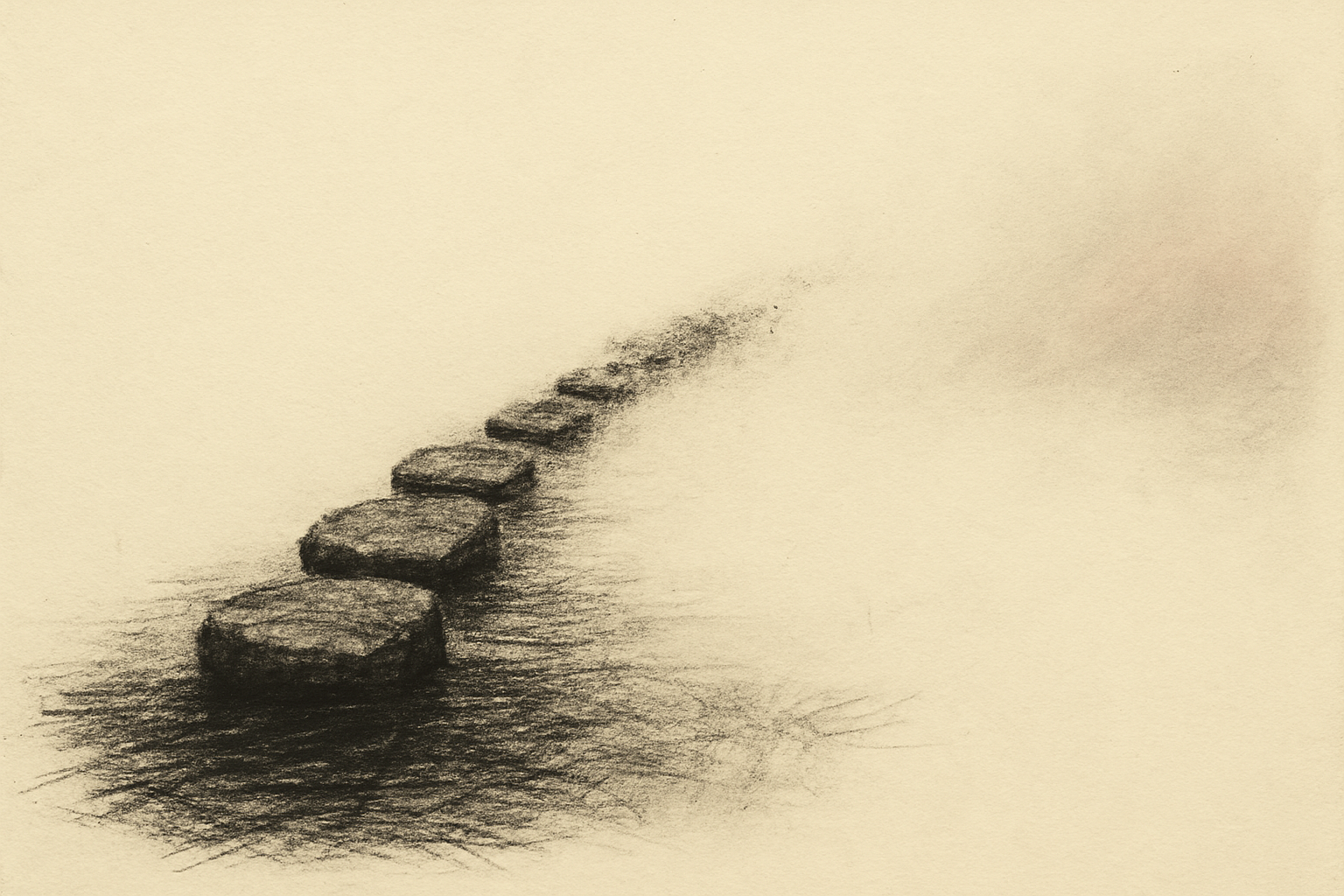
It's like stepping away from the old paradigm without there being another paradigm. And so that void: is there a very conscious awareness there, rather than… someone once called it the "fertile void." There's something there, but because you can't see it or understand it, you have to trust that something will appear.
Exactly. My teacher called it the void of all possibility, which is this fertile void.
And there's this dance between letting go, surrendering, and waiting on the one hand, versus actually planning and structuring on the other. But I suppose, as you say, it's all about what's happening right now. Perhaps right now is to plan, and perhaps right now is to wait and allow.
The planning itself as spontaneous arising
Yes, and the planning is not really a matter of choosing between one option and another. It's more about seeing the planning itself as a spontaneous arising. The less you try to frame it, the more you realize: it's not about planning or not planning, because that is just trying to fit things into a new paradigm. "Now the new thing is: I don't plan." But that itself is a paradigm.
So often, when we come to this void, we can't see it and integrate it fully all at once. It's too much. Instead, we upgrade our paradigm to align it more closely with what we've glimpsed, but in a way that's manageable. We keep upgrading, step by step, so that we can gradually touch that voidness and be with it.
It's appropriate to say, "I'm tuning my paradigm so that it's more in service to, and aligned with, what I've understood of myself and reality." Because it's pretty hard to just fully throw out all paradigms, look straight into the void, and come out on the other side. It happens to people, but it's very challenging. It can be very shattering. And I don't think that's where you're at, or what you're describing. You're describing a movement into the unknown.
Working with old habits
So regarding planning and not planning, see it in terms of what feels right in this moment. What should I plan? What should I not? Look at the old habits, the habitual ways of functioning, and make room for something new. If in a certain situation you're used to heavy planning, now you can look at it and ask: is it really needed? What if I plan less in this situation? Oh, it's scary. Interesting. Go into that. Vice versa: if you're used to not planning, because that too is a habit, then ask: what if I plan this? Oh, that's uncomfortable and not my kind of thing. Well, go into it. Try it out.
So what feels right in the moment might actually be the default, comfortable thing rather than the right thing. Because the other direction feels scary, you might end up doing the habitual thing.
Fear howls, the heart whispers
Yes. The direction where there is fear, approached with discernment, is most likely the right thing. Where we realize there's fear in a certain direction, go in that direction, but always with discernment. Discernment will sometimes say, "This is an unnecessary risk." There are obvious examples: I'm afraid to jump in front of a moving bus. Well, that fear is appropriate. But much of the time, the fear that keeps us in the trap of the known is exactly what this work is here to break free from.
My teacher once gave a talk and spontaneously said a phrase that became the title of a book. In English the translation is less poetic, but it goes: "Fear howls, the heart whispers."