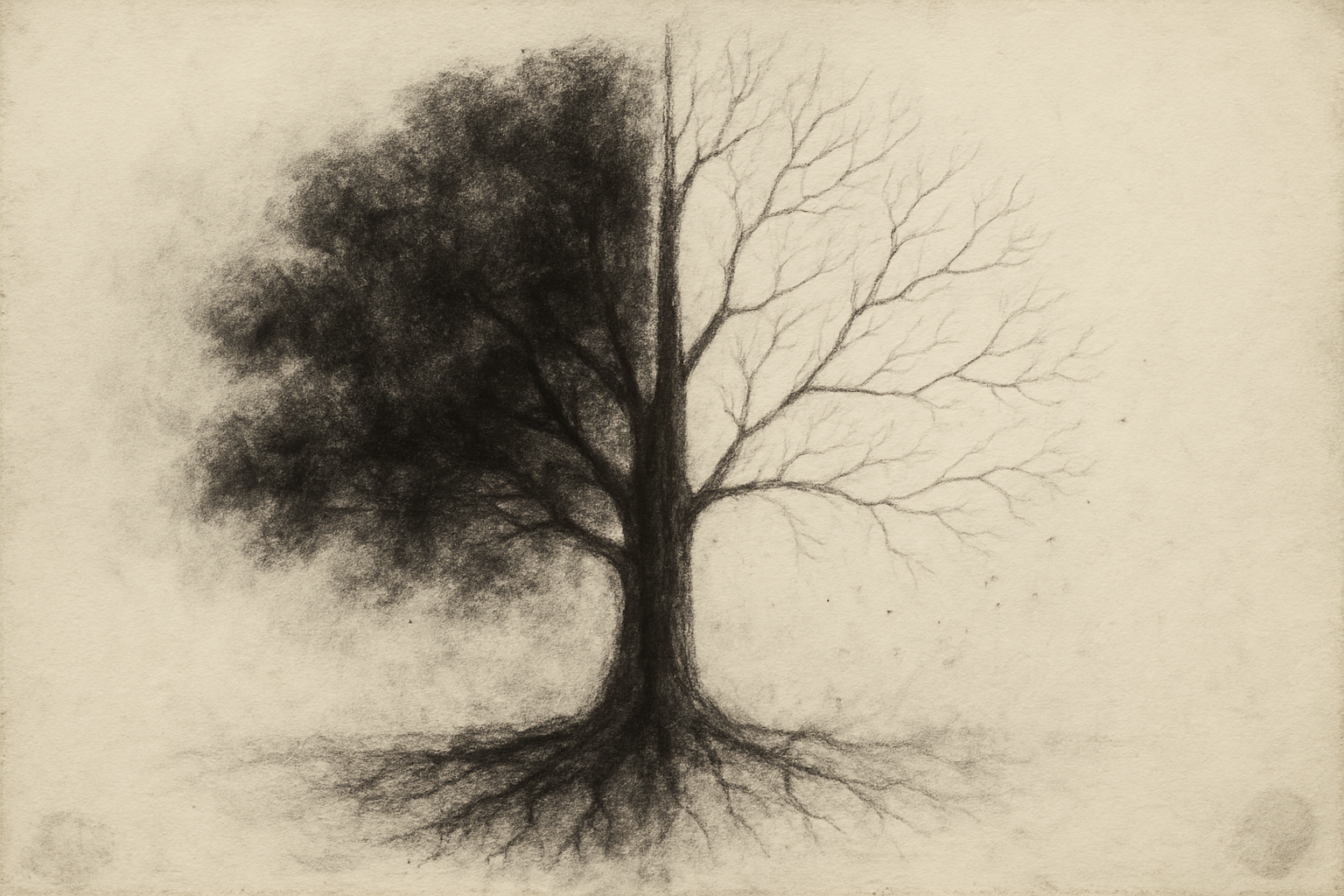
The Two Deaths
Las dos muertes
A student reflects on the mind's compulsive drive to map and systematize the path, and the teacher explores why we constantly chase: to escape a death that is already happening in every moment.
The Two Deaths
A student reflects on the mind's compulsive drive to map and systematize the path, and the teacher explores why we constantly chase: to escape a death that is already happening in every moment.
I'm trying to take in what you're saying and make a map of it.
Exactly. Trying to find a way to put it in a system, something you can place in time and work towards. That's not your brain; it's your mind.
It just never stops.
It doesn't. And more specifically about that: just knowing that this is what the mind is doing matters, because there are two options.
The agreement with the mind
One option is that you fully buy into the promise of the mind and create an agreement. You go to the mind and say, "Please fabricate a future I can chase." And the mind says, "Here, chase this. It's going to get you there. Isn't it great?" You say, "Deal," and you sign the contract. Then off you go. It's a constant negotiation: "Well, that didn't work." "But hey, look at this!" "That didn't work either." "Oh, look at that." It runs twenty-four hours a day. This agreement is rooted in fear. It's an agreement based on: don't look at what's actually here. Just don't look. Chase this.
So what I'm pointing to, which you said sounds fun, is a bit dark. Because from the perspective of being immersed in that process, all of what we've been working towards is not going to work. And what it will take is what I described as the body experiencing a shock, as if it's dying.
Two possible deaths
That's exactly why we chase: because right now there are two possible deaths. And it's the same death, but one can happen before the body dies.
One death we try to escape from is the body dying. We cannot tolerate that, so we chase, and chase, and chase. The other is the death of that which I think I am: the ending of that belief. And that's just as scary, because the mind cannot tell the difference between the body dying and that sense of "I" dying, ending, or even pausing.
Are you saying that we're constantly trying to escape that death?
Exactly that. And what it actually is, is literally just the body-mind having a bit of an intense tantrum. But to us, it feels like the end of the world.
You've spoken about this many times, and I always thought it was just some sort of event that may come. But now that you say it this way, I see it as something that's happening all the time.
All the time. Now. Now. Now. And that's why it's really hard to sit and be at rest, to meditate, because if you're not energizing that activity, this anxiety is going to start creeping in.
Yes, it's always available.
Drives and their limits
From a psychological perspective, I think what we're talking about is drive, or will. There are many psychologists who each focus on a different type of human will or drive, and they all claim that theirs is the primary one. But I think they're all there, all important, and exist on a spectrum. Some that come to mind are the survival instinct, the sex drive, the will to superiority, and the will to meaning.
I think what the teacher is saying is: if you can go to that completely direct seeing of what's really happening, that's obviously in a sense the most true. But if you start trying to navigate in the moment, asking "what is this drive, where is it coming from?" and observe it in a more granular way, it can help.
They go roughly in that order, and they're all important. But if your survival instinct is kicking in when you're, say, talking to your son's teacher, and your life is not under threat and neither is his, then you can recognize: "That's what's driving this behavior, and it's not reasonable. So what's going on? Why am I feeling threatened to that level?"
The one jumping to mind for me is the will to superiority. That's a theory from the psychologist Adler. He posited that the will to superiority was a very positive thing for human beings. It basically means doing your best to become better and better in your life. Becoming a better tango dancer, for instance, is a genuinely positive thing. But the will to superiority, when it's out of balance, becomes addictive, because it's taking you away from some feeling you don't want to feel: the shame, or the terror of nonexistence that the teacher is pointing to. That's when you get this compulsive quality of "I have to be good all the time, I have to be amazing, I have to be the best." It becomes constant, and you lose track of what it's all for.
One of the best ways to settle that is to look at the will to meaning: what is meaningful to you, what actually matters to you. Then that addictive "I'm not good enough" drive can settle a bit. But some of what the teacher is bringing actually undercuts even the will to meaning. Because what is the meaning of all this? We actually have no idea.
Beyond life and death
What you're saying about meaning touches exactly on what I said at the beginning: that we can have a movement from this idea of what I am, which is limited and based on fear. Or we can have a movement based on what I call "what does the universe want as you?" That points to a kind of meaning that goes deeper, because it asks: what is so meaningful, so valuable, that it's beyond life and death? That it is almost more valuable than staying alive?
I don't think I've experienced anything to that level.
What about your son?
Wouldn't you give your life for your son?
I haven't really thought about it, but yes. Of course.
Something that is more meaningful than your own life. That's so real, right now. And he's not the only thing.