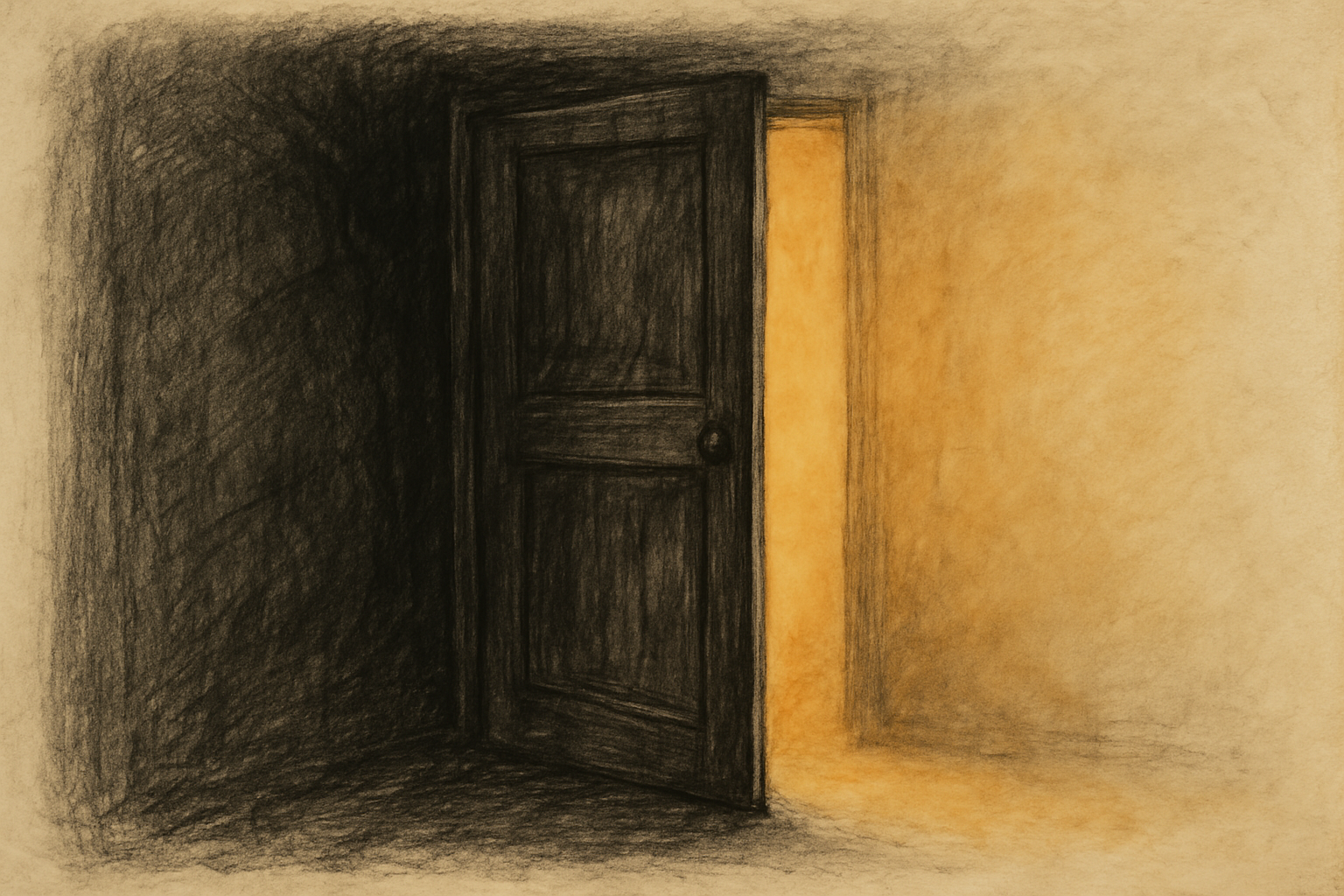
The Door to What Feels Unsafe
La Puerta a lo que se Siente Inseguro
A student explores how identifying with smallness and insecurity has become a comfort zone, and the teacher points to the difference between false safety and true safety.
The Door to What Feels Unsafe
A student explores how identifying with smallness and insecurity has become a comfort zone, and the teacher points to the difference between false safety and true safety.
There are some inspirations from what we've talked about. What's normal to me is feeling small, caught in this victim identity, very insecure. Sometimes I wonder if that's also my comfort zone.
One hundred percent.
There is a very powerful and angry side in me, and it scares me a lot when it comes up.
The vulnerability beneath the smallness
That smallness, that insecurity, could have an aspect that is real, in the sense that the one seeing it clearly would recognize it as a kind of vulnerability. There is a preciousness to it, a delicacy. But it is so vulnerable that we wrap it into smallness with a narrative of "not good enough." In a sense it's somehow related, it fits, but the narrative is a complete distortion of what it actually is. That narrative is self-involved, self-created, self-hypnotic.
Because you're mentioning it, you're already seeing it. I'm simply confirming. Very, very likely that's what it is. As you discover this and begin to express it, things will start to shake up and good things will happen.
I get it, though. It's scary, because that smallness is where you know yourself to be, and it's ending. It must end. You cannot sustain it much longer, because it requires so much energy and creates so much friction with everything.
This feels new and unsafe.
True safety vs. false safety
Unsafe. I understand. What I can say is that true safety lies in the direction of what feels unsafe when you're living inside a false safety. When our sense of safety is conditional on our state, our story, and our emotions being a certain way, that safety is not very safe at all. It is conditional and transitory, always under threat. I need to keep an emotional and mental state arranged in a particular way for safety to be experienced.
True safety is not conditional. It does not depend on situations, context, states, thoughts, or emotions. But in the transition, if we want to discover true safety, we must go toward what feels unsafe.
The Truman Show door
If my words aren't inspiring enough, you can look at stories and myths. They all point to this. Think of The Truman Show. Where the movie ends is exactly this: he's standing at the door, and he says, "Okay, I'm going through." That door is perfect, because it really shows the complete unknown. But it's reality. He has crossed his biggest fear in order to get the opportunity to cross the door, and right at the door, the biggest temptation to go back appears: a voice telling him, "You're safe here."
Thank you for sharing.