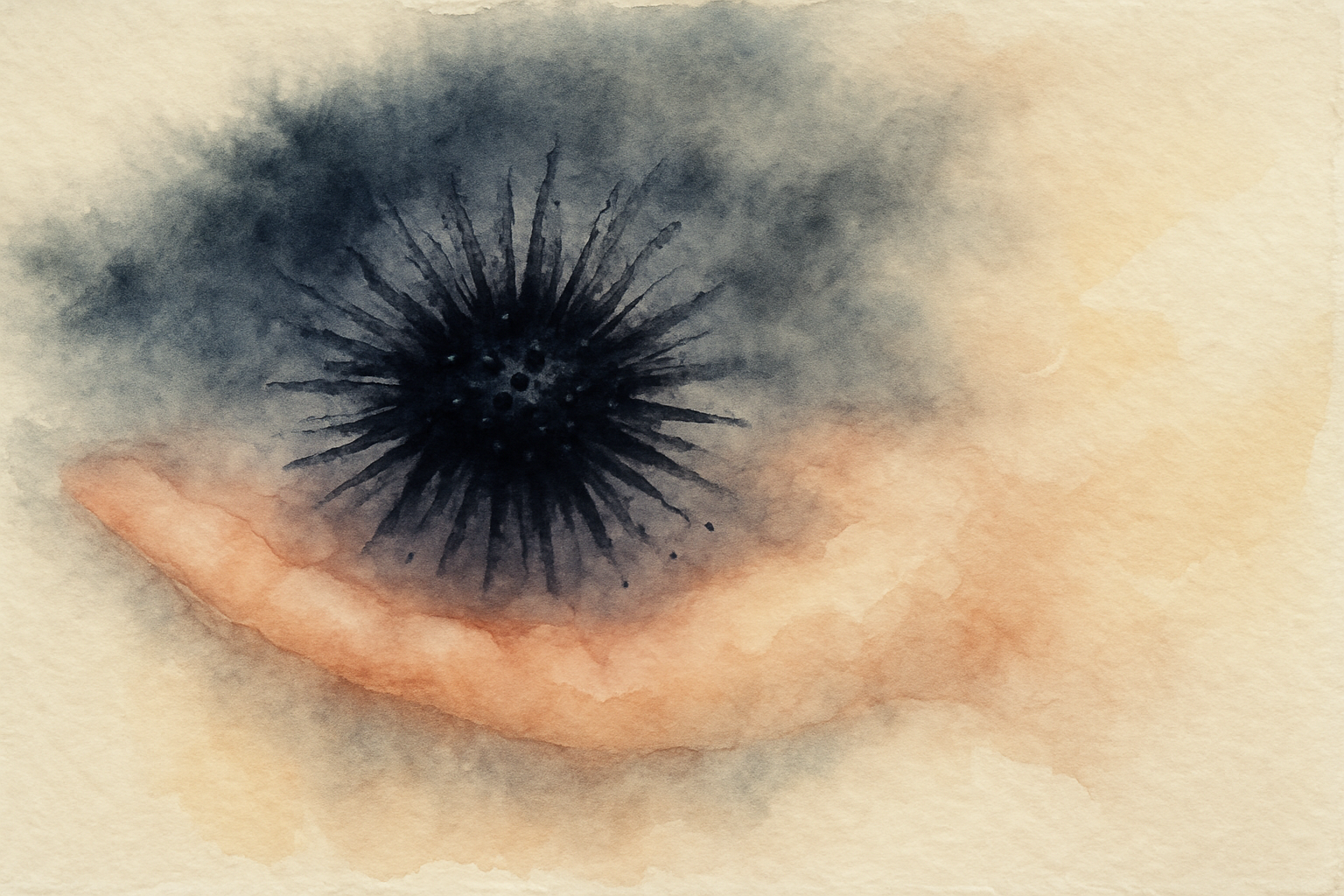
The Sea Urchin and the Spell
El erizo de mar y el hechizo
A student describes a painful sensation encountered in present-moment awareness, likening it to holding a sea urchin, and asks whether the root of this pain is the belief that one is a body inside an external world. The conversation expands into how we choose our suffering out of love, and how seeing that choice clearly can dissolve the spell.
The Sea Urchin and the Spell
A student describes a painful sensation encountered in present-moment awareness, likening it to holding a sea urchin, and asks whether the root of this pain is the belief that one is a body inside an external world. The conversation expands into how we choose our suffering out of love, and how seeing that choice clearly can dissolve the spell.
During the meditation, a mix of sensations, thoughts, and intuition came up. There was this sense that certain things in the present moment feel as if you're holding something painful. The image that came was of holding a sea urchin: you have to get used to holding it. And at one point it seemed as though the ultimate sea urchin, an almost constant pain, is the idea that I'm a body inside an external world. It sounds so impractical, though. How can you live without the idea that you're an autonomous body inside a world?
I agree that it's about holding that pain. What you're calling the sea urchin is something painful, and that's what happens when we bring our attention to the present moment. We get in touch with what is happening now, the very thing we've been trying to escape.
The only way we can escape is by contracting into thoughts. We constantly employ the strategy of imagining that when we get somewhere, whether in one minute or ten years, things will be better. All our energy and attention contracts into that thought process. It's very addictive, and it's constant. It's all about imagining something different from what is now.
Seeing thought as thought
When you look at that strategy and recognize it for what it is, only one thing can happen: you automatically start coming into presence, because you begin to see thought as thought instead of seeing thought as reality.
When we imagine the future, it starts to become real. It's like watching a movie and forgetting that it's a movie. You enjoy it precisely because you forget. With a movie you don't completely forget, but with thought you can completely forget that it's thought. It becomes reality. The future becomes reality. Whatever you're imagining becomes reality. And it's a constant effort to fabricate in our imagination a reality that is better, one we will get to, one we will find a way to create. All of it is a contraction away from what's happening now.
What you're describing is exactly that: getting used to a certain kind of pain that is present. Just to generalize, there is something very uncomfortable. The more we see that we are completely immersed in fantasizing, strategizing, and efforting to get somewhere, the more we start getting in touch with that pain, with what you're calling the sea urchin.
The pain beneath the strategy
As you get used to that, as it becomes something you don't need to run away from, then you can think about the future while knowing you're thinking about the future. You can function in a much more appropriate way. Because when we create a future that becomes reality and tune out the present moment, we disconnect. We suppress our pain. We suppress whatever is happening that's uncomfortable. At the core it's going to be a kind of pain, but on the surface it could be discomfort, boredom, anything we want to fix. We think we'll fix it by getting to some future thing.
If I'm hungry, I can eat. But there's something deeper, which is what you're describing: a deep pain. And it has to do with what you said about the belief that you are inside this body in this world. The problem is not the idea. The problem is the belief.
You mean the belief that the idea is reality?
Yes. And the problem is that you won't really know you believe it while you're believing it. It's not like believing or not believing in God. It's not like that. It's a functioning as if you know what you are. It's a deep sense of knowing what you are.
You can describe it, and obviously we talk about it: "I am this body. I am not that computer." If I say to you that you are that computer as much as you are the body, it will seem ridiculous. That's how deep the belief goes. Anything that becomes a knowing of what you are is going to create pain, because you are reducing what you are to something you are not.
Functioning without the belief
And to address the last thing you said: "How could I function without the idea that I am this body?" That is actually the only way to function, just knowing it's an idea. It's a thought that has a functional reason. But eventually you don't need even that, because when you're playing guitar, for example, you're not coordinating every single muscle. The same applies to functioning once you drop out of the belief in knowing what you are. It becomes like playing the guitar when you already know how. There is a flow.
When you say it's the only way to function, knowing that it's an idea, you mean it's the only way to function more sanely, without suffering?
To not be dysfunctional. If you "know" what you are, you will be dysfunctional in some form.
But what I was saying earlier is that this knowing of what I am isn't obvious. It's hidden. It's deep. Though we can talk about it to make it a conversation.
If you experience that you are that body and not what is around you, that is a belief. There's no reality to it. I'm saying that as a way to offer a kind of litmus test. You could think I'm saying something crazy, or you could consider the possibility that there's something to it.
I consider it and I intuit it, but I don't feel it.
The rope and the snake
It's not about feeling it, because you actually do feel it. You just overlook it. What I'm trying to point to, which is impossible to fully describe, is already here now. It's how things are now. Then there is a process of thinking that veils it. But it's veiled at the same time as it is seen.
It's as if you're looking at something directly, seeing it for what it is, and then there is a veil where it seems like it is something else. One classical metaphor is walking in a forest and seeing a snake, then getting closer and realizing it's a rope. You were always looking at a rope, but in your mind you were relating to a snake.
Right now, what you are experiencing, what you're feeling, is that you are the universe. You're interpreting that as being something really small inside a body, in a world of thought. But if you hear sound, it is inside of you, and you are it.
I've had glimpses of that.
The only obstacle is the pain and the fear, because there's a letting go of that belief, of that knowing what we are. In letting go, there's a transition that can be very scary and painful. There's fear that we won't be able to function, fear that we will die or go crazy. And then there's the pain when something we feel we deeply are dies. We are very attached to being small, to being contracted, to being in a state of struggle.
Somebody attached us to it.
It's not a curse. It's us. It's a choice made in freedom.
So what are glimpses, then? Just a temporary scene of that, and then going back to attaching to the beliefs?
It's like giving yourself a break so that you can go back to the struggle.
Sounds masochistic.
The beauty of the struggle
It is, but not really, because it's fun. The struggle, the drama, has a kind of beautiful intensity. That's why I say enjoy it while it's happening. Take your time. But what matters is that you know you're choosing it. That's what will make the difference. You're not cursed. It hasn't been done to you. And that's what we don't want to see, because it will end the party.
The moment you see so truly, so deeply, without a doubt, that you are creating it and choosing it, the party's over. You can't go back into the dream. Thinking you're not doing it, that you're not choosing it, is part of the spell. The spell is: "It's happened to me." Any form of sensing that it's happening to you without your choice or your preference carries a sense of victimhood.
I got really energized by this conversation. I was remembering how important it was, in relation to that sense of victimhood, to realize how much I love myself. I struggled for so long trying to get rid of something, as you describe, the dissatisfaction, the sense that something is not good. But what I actually wanted to see was that I love myself so much. Especially for someone as self-involved as I am: I am the one thing I have loved my entire life. I am the only evidence that I have loved something throughout my whole life. It was so important for me to see it from the side of love, because then I could see how it actually was. That was what I was afraid to lose. I truly am the evidence that I have loved, because I have loved myself all this time. I don't know if that makes sense, but in a way it was like seeing from the other side: not the universe imposing it on me, not just "we are creating it," but finding it through love.
Yes, exactly. That is exactly my experience. I wasn't verbalizing it that way, but I said "beauty," and there's something so beautiful in the creation. I look back at memories of so much pain and struggle, and there was something so beautiful in it. The beauty, to me, is equivalent to love. It's just so much love.
That's really nice, because it's also an interesting path of investigation. In my experience it was always about looking for the struggle, looking for the source of dissatisfaction. This was different: look for the love, truly, and then see how afraid I am to give it away. I'm attached to it. But first, look for the love.
Yes. And for you it's "first look for the love." For the next person, it could be "first look at how you are choosing it." But it's all a creation from love, including the suffering.
Every time you say that, my whole being just looks.
Freeing love from definition
And when you say "myself," just look at what that "myself" is, because there's been a real shift and a breakthrough in that love. Just keep seeing the definition of "myself," because that love can still grow. What grows is freed by releasing the definition of what you are.
It is interesting that you point to that, because I was also listening to the meditation and the conversation where you said to look at the difference between really knowing that I am here in this body and not the world. Lately my experience is very confusing. It's not that I can say yes to the counterpart of that. It's more like I'm not sure about anything anymore. It's not obvious to me. It's more of an "I don't even know" kind of situation.
For some people it shifts suddenly, but often, when that deep belief starts to dissolve, there's a state of confusion. At first it's horrible, painful, scary. Then it opens up the wonder of being. It opens up the mystery that is always here, the mystery that you are, that we are, that everything is. The mystery never went away. It's right here. It's always here. And it's beautiful. It's loving. It's infinite. And then we cover it. That covering is a choice, and it's not a choice. That's why when someone says "it sounds masochistic," I say no, it's not. There's a love there. There's a freedom there.
It truly is a party. There was a lot of movement in me as I was listening, so thank you for giving me the space to share.
Savoring the depth of hell
One way I can describe it is that I really, really wanted to know the depth of hell. I really wanted to savor and taste despair, pain, horror, misery, in my own way.
You wanted that when?
While I was experiencing it. I realized I really wanted that. And when I had enough, when I wanted to change the flavor of the buffet, it changed.
I really want to emphasize: I wanted to have the experience. I wanted the journey. I wanted to know. But it was a very deep, almost unconscious want.
The way I relate to that wanting is that there's a belief in it, something about life meaning something.
It wasn't based on a belief. It was based on love for the experience. A really unconditioned wanting to taste.
That's fascinating.
But I needed to not know that for it to be what I wanted to taste. I needed to not know that I was choosing it in order for it to be the taste I wanted.
I do have a memory of one moment when I sat with a lot of pain and realized something like that. What I had been desiring and wanting, it was as if I was willing to go through everything that came with a certain idea of what love was. I knew it would come with pain and suffering, but I was willing to go through all of it because I had this idea that this is what love is.
Strategies and their limits
That's the strategy, and it's unavoidable that we'll have strategies. Even with this work, being here, spiritual work, meditation, all of that is only valuable in a limited sense. Spirituality is only a tool. Meditation is only a tool. There's no ultimate value in any spiritual teaching or any kind of meditation. It's only valuable if it's useful as a tool for a specific person. There's no intrinsic value in spirituality, because there's nothing that's spiritual as opposed to something else.
So you're making the analogy that these are just strategies.
They're useful if they're useful. The same applies to having a strategy of "I need to sit with my pain in order for it to get better." That strategy is useful until it's not. It's useful to help us learn to change direction, so that instead of escaping pain we sit with it. But then it stops being useful when the next step is to see how much we are choosing and loving the struggle. In a sense, the strategy then is not about getting into the pain but about seeing how you might be creating it, loving it, choosing it. And not from a pathological place, not from a sense of "something is wrong with me and it's happening to me and there's nothing I can do."
There truly is a sweetness to pain. I cannot really say the same about fear, but at least to pain, there truly is a very delicate sweetness. So loving. I can see why pain is something that we love, in a way.
I know what I'm saying could sound a bit radical or extreme, but at least it's a direction that could be useful. It is a bit sensitive, depending on the person. If somebody is struggling in a place of deep suffering and perhaps some self-hatred, hearing that one is choosing and creating and loving that may not be useful. But it could also be the perfect thing.
It was right for me. At the right time. Not before.
---
Going into the experience
What can you do if you're feeling small and contracted?
For you, I would say: very dedicated looking at the direct experience of contraction and smallness. What is it made of? The key is that it doesn't become an idea. There's a labeling of an experience: "small, contracted." Once you label it, it becomes the problem to solve, the thing to fix, and that's where your question is headed. The other direction is to go from the label back to the experience. What is the experience made of?
Don't answer too quickly, because you can't go into it if you immediately label it. It's not about being right. It's not about knowing. My suggestion is: do not label, do not answer, do not know. Just relate.
You have a label of an experience. Go into it. Take time. Any answer you have about what it is, whether it's a thought or anything else, put it aside. Recognize that a thought is a label. Go into the experience, because even if it's caused by thought, it's going to have a flavor. There's another side to it that you're not relating with. It's going to be more tactile, more sensorial, more embodied, even if it's made of thought, even if it's emotion. But labeling it to then create a problem and a strategy for how to fix it is not going to work.
Does it appear to be located?
No, I can't really pinpoint it.
Ask yourself: is there something there other than the label? Is this sense of being contracted and small actually there?
If I truly look, no, it's not.
But what is there that you were labeling? What prompted that?
A feeling, perhaps. But if I look at it, it kind of vanishes when I really look.
When looking reveals vulnerability
It could be that it's not very real, or it could be that it's very vulnerable and sensitive. If you're on the spot, it's hard to reveal, even to oneself, a sense of being unsure, or small, or afraid, or insecure. Not knowing is very scary. I don't know your experience. I'm just attuning to what I can imagine a sense of smallness could be related to: a deep vulnerability.
And there's the collective conflict. The world is becoming divided ideologically. And you are clearly on one side, away from me.
That's something to be aware of: there's a collective energy of conflict. Your background, your history, your conditioning, your blood places you on one side. I can imagine that being scary.
It makes me want to go into hiding. I don't want people to know my identity, even being in one of the safest places in the world.
Just keep that in mind. I think you know it's affecting you. Just the vulnerability of it. Don't politicize it. Go to the vulnerability, the feeling.
It's very scary.
Question (from another student): I notice that what you're describing seems to show so much in your body, your physical posture. Maybe that would be a good way to experience what you're feeling: really feel into your body, that contraction and hiding, or whatever it feels like, that lack of safety. Go in. Let yourself feel it.
Don't try to fix the sense of smallness or contraction. Just go into the deep, deep vulnerability and feeling.
My grandfather was in Auschwitz, and seeing what's happening now makes my blood boil. I was raised with the history of my people being persecuted throughout history. I always thought it was in the past. Seeing things happening now makes me understand why those stories are important. It's something I never thought I would see. There is a huge sense of being misunderstood. And it's also unsettling to watch how ideological viruses spread.
Don't try to fix the sense of smallness or contraction. Just go into the deep, deep vulnerability and feeling. Reach out anytime.
One of the silver linings from all of this has been the strengthening of community and support. It doesn't make it disappear, but it definitely helps.
---
Embodying rather than accessing
I did some yoga recently, and during some breathwork afterward, I was really trying to feel the musculature, breathe into my body, and feel the ways it has grown accustomed to being in a certain formation. I felt like I could access deeper layers of my operating system, the areas of pain and difficulty that I think my personality and habits developed around. I had a really strong desire to lean into that and do more yoga and somatic practices to access that state.
Think of it more as embodying rather than accessing a state. Just let it come into the body. A movement down.