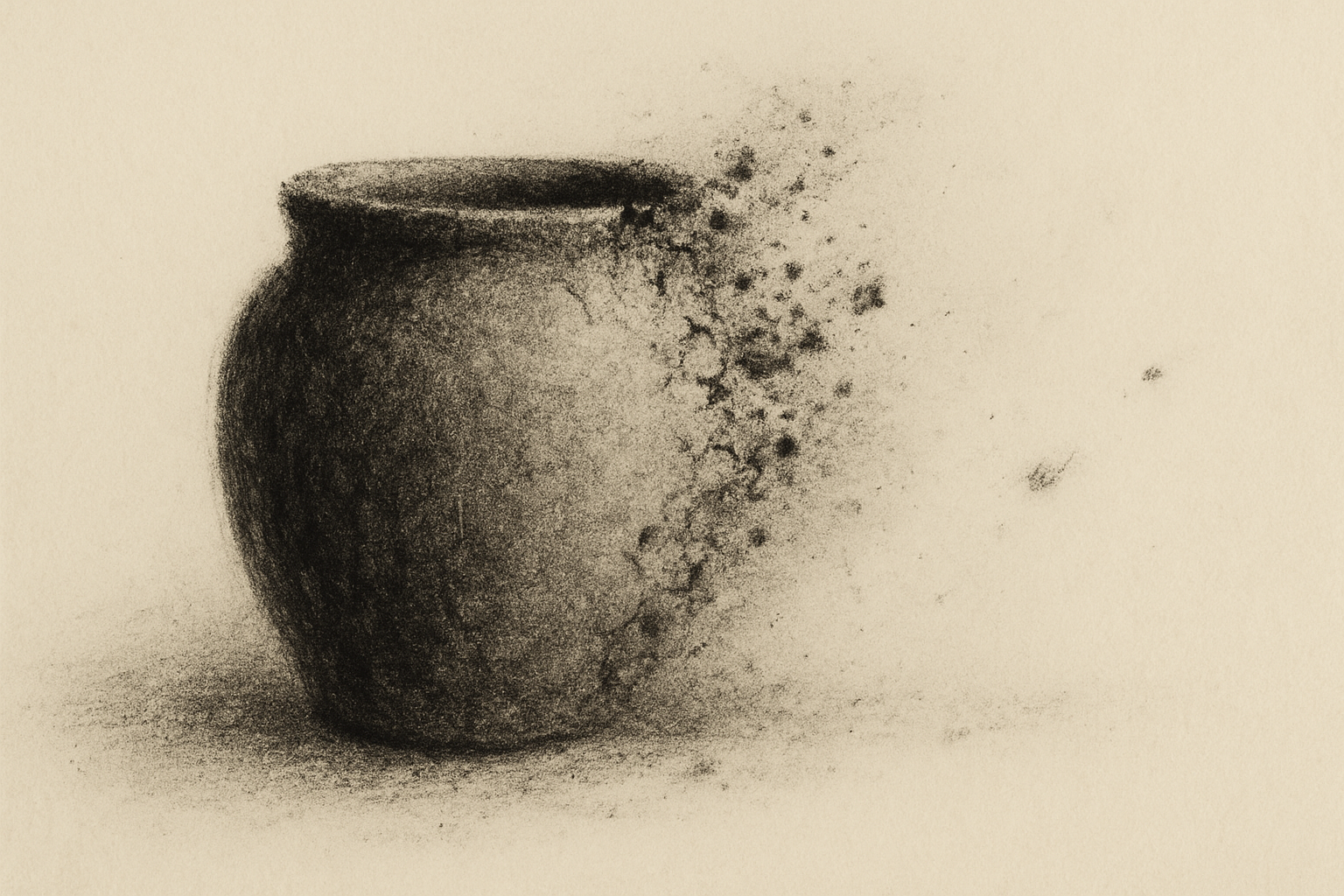
Form, Emptiness, and the Crumbling of Concepts
Forma, vacuidad y el desmoronamiento de los conceptos
A question about the relationship between beingness and nothingness, and how the teaching that consciousness contains "objects" eventually dissolves under closer investigation.
Form, Emptiness, and the Crumbling of Concepts
A question about the relationship between beingness and nothingness, and how the teaching that consciousness contains "objects" eventually dissolves under closer investigation.
You mentioned beingness at the beginning of the meditation, and it connected me with the teaching that refers to consciousness as something that is everything and nothing at the same time. When you guided us through the meditation and through this beingness, it felt so rich. I kept looking and asking, "How could this be nothing?" The fact that I call it "my experience" is already something. Could you elaborate on what it means when we talk about consciousness being everything and nothing?
These are all pointers to something, and they may be useful or not depending on the context and the person. In the beginning of the meditation I used many words for this. It has been called by many names: beingness, consciousness, I-am-ness, awareness. But they point to one side of things. "Things" is not even the right word.
When you said, "How could this be nothing?", I think you're referring to some pointer about this being nothing.
Well, Nisargadatta has that famous quote: "Wisdom tells me I am nothing, love tells me I am everything, and between the two my life flows."
The grasping nature of mind
When you're contemplating that nothingness, that pointer, which seems to be active in you, notice the grasping nature of mind. If you don't look very closely, it will stop being known as mind and will be known as "I." It will be known as that activity in the center that is making an object. It is simultaneously grabbing an object as it is making an object. And because there are no objects, it has to constantly be making them.
When I say there are no objects, I'm not talking about the level of our experience of matter. A computer is an object in that sense. But in the experience of consciousness or awareness, there are no objects.
Let's say in the experience of consciousness there are no objects.
No boundaries anywhere
Experientially, even if you contemplate an object and touch it, the true experience of that is that there are no boundaries anywhere. All you're experiencing is one field of sight where the mind can draw an outline. It's one field of visual perception and one field of sensation.
If I close my eyes, I can still identify three-dimensionality. Without the information of sight, if I have to guess, I can play around with my hand. Imagine there's no memory. I close my eyes, and I can still make out five fingers, but it takes a bit of playing. I have to move them.
What I'm getting at is that even the sensation of the fingers holding the supposed object is a constantly moving, tangling quality with a very vague area, without any clear boundary. There are three places of sensation, but actually five, because two of them are touching my hand. Three are colder and two are warmer. That's all I know about this supposed object, plus the side of it. To the side of it, it requires thought to make out a separation. If we got really scientific, it's exactly what science tells us: there are absolutely no boundaries. In fact, this is all empty, all of it.
What do you mean by "this"?
Everything. Everything we're experiencing. The physical object as well is completely, one hundred percent, empty. Without going too much into the science of it, the experiential reality is that there are no objects.
I want to double-click on that, because maybe what you're saying is that there are no objects in the way we believe objects to be. There is no cup, experientially. When you touch it, there is a sensation, textures. But then the sensations themselves are objects. Can you elaborate on that?
Why are they objects?
Well, they are the contents of consciousness appearing in consciousness.
Forms, not objects
That's a teaching. It's a way in which a teaching can proceed, where you refer to the objects of consciousness. But let's dive deeper into the concept of an object. What is an object? An object is something independent, something separate, something that has a boundary that is a real boundary. Even this cup: if you look at the atomic level, there's no boundary.
Right. I can sometimes follow that intellectually, and sometimes experientially I'm like, "Yeah, there's no boundary, I can see that."
Go back to the sensation of your fingers. Where is the object? Touch two fingers like this.
But then what are those? Okay, let's not call them objects, but there is something appearing.
That's what we're calling sensation. We agree to refer to that as sensation. But the sensation itself, if you were to really investigate it, if you put it under the magnifying glass of your attention, it's a very blurry, strange thing. It's not very "there." It doesn't have a clear boundary. You have to rub your fingers quite a bit to create a sense of a boundary. If you're just touching gently, it's very vague. In fact, if you do this, there's not two sensations. There's only one.
Maybe what I was trying to get back to is where my confusion lies and what I've been trying to untangle.
One field of varying qualities
Because of this teaching about the "objects of consciousness," you need to look at that differently and see: where are the objects? See the aspect of there being no objects. What appears is one field of varying qualities: sight, sound, touch. But they're all in the same field of awareness. Those have been called the objects of consciousness, but "object" is only practical until you start conceiving of them as true objects, which they're not.
That's where the nothingness is, because it's no "thing." It's like the metaphor of an ocean and a wave. The wave isn't a thing. It's the way in which the water is moving, which appears to be a thing you can separate and conceptualize. Concepts make things into objects. But the concept itself is an image, a sound, again without any boundaries. The concept of a point or a circle or a line is not a thing. It's an image in a space. There are no boundaries.
If I imagine a space and divide it with a line on paper, there is no real boundary there. We can add the level of the page and conceptualize a separation, which is useful. But that's why there are two sides to it.
Nama Rupa and Satchitananda
What you're contemplating is what in Buddhism would be called sunyata, which is emptiness. The sensation is form. Consider it more like "form" instead of "objects of consciousness." The forms of consciousness.
Yes, there is form, but it's not separate from anything in any way. You cannot find a true separation here. You can say, "Between air and ceramic there's a separation." But if we look at the experiential nature of this, you cannot find one. So there's form. Now, if you contemplate the nature of those forms, they are also empty.
That's the leap.
It will appear like a leap, because it's both at the same time.
In Hinduism, they say Nama Rupa Satchitananda. Satchitananda is a trinity, three aspects of reality, but it's preceded by Nama Rupa. Nama Rupa means name and form: the naming of forms. So you actually have five aspects, but one pair is within the boundary of mind and thought, and the other is not. The other contains thought and goes beyond thought, which is Satchitananda.
What I've been talking about with beingness is starting to move from Nama Rupa to Satchitananda. Satchitananda you could translate as beingness, consciousness, bliss, knowingness. There are many words, but it has to do with this: there is something that is, yet it's not a thing. There is a knowing, and there is peace. Then the mind isolates forms and gives names. In that naming of forms, Nama Rupa, there is an obscuring of Satchitananda, a forgetting, because all the focus goes into Nama Rupa.
But all of it, Nama Rupa and Satchitananda together, is empty.
That's the leap. What do you mean by empty?
There are no things. Even thoughts, even concepts, even sensations don't have "thingness."
That I get, because the concepts of Nama Rupa are not real. They're concepts. The naming of objects and the boundaries of objects are projections and concepts. I get that. But then you're saying that in all of Nama Rupa Satchitananda there is emptiness, yet in Satchitananda there is being.
Where objects live
Where you are calling things "objects," that only exists at the level of Rupa, which is forms. The Nama is what makes them into objects. It's not a leap. It's just looking more closely.
Right, I agree. When I say "the leap," I mean it's where I find I have to take a leap so far.
When you said, "In Satchitananda there are objects..."
No, I'm not saying there are objects, but there is beingness. There is something rather than nothing itself.
The word "something" is where it's flawed, because it's not a thing.
Yes, that's just language failing.
There is isness. And that's why it's so hard to name.
Thank you. It's not that I fully get it, but it is an interesting exploration for me.
Contemplation, not thought
Think of it as a contemplation, because the more you engage thought, the more it's going to get obscured. By contemplation I mean: look closely with your awareness at your experience right now, as it is, and notice everything that's coming from memory. You need memory to start creating forms and naming them.
I'm not prescribing for us to live without memory, but to be able to know reality not filtered through memory, not filtered through Nama Rupa. We have lost that ability. That's how we were born. Jesus said that to enter the kingdom you shall be as children: to go back, to be able to know experience without the filter of naming, without the filter of the knowing of the mind.
To have the possibility of experiencing directly. And "directly" doesn't mean thought disappears. It just means you know it's thought. In some way it's put aside, but actually a better way to describe it is that it's seen through. Instead of focusing on the layer of thought, we see through it. Seeing through that veil of thought, the experience of reality is Satchitananda. It's empty, it's full, it's alive, it's beingness, it's peaceful. But all those qualities can be refined once we are able to have a more raw, direct experience of it.
What you are asking about is really important.
Thank you. I was going to say that I connected the whole Nama Rupa conversation to what you were pointing at in the meditation: what happens if I have no memory of these concepts, their boundaries, their definitions? That happened to me today with the "objects of consciousness." It's time to let it crumble and see it from another side.
Seeing through the veil of "I"
Very simple contemplation. Where is that? How is it possible that it's empty? The word "empty" is pointing to something, and it's pointing to experience you're having. You are experiencing emptiness constantly. You never have not. But it gets veiled and interpreted as things.
It's not about discovering something that wasn't there and now you perceive it. It's about clarifying the true nature of consciousness, awareness, perception. The direction is mystery, because when you experience objects, prior to that there is an intellectual, mental knowing of what a thing is for it to be an object. That narrows down mystery and makes something "known," when really it's only being interpreted.
We know we're approximating things with thought in order to function, to live, to relate, to communicate, to play. The other key is that the attachment to not seeing this has to do with "I." It's in service to the knowing of what I am. And by "knowing," I mean the false knowing, because the emptiness I'm talking about applies to "I" as well. That's something we are very attached to not seeing. It's the core of all spiritual teachings: Buddhism, Hinduism, Christianity. It's more clear and direct in Buddhism and some aspects of Hinduism.
As you start to see that there are no things, the "I" that grasps to be a thing starts to lose its bottom. It starts to lose the ability to hold on to anything, to attach to anything.
Sometimes I find that one easier, more direct, more obvious than the emptiness in form.
It's only difficult for the mind, and it's difficult because there is a deep desire to be something, to know what I am. It's a beautiful desire, a beautiful journey. At some point, something lives its journey and gets, in a sense, tired of that. It starts to want to let go, starts to want to surrender, starts to want to go back to the source, to be free. But it's definitely not something to rush. It can get very intense if rushed.
Thank you. I just find it very beautiful when a teaching that has carried us this far suddenly crumbles, and in that crumbling you see it from another side. That happened to me today with the "objects of consciousness."
"The Tao called Tao is not Tao." Or more commonly: "The Tao that is named is not the true Tao." When you refer to reality as "consciousness and the objects of consciousness," that is the naming of the Tao, which is not the Tao. But as you said, the teaching can be useful. And that applies to everything I'm saying as well.