The Bucking Horse in the Chest
El caballo desbocado en el pecho
A student describes the intense physical resistance that arose during a breathing exercise, leading to a wide-ranging conversation about coping mechanisms, the fear of well-being, and the freedom to come home.
The Bucking Horse in the Chest
A student describes the intense physical resistance that arose during a breathing exercise, leading to a wide-ranging conversation about coping mechanisms, the fear of well-being, and the freedom to come home.
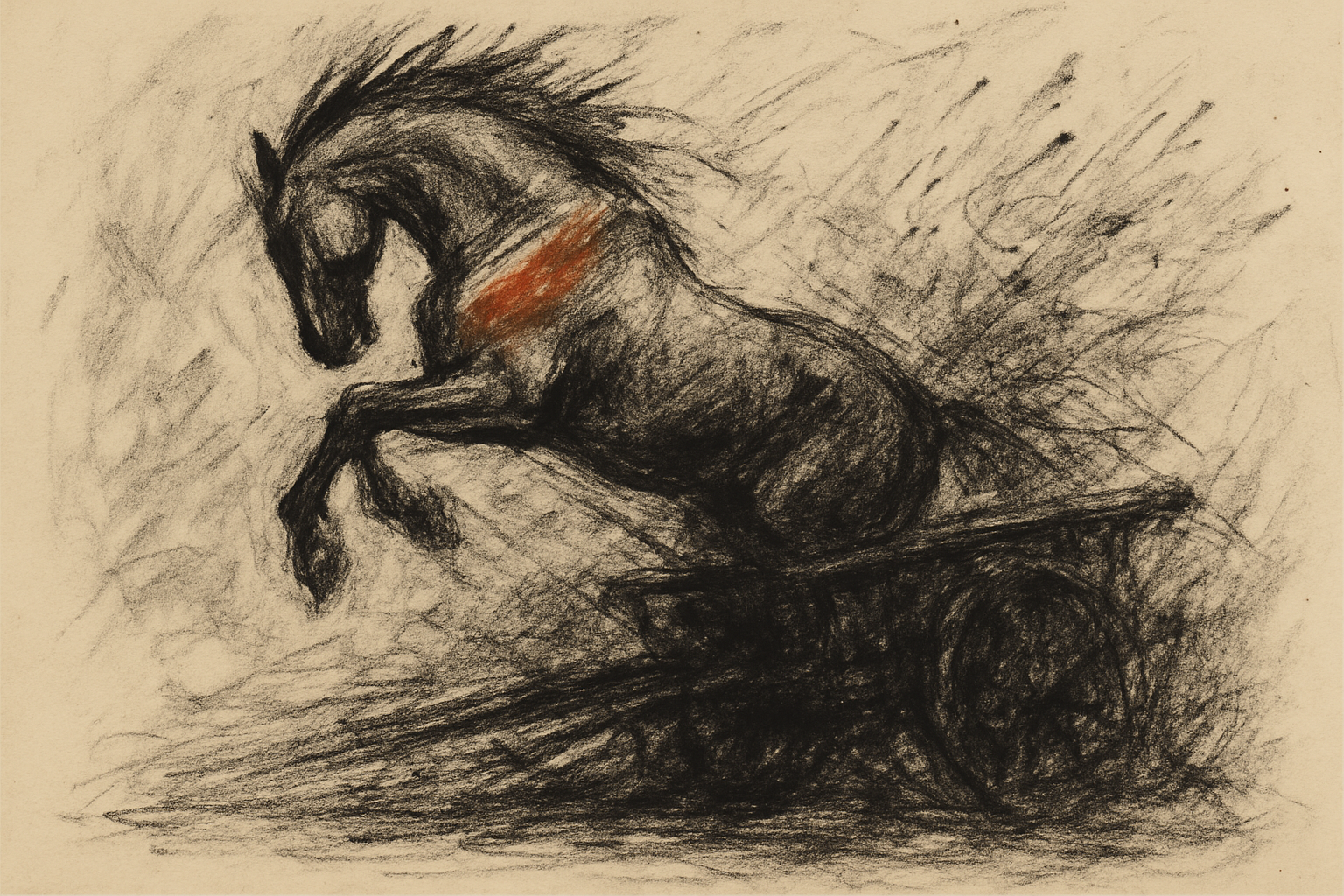
I'm used to the recordings, so these live sessions feel more potent. There's a feeling of being on the spot, of having to engage. I was having racing thoughts about what I would share with you, even during the breathing exercise. As you were talking about the breath becoming aware of itself, I had this image pop into my mind of a bucking horse. There's a bucking energy in my chest, the whole torso, like wanting to escape. And then as I just kept not running away, it was a really powerful exercise. I also had the thought that I've been controlling, or hijacking, my breath my whole life. As I listened to you, it was relaxing and going back to its own natural rhythm.
That's a really good practice, and I would confirm: you were probably controlling your breath your whole life. I think we all did that, or do that. It's becoming quite well known, medically and scientifically, that controlling the breath is a way of suppressing feeling. It creates a lot of distress in the body, so it has a very powerful side effect. Usually what happens is that we start to notice the physical side effects, and that brings us to this kind of work. I won't dive too deeply into that, but I want to confirm: yes, this is something that happens, and it also brings a lot of anxiety.
I couldn't believe the resistance. At one point you said "trust," and it just hit me. The fighting of it is so strange. You're pointing to being, to trust and warmth, and then there's this bucking horse inside. It's so strange. But thank you for calming it. It's amazing to see that as you do trust, it does calm down.
The coping becomes the bigger problem
We've learned mechanisms to cope, and then the coping becomes the bigger problem than what we're coping with. At some point we are able to deal with what we were originally trying to cope with, and then the coping mechanisms themselves become the thing to work with, to start letting go of.
For me it was alcohol. The focus began to be on alcohol, on controlling that and what it might be doing. But I think it's what you're saying: all the focus shifted to that coping mechanism of alcohol and other substances.
Exactly. It's all a form of addiction. Some of us don't have those very explicit coping mechanisms; they might be more thought-based. In a sense, those can be harder to notice because they're not so explicit like a substance. And usually it's a combination.
That makes me think of something. During the meditation, I had a self-image of picturing myself sitting here. Is that the kind of thing you're talking about?
No, I'm referring to ways of functioning, ways of thinking about the world: what my mission is, what the point of being here is. A lot of the drive that drives the world is this coping. That's why there's such a mess.
Seeing the door
The thing is, for you to see all of this is a huge celebration, a huge breakthrough. It gives you the opportunity to see where there's a door.
The breath?
All of it. Just notice everything you've described. You start to see what's going on, because we start living walking with crutches, and then we forget we're walking with crutches. At some point we see somebody walking without crutches, and we think, "Why can't I do that?" Well, you actually can. But then there's a process, a kind of rehabilitation, like the physical therapy you do after breaking an arm. Metaphorically, that's what all of these practices are about. Breath work, all of it.
I was raised Mormon, and there's a scripture that keeps coming to mind. There was a pre-mortal battle before the earth was created, between Jesus and the devil, over who would save mankind. Jesus said, "I will do it, I will sacrifice myself, and the glory be God's." And Satan said, "No, I will do it, and the glory be mine." That keeps popping into my mind. The glory is already here, but then the ego says, "The glory is mine," hijacking the system.
Making it personal
That's very poignant, because it does have to do with wanting to make it personal, wanting to make it about "me." I'm the one who found the problem and solved it. I'm the one who is the problem and is out to fix the problem. There's a creating of a problem and a mission to fix it, this whole self-involvement. In religions they address that with really powerful, scary myths, but in a dimension it's true, it's real.
It's also natural. It's part of the evolution of the human psyche. That battle, that struggle, is natural to evolve into and through and out of. I'm making a statement of a position. Others might not agree with me, but I think it's a natural and necessary process.
That made me think of when you talk about the prodigal son, the choosing of the father. I think that might be what you're talking about. That process is there because there's a seeing and a choosing.
It requires a responsibility, because it's all about freedom. In a sense, I could say that freedom is the highest value. Within the language of Christianity, it's the freedom to go against God. You're free to do so; it just has consequences. It's not so much that God will punish you. It's more that it creates distress and disharmony. If I switch out of the Christian language, God would represent reality and what is true, which is mysterious. You cannot put it in a book. But when we think we know what it is, that represents Satan. It represents the "I" that knows, the "I" that makes it about me.
That creates a constellation of a very small, limited entity that believes and thinks it has a power originating in itself, separate from God. And that's false. It's simply not real. Operating from that falseness creates distress. In the Christian narrative, that would be the original sin.
Yes, the fall of man, the repentance, the sacrifice. It's all so beautifully woven in with the way you talk about it. And that's where the fear and pain come in. That little entity has caused so much trouble, and then you feel the opportunity to maybe drop it, and it just blocks in your chest and doesn't want to leave. That's how it feels.
The door to well-being
We're very attached to that. That's why we end up in these groups, because something in us just wants to stop. As you refer to the prodigal son, it's just a choice. What happens is that he squanders all of the inheritance, has a pretty rough time. Everything went wrong. Then he goes back home and is welcomed with a party.
If you take that as a metaphor, as a narrative of one way of interpreting this work, this path, it operates on different levels. There's a micro level and a macro level. What you've spoken about today is that micro level. You notice something, and you just want to get home. You want to stop with all of the coping. That requires a responsibility: you can't have it both ways. You can't indulge in substances as a way to not feel and then avoid the consequences. The responsibility is to learn how to be with what you feel. When I say "trust," it's trust in the mystery of it. But I can also offer a kind of guarantee: it's a better way. Not a guarantee in the outcome or how it's going to play out; I can't speak to that. But I'm here to say very emphatically: it's a better way. The way itself is complex and mysterious.
Right now I guess it's just a lot of the fear and pain. Maybe that is the repentance process. You just have to sit with the shame and embarrassment, or whatever it is, of thinking you knew better than God.
That's part of how it begins. But then you can also start to discover that what you fear is well-being.
That's ridiculous.
When I speak about going toward pain, I don't want it to become a thing, as though that's the end goal. The point is that we stop running, that we're able to sit through it, to realize it's not the end. It's quite okay when we're able to sit with fear and pain. And then that opens a door. What lies through that door is, I believe, a birthright of being: well-being. "Well-being" is just a word, of course, but it's something much more than you can currently imagine, and also simple. It's not a fantastic experience. It's peace. And it's you, so it can't come and go.
We love adventures and journeys, some of us at least.
To the point where it can be so risky, risking death, messing with your health. And many go that way, it seems.
I know that for myself.
Thank you.