The Cart Full of Stuff
El carro lleno de cosas
A student describes a persistent gravitational pull toward images of self and identity, and asks how to understand the mechanism behind it. The teacher explores the difference between two kinds of curiosity and reframes contraction as interpretation rather than obstacle.
The Cart Full of Stuff
A student describes a persistent gravitational pull toward images of self and identity, and asks how to understand the mechanism behind it. The teacher explores the difference between two kinds of curiosity and reframes contraction as interpretation rather than obstacle.
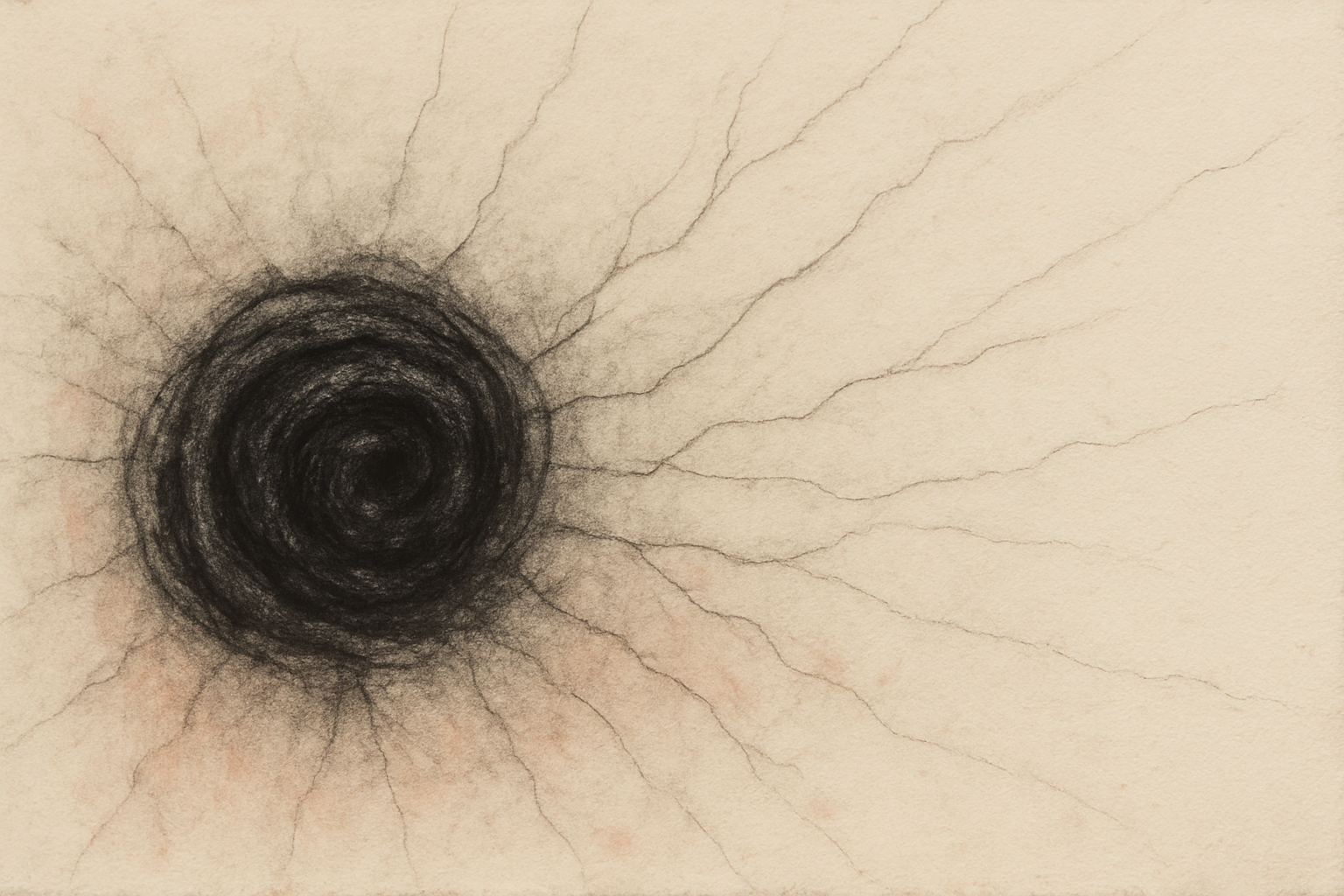
In the meditation just now, I noticed something I see constantly: a gravitational pull toward certain thoughts and images of myself, my body, my face. Sometimes they're not even my face. It's ridiculous. But they all seem to fall into the same category of identification, or whatever you want to call it. I understand the theory, but I don't really understand it. There's an interest in wanting to understand the actual mechanics, because it feels pretty constant. Day to day, it limits my fluidity. It's almost as if I were going through life carrying a cart filled with unnecessary stuff. I'm not sure exactly what the question is. I'm just expressing this curiosity and realizing I don't really understand this mechanism, what's really going on.
And the mechanism you're referring to: is that identification itself, or the images of self?
More the identification. Not necessarily why it started, but why does it continue to happen, and why is the pull so strong?
Two kinds of curiosity
First of all, there is curiosity of different natures. There is a curiosity that is a longing for awakening, for freedom, for being oneself. And then there is a curiosity that often comes in through the back door: a wanting to have a mental map of how things are, how they work, how it's all going to go. I'm not saying your curiosity is either of these; it might be a mix of both. But what matters is that first curiosity.
At a certain level, understanding the mechanism isn't that important. You're expressing the sense of being in a kind of cage and wanting to drop it. Is that how you experience it, when you say you're walking around with these images?
More or less. I don't know if I experience it that way every day. It was more of an intuition that I could be more fluid. And I think what I'm trying to say is that it's more the first kind of curiosity. I'm tired of the second kind.
The assumption that it should be different
You said you're carrying a cart full of stuff, and I think the key might be there, because there's a rejection in that.
I didn't mean "stuff" as in bad things, just unnecessary things.
But "unnecessary," right? You know it's unnecessary.
I'm not sure. I'm not viewing it as bad. It just makes things clumsy.
It's making you clumsy. And maybe it's adding spice in there.
In the sense that I choose it for that reason?
I can't say why you choose it. But the assumption that it should be different is creating a subtle rift. You're describing knowing these images, knowing this process, knowing your experience of it. And the problem with it is that you feel if it weren't there, you would flow more. So a strategy emerges: "I need to understand it so I can do something with it, stop it somehow, let go of this cart so that I'll be less hindered."
Now I see it. So that's the second kind of curiosity you were referring to. Maybe there's both, but there's also an interest in seeing it for what it is.
That's the one. And that interest should not have any desire in it for the thing to go away or stop or end. If it does, it's of the second kind.
That's hard to hear.
You could just play with it. I'm going at the notion that something would be freer if that changed. That's not where freedom is. That's a conditioning. You're intuitively sensing and knowing the freedom, but it's not found by something going away.
It's strange, because I can also describe it the opposite way, that something does stop. Sometimes I feel this contradiction: I feel the direct experience of beingness, the obviousness of that, and at the same time this limitation is there. How can both be there?
Limitation exists only as belief
What limitation? There is only limitation if you imagine it and believe it.
I'm referring to that identification. I'm viewing it as something that has a gravitational pull.
You're not the victim of the identification mechanism. You could notice an image of your face, and it's simply that: an image. Or you could have the image of your face and interpret, "I'm identified, I'm limited, I'm stuck, I can't stop this, how do I stop it, let me figure out the mechanism." The image of a face is just the image of a face. It's mysterious. It's beautiful.
It usually brings contraction with it, or pain.
That's the interpretation. There is a judgment, a decision about what it is, and that creates an illusion of contraction, which then creates a sensation of pain or an emotion.
I'm not sure I understand what you're saying. In my mind, the image itself is harmless, but if I believe I am that for a while, that generates contraction.
Believing is a choice
Stop believing it. The point is that you are interpreting the believing as something that happens to you. Where you're at, where you're going through, that is a choice.
You interpret this believing as something that happens to you, and as a consequence you're thrown into a contraction that also happens to you. I understand the contraction feels real at a certain level. But where you are, that contraction is an interpretation. By that I mean there is no such contraction. An image of your face, or somebody else's face, is just an image. It is not identification. The sensations of contraction are not contraction. They are just sensation.
You said "by seeing what it's made of"?
Yes. That curiosity you have, the deepest part of it, is a desire to know it more intimately. But if you're wanting it to stop and go away, there is no way you can be intimate with it. It's like wanting your friend to come over so you can get to know him, but wanting him to leave the minute he arrives. You're never going to know him well.
Intimacy, not elimination
This work is not about that which we don't like leaving our home. It's about having such intimacy with it that it could be here forever and you'd be totally fine. Because then you start to realize it's not an enemy, it's not a threat. Fear, pain, contraction: it all becomes part of that same aliveness.
The contraction is an interpretation. If you go into full, direct intimacy with that experience, you'll notice: there's sensation, there's emotion, there's thought, and all of it is, in a sense, transparent. It's not an object. We make it into an object. We call it "contraction," we call it "identification," we call it "I," and it becomes a thing that we then wrestle with. But if you see it's all transparent appearance, you can't wrestle with it, because there's nothing there to wrestle with. No thing.
It's like being underwater, fighting with water. There's nothing you can pull or push against. You're trying to fight a part of the ocean, and you're just going to tire yourself out. It appears as though there are things. That's why the metaphor of waves on the surface works: it appears that there's a thing called a wave, but it's just more ocean. We try to manipulate those waves, to get them to go where we want or be the shape we want. And when you realize it's all just ocean, there's no thing there, you can't push it, you can't pull it. Then you can start surfing.
Thank you. I don't want to take more space.
You're welcome.