What's Actually Wrong with Staring Out the Window
Qué tiene de malo, en realidad, mirar por la ventana
A reflection on the presence that death brings, the difference between superficial and deeper wanting, and whether purpose needs to be grand at all.
What's Actually Wrong with Staring Out the Window
A reflection on the presence that death brings, the difference between superficial and deeper wanting, and whether purpose needs to be grand at all.
I went to a funeral yesterday, and on the same day another friend's mother died. So I've been with two different people who've just lost a parent on two different days. It's been quite a weird experience, quite exhausting, but also something like watching. The aliveness of death is what I want to say.
I remember when my mum died. I went to the hospice, and there was an evening where you could go and just sit. All these people were there just to sit and listen to what you wanted to say and share. I said to the volunteer, "Why do you do this?" And she said, "It's just a beautiful thing to hear people talk about people they've lost."
There's this real presence around death. We all get real. In a weird way, it's refreshing to be around, because there's nothing else but what's real.
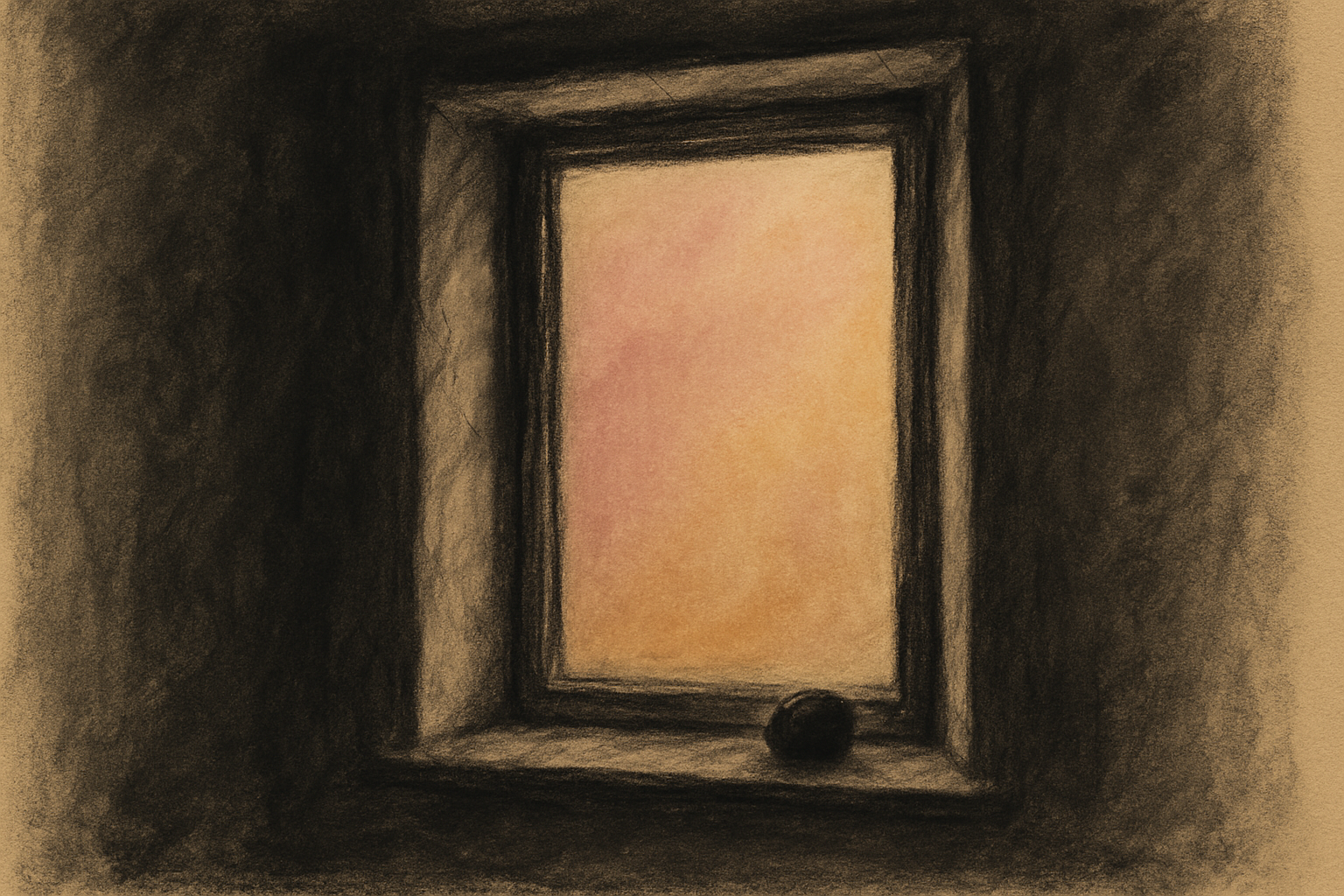
I was interested in what you were saying earlier about how, rather than addiction, there can be a kind of obsessive thinking around mission or purpose. On the one hand, I remember you once said to me, "Ask yourself what the universe wants to do, or be, as you." But on the other hand, I think you were also saying that if you're obsessively thinking, "I've got to save the world," that's almost a workaholic, addictive type of thinking. What's actually wrong with just staring out the window? Just sitting and being. Maybe that's all that's needed until something arises. I guess I'm interested in: if we were a bit healthier and less neurotic about everything, what would the world look like?
I wonder that myself.
Two kinds of desire
I think you put it quite well that I'm saying two different things. I'm trying to talk about something that's hard to put into words, because if you make it too explicit, it can become a known method, and that's problematic.
You could say there is desire that's egoic and desire that's of the self. But I hesitate to speak that way, because then it creates a map where there's an ego and there's a self, and it's a lot more mysterious than that.
The want of this moment
When I say the universe, as you, has wants or desires, that could very well be to stare out the window right now. I'm not speaking about any kind of grand vision or mission. In fact, it's most likely really simple. And it's not something you can write down, because it's alive. At any moment, it could be: stare out the window, make tea, go to work.
That's what one of the Zen stories addresses: "Before enlightenment, chop wood, carry water. After enlightenment, chop wood, carry water." Something fundamentally changes, but you can't describe it. Something deeper is operating.
Carrying death on your shoulder
The Sufis say to carry death on your shoulder. That awareness is what wakes up when you're at a funeral. The thing we are all, in a sense, juggling, trying to see where to put, suddenly becomes explicitly in the foreground. We're in a social setting where death is what we are present with, what we're talking about, where the attention is. The whole social setting flips from one side to the other.
On one side, you never talk about it. It's rude if you mention it. If you say anything, it's dark, it could be offensive. Depending on the culture, you will get some kind of friction. Then suddenly it's okay to talk about it, okay to contemplate, okay to share. That's beautiful, because death is one of the most mysterious things, and one of the most important.
Avoiding death, avoiding depth
These two things are very closely related. When you are in touch with death, you're most likely going to be in touch with what I describe as the universal want. Because when you're avoiding death, that's when the superficial want is usually active. It's a coping mechanism, a way to cope with fear and pain. And fear ultimately is always around the sense of something ending, which is the only thing we know about death. Something ends. The body ends. That's all we know.
Wanting that doesn't come from lack
So the grand question of what you are here for: I can't think of a more beautiful answer than to look out the window. And then the next moment, something mysterious shifts, and what one wants is different. The quality is different. Deep wanting doesn't come from a sense that something is missing. The other kind of wanting comes from the sense that something is missing, and so you want the thing that fixes or fills what's missing.