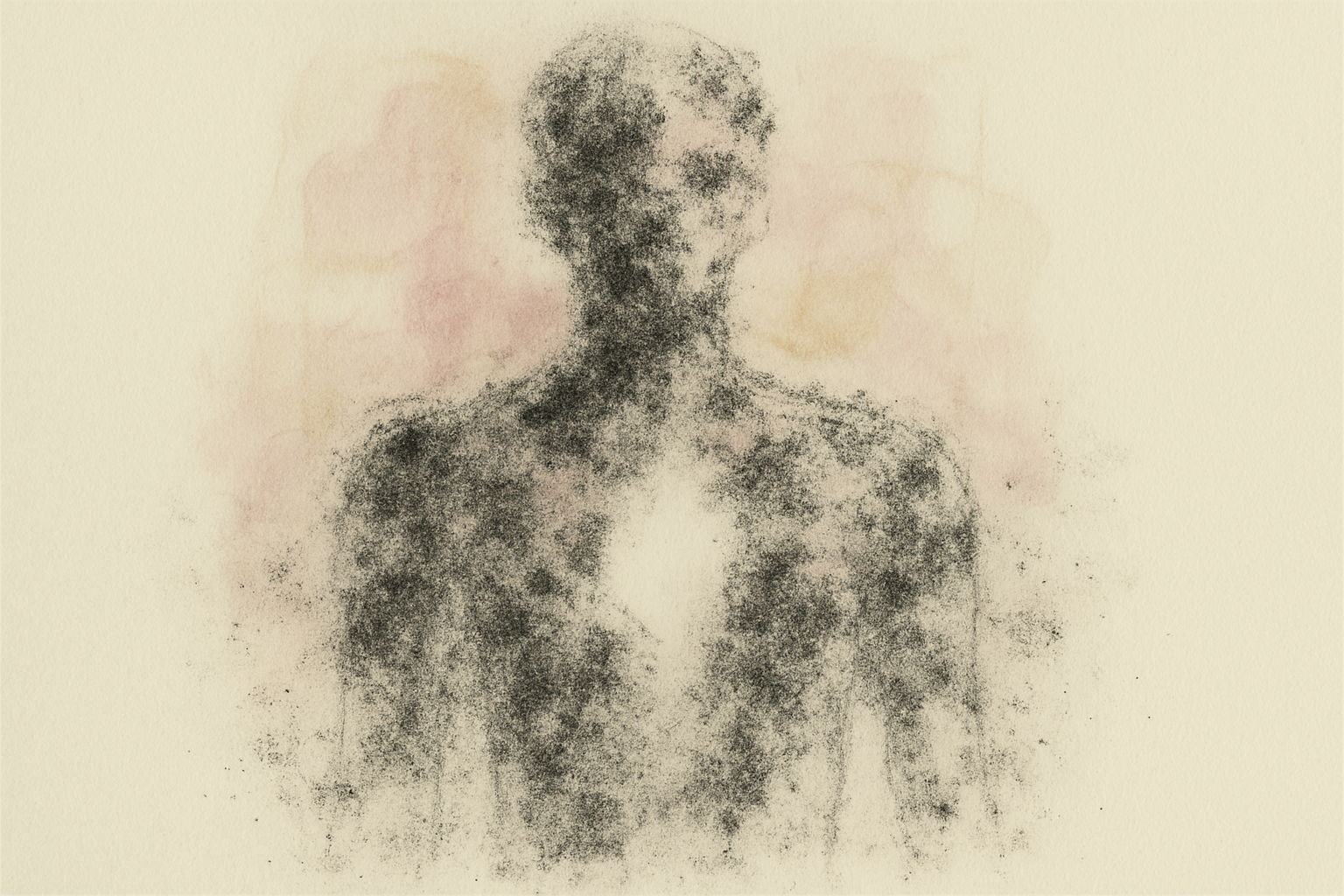
Sensation, Image, and the Subtle Subject
Sensación, imagen y el sujeto sutil
A student explores how bodily sensations and mental images sustain the sense of self, and the teacher describes how noticing these can become a practice of disidentification.
Sensation, Image, and the Subtle Subject
A student explores how bodily sensations and mental images sustain the sense of self, and the teacher describes how noticing these can become a practice of disidentification.
The two most predominant experiences for me are a tight stomach and, often when I close my eyes to meditate, something like a picture of my own face.
Sensation is what we can identify with. If my hand is relaxed and I put it down, that sensation diminishes to a degree that it almost disappears, and I can no longer identify with it. The same happens with sensations in the body.
We anchor our ideas of what we are. We have mental images, we have stories, an image of "I." And then that image is associated with a sensation. It is not one sensation; it is a complex of sensations, and a complex of images and thoughts.
Noticing as disidentification
The practice is to look at that and notice how it pulls, how it draws you back in, the temptation to return to it, the addiction to it. Just notice. The seeing of that is the disidentification. The noticing is the peeling away, the freeing. This is a practice, but it has to be directed. It has to be deliberate. It can also happen spontaneously, but as a practice it requires intention.
So when the image of my face is there, seeing it is just acknowledging it?
Yes. Knowing: "Oh, there's the image of me. That's not me. I know it is an image; therefore what I am cannot be the image. I know it is a sensation; therefore what I am cannot be the sensation."
The risk of creating a subtle subject
The risk with this kind of practice, which is neti neti, is to create an object: a subtle image of a subject, the perceiver. It is still an image.
It is still an image, you said?
Yes, it will be a subtle image. But it can be a valid form of practice, in the sense that it simplifies the identification and separates it from all other habitual sensations and thoughts. You are no longer identified with physical sensation or with images of a person. It becomes the image of a subject. But then that, too, needs to be seen as an image.
For you, though, it is just sensations. Notice the sensations. Let them be.
Can you describe the image of the subject you were talking about? Is that just the emptiness, where your face isn't there?
There is likely going to be something you refer to as a location that is the subject. Even if you look at your body and say, "Well, I'm not my body; I'm that which sees it, knows it. I'm not the sensations, not the thoughts, but that which sees and knows them." There is likely going to be a location and a subtle object which is "that which sees it, knows it." The perceiver of perception is still a thought.