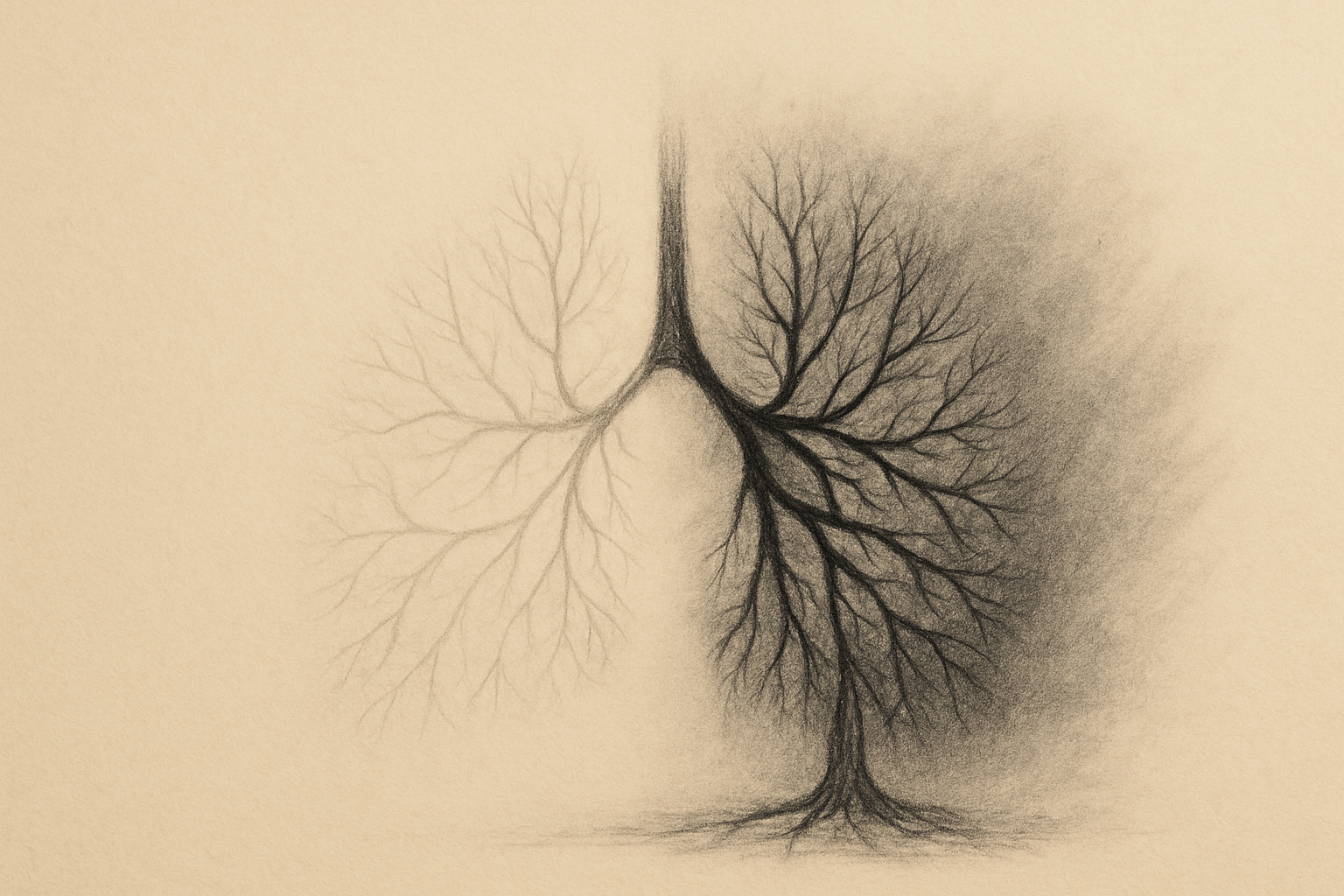
Breathing as a Way Back to Feeling
La respiración como camino de regreso al sentir
A student asks whether it is appropriate to intentionally modify the breath during practice, particularly when habitual breathing has become shallow and difficult to perceive.
Breathing as a Way Back to Feeling
A student asks whether it is appropriate to intentionally modify the breath during practice, particularly when habitual breathing has become shallow and difficult to perceive.
I would like to ask a practical question about the practice. I feel very close to what has been shared in recent weeks. Being in daily satsang for several years brought some real acceptance with emotions and feelings, but I realized I really needed to go closer to the feelings and be truly present with them. There had been so much avoidance. So I left that community about a year and a half ago, and my practice now is really being present with the emotions I had been suppressing.
The practice you suggested in an earlier exchange resonated for me as well. Like what was described before, my breath is also very shallow, and I have a very poor perception of it. I don't really know whether I'm breathing or not, which is a strange thing to say. My question is: when you talk about going deeper into the breath, does that also mean changing something in the breath? I feel like my breathing is quite shallow and quite short. Would you suggest modifying it, trying to sink into the breath with a longer exhale? Or is it simply what you described before: sinking into the sensations by bringing attention to the breath?
It is never necessary to change your breathing.
The breath is already being modified
Regarding practice, changing the breath is not a requirement. But because we have already messed with our breathing so much, it is often useful to explore some new practices, including consciously and intentionally changing the breath.
That is what I understood while you were speaking.
So it is not necessary, but it might be a useful exploration. There are many breathing practice traditions, some thousands of years old, and they are useful.
What I described earlier is a simple experiment: slow down the breath consciously and notice, as you come to the end of the exhale, whether you can let it go even deeper than feels normal. This is where you use a little bit of gentle direction (not effort, not pushing) to go a little further in the exhale, a little deeper. Then hold briefly before the impulse to inhale, not forcing, and let the breathing come back up. Repeat this: focusing on letting the exhale go deeper, holding a little in the space where the exhale ends and the inhale begins. In that space, bring your attention to sensation, emotion, feeling, whatever comes up.
That is exactly what I understood, and it really resonated. I tried to do it and could feel the resistance, the sense of it not being natural. I wanted to make sure that modifying the breath and slowing it down is acceptable, because my habitual way of breathing is that really shallow pattern that is barely perceptible or noticeable.
Think of it this way: you are already breathing. You are already modifying your breath.
That is so true. People have told me they had the feeling I was breathing through a straw. My breath does not feel entirely natural.
Don't fix the breath; feel what you're avoiding
Don't worry too much about fixing the breath. The breath will become natural when you are able to feel what you are avoiding feeling.
I feel that too. Thank you so much. I really want to try this. I have been spending a lot of time over the last year and a half with my strong emotions, and I can see the avoidance is really decreasing. But it is something that was rejected and avoided for such a long time that it is still not completely resolved. I do feel the breath could be a helpful entry point. It is interesting, because about a year ago I started swimming again and am really enjoying it for the first time. There is something about the breathing in swimming that slows my breath down and makes it much more conscious than when I am outside the water.
You're welcome.
I also want to thank the person who has been sharing so openly in this group. It is beautiful. I can really relate to everything being said. I have not been speaking up, partly because I know at some level that it is just emotion and sensation. But there is a bit of spiritual bypassing in simply saying "this is like that, it's fine." It is a good balance to have someone in the group who really acknowledges these experiences.
The other student responded: I try not to spiritually bypass either. That is why I relate so much to the breathing and feeling practice. It is not enough to just bliss out into unbound awareness. There are other components that need to be seen.