Finding the Problem Before the Solution
Encontrar el problema antes que la solución
A student asks about seeing through the illusion of selfhood and the sense of being a person in the body, and the teacher redirects toward examining the actual felt problem rather than pursuing conceptual solutions.
Finding the Problem Before the Solution
A student asks about seeing through the illusion of selfhood and the sense of being a person in the body, and the teacher redirects toward examining the actual felt problem rather than pursuing conceptual solutions.
I would like to ask you about investigation and what I believe is seeing through the illusion: the illusion of the sense of feeling like a person in the body. The total illusion feels like a sensation, like "I am speaking." That is the quality of what the illusion feels like. I don't always see through it clearly. I can say it feels like I'm speaking, like a sensation, but how do I totally see through that sensation and see that it's not there? I don't worry about it, and there's really nothing to worry about. It's only extra sensation.
I understand. You said something just there at the end: "How do I see so that it's no longer there?"
I think that's a thought, a hidden desire somewhere, that this sensation of "I am talking" will dissolve. And it's also a realization that no one is talking, that it's only a concept.
The strategy of seeking a breakthrough
If you look at everything you've learned about this, and the strategies about what needs to happen and what you need to see, just look at how it's creating a certain process. If you were to see something, if something clicked, then you would be free from something, and that would get you what you want. Something like this, right?
So the sense of you as a person in the body, or you speaking: how do you know that there's a sense of you speaking?
It's an assumption, and it sometimes appears strong, sometimes it doesn't. Right here, right now, in direct experience, it's not strong at all. It can be easily accepted.
So what's the problem right now?
There is no problem, no problem at all. I think the worry is that later on it gets strong.
That's a problem now, which is that you're worried that tomorrow or later you'll have a problem. What's the problem with a sense of self?
It's the experience of time and space that comes from the sense of personhood.
And what's the problem with that?
With space and time still feeling real.
And what's the problem with space and time feeling real?
That is the foundation for the collapse into thought.
But, asking the same question: what's the problem with collapsing into thought?
It's not a problem. Experiencing thoughts is not a problem. In the end, experiencing what the thought suggests as sensation wouldn't cause any problem. It's not a problem.
The problem you can't locate
So if you don't have a problem now, the only problem I've heard is that you might have a problem later.
Yes, and I cannot figure out the problem. I don't have a problem, but I feel like there is a problem. I don't know where the problem is.
And that's important. What I'm getting at is for you to have a more refined, subtle awareness of what you're experiencing. You're describing the feeling that there's a problem.
I think it is this experience of time and space.
I'll pause you there, because that's an analysis. You've been told, or you've heard, that time and space, the belief that they are real, or the self, or the sense of self, and so on, are the problem. And so that's where your strategy lives: "This is the problem. I just need to figure this out, and then the problem will go away." But that's not really the problem. That's what you are interpreting as the problem. The problem is something you're feeling.
Drowning in concepts
So I am now being soaked in this concept of no time and no space. I'm so deep into this belief about what reality is: no time, no space.
I'm guilty of that, because as I said in the beginning, as soon as I say something, it's wrong.
The language is immediately taken in by the mind and interpreted. I am totally going into it. Sometimes I realize it, sometimes I don't. At this point I realize I am totally drowning in this concept of non-duality. I'm realizing it. I don't need to get out of it. I'm just in the idea, experiencing the idea.
Forget the solution, find the problem
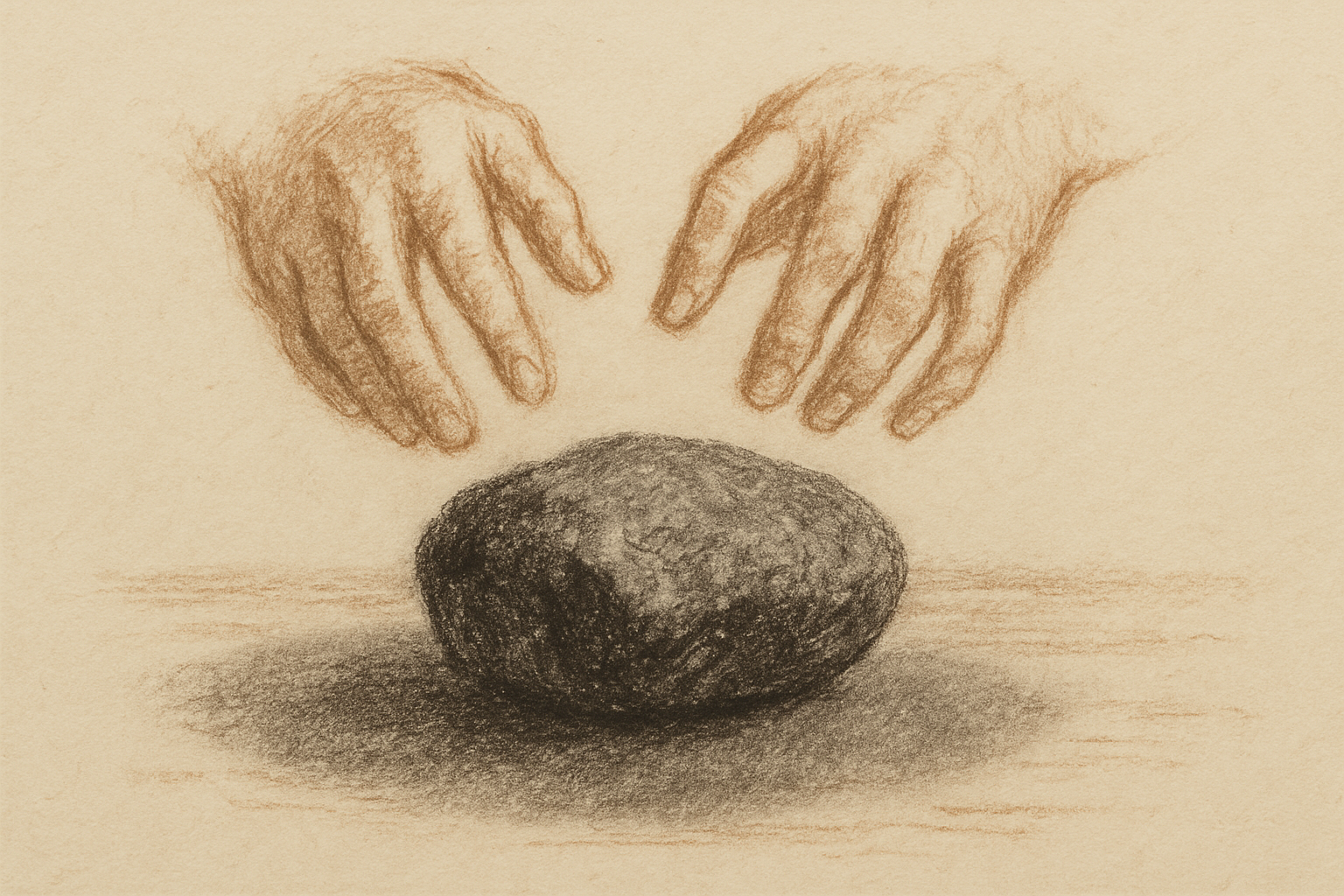
I understand. The direction is to really look for the problem. Forget about the solution. You are experiencing a problem, but you don't know it closely enough. You don't know it well enough. There's an experience, but you're too focused on a solution.
It's like a labyrinth of concepts and words and teachings and teachers and traditions, and it's infinite. An infinite labyrinth where you will get lost. Find the problem first.
We can go back and forth on it over the weeks. You might think, "Oh, this is the problem," and then again it turns out to be something else, not really that. It's an impossible task as well, what I'm giving you, because there is no problem. But that's for you to see. So I'm giving you the solution ultimately, but you're experiencing a problem, and in that sense it's true and it's real for you.
So just look for that. What feels most authentically your struggle or your problem? The way I talk about this is "the sense of something's missing, or something's not okay." But those are my words. It needs to be your knowing of it, your experience of it. It could be very different. You could describe it as a sadness that the bird isn't singing today. Whatever it is that is deeply anguishing. It could be fear, it could be sadness. It has infinite forms, and it's very personal. It's not going to be one thing; it's going to change. But it's for you to really get close to it.
The raw experience beneath all strategies
Right now, everybody has that experience. It's a human condition. Because of not knowing it really well or closely, we try to solve it with things that are given to us. All religions and non-duality, it's all the same: making more money, the relationship, the non-dual insight. The only difference with non-duality is that it's closer to a real solution. But it can still be really misleading and confusing, because it's words.
So it's really important to get close to what is experienced as the problem, what in Buddhism they call dukkha. But it has to come in your words. Because you could say, "Oh, I have dukkha. Okay, what's the solution? Non-duality." And then you're going to go into a process of figuring that out, but you're not connected to the raw, direct experience of that sense of something missing, something wrong, something lacking.
When the core is settled, problems become relative
And then, when there is this knowing, this peace, or whatever you want to call it, this silence, then the problems are just relative. There is that thing, and there's that other thing. Sure, not a big deal. One problem seems real and important, another seems a bit more important, but it's all relative. It's not the core thing.