The Fear of Never Letting Go
El miedo a nunca soltar
A student describes the deep-seated belief that a fundamental flaw prevents full release from thought identification, and the teacher offers an alternative paradigm: that this clinging may be a choice rather than a curse.
The Fear of Never Letting Go
A student describes the deep-seated belief that a fundamental flaw prevents full release from thought identification, and the teacher offers an alternative paradigm: that this clinging may be a choice rather than a curse.
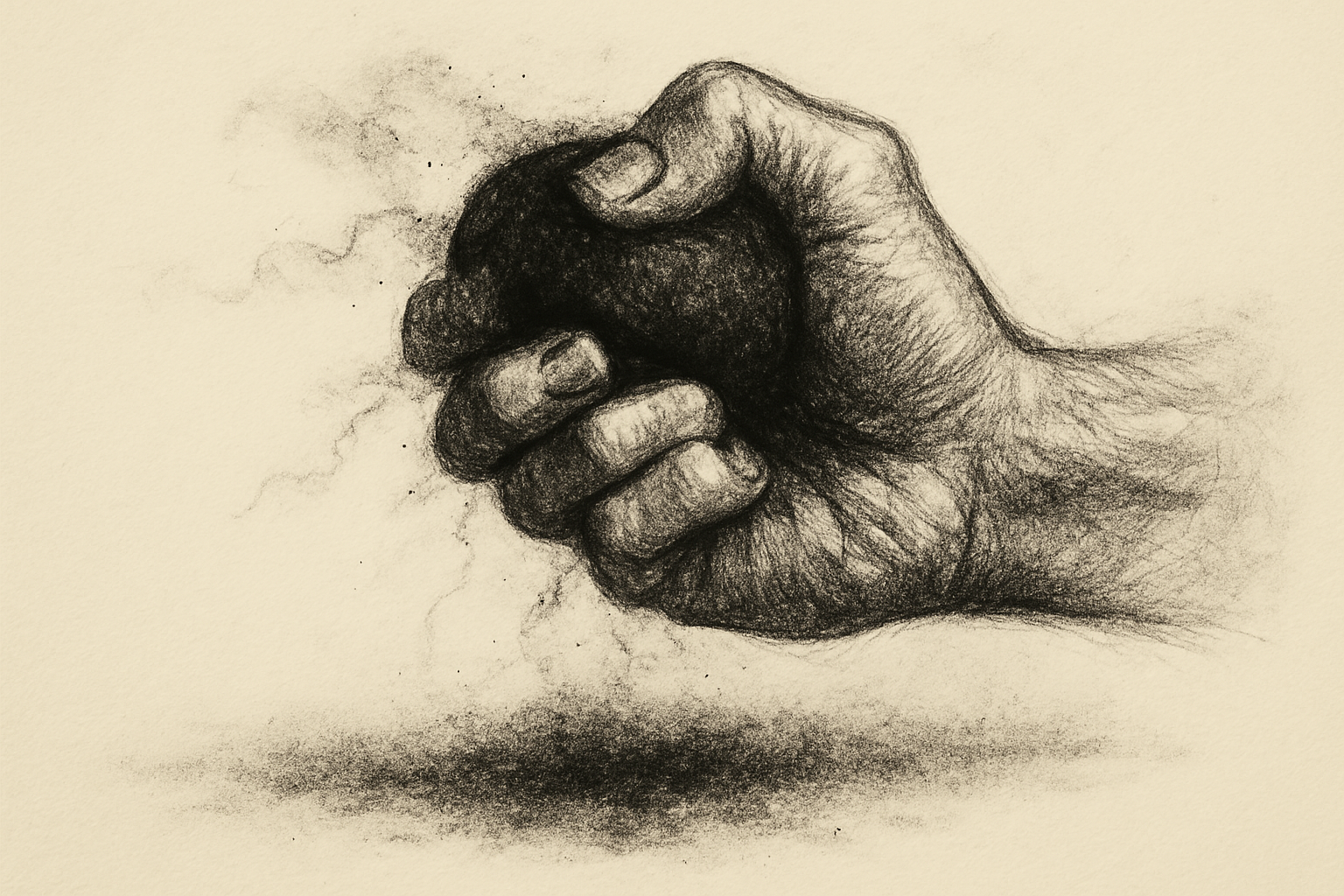
While I was listening to you, one word popped in that made what I commonly see as my predicament clear. Easily attributable to my Catholic upbringing, I feel blessed and fortunate because I've seen into that which doesn't change. But I spend most of my living experience, and even my meditative experience, feeling like I've got a fatal flaw. I'm locked into my thinking as if I'm some kind of mutant: completely attracted to this teaching, but never able to get free because I've got a defect. I will always have one talon left in thought identification.
I know it's really psychological. It's probably just self-crucifixion. But it hangs me up a lot. I get to that same place, and I know the infinite is right there, yet the whole of my existence is just this one last claw that won't let go. I'm frightened and intimidated by the power with which I cleave to my thought process. It's both my meditative life, where I see things that way, and my personal life, where I have insomnia and all these worries. At the same time, I'm fine but I'm not fine. When you described what it's like to be anchored in thought as a basis of resistance, it just really hit home. I know something better than that, but I doubt my capacity to release.
First of all, please don't apologize. What you're describing is not merely psychological. You're describing your real, raw experience. I find it quite revealing and vulnerable for you to share in front of a group. It's valuable to share, and we can talk about all of what you're going through. It's all part of this.
The belief underneath the worry
You're describing a doubt about your capacity. The way I would suggest looking at it is to try flipping it around. Obviously, you know this: you're describing a belief. It's a belief that you don't have the capacity.
It's funny because it's a belief in the form of worry. When you worry, you're not convinced. You're just worried it might be true.
So the way I would flip it around is this: play with the idea, as a different belief, that you want it this way. It's not something happening to you. In Catholicism, in Christianity, there's a sense that you're doomed, cursed, that there's original sin, that something is wrong with you.
Play with a sense of this being something you actually want and choose and get something out of. You mentioned self-crucifixion, as if there's a masochism. But that framing, along with all the others (you're masochistic, you have a problem, something's lacking in you, you don't have the ability) is one perspective, one belief system.
A contrasting paradigm
The paradigm I'm offering as a contrast is this: there is nothing wrong with you. There is something deeper that wants it this way. Not because you are cursed. That's the other paradigm: something is wrong with you, there's a defect in your nature, you were made this way, there's nothing you can do about it, the harder you try nothing works, there's always this hook that won't let go. That's all one paradigm.
The other paradigm is: you are deeply choosing this for the right reasons.
What could be the right reason?
That's exactly the point of this paradigm. It's meant to get you to wonder. What could be the right reason? For you to start looking at the other side. You said there's this fear and this clinging to the identity of being in thought.
It's a fear that I'll never let go.
Now play with the possibility that maybe you don't want to ever let go. Why would you want to let go?
The terror at the threshold
I've gone very far into the place where I see that there's existing, and then there's not existing. I've been there in the place both of acceptance and also of terror.
I want to pause you. What do you mean by "there's existing and then there's not existing"?
I've experienced the brink of not being alive as a separate self anymore. That experience isn't inherently terrifying, but I've seen what it's like when you brush right up against it and you still have your ego with you. It's terrifying. That imprinted on me heavily. Maybe not infinitely, but the imprint was deep enough that it's what I'm scared of: that I'll get locked in there.
So that's what you're calling the non-existing.
It's like taking all your baggage with you right up to the point where the existence barrier breaks. Right up against that, before you break through, there's sheer fear of really letting it all go. I know all of that is just thought-form, but I'm still frightened of it.
Don't dismiss it. It's a real aspect of what is experienced on that edge.
What if you don't want to let go, and that's okay?
Your fear of never letting go: what if you come to this other paradigm and wonder, what if I don't want to ever let go, and that is okay, and that is the right thing for me? What if I want to do this for a thousand more lives before letting go, and that's totally fine? There's a beauty in that.
There's such a huge thought of "no, I don't want to," because it's not pleasant. I don't actually want to do it for that long. So I'm in conflict with myself, and it's all mental.
You're pretty regularly in this conversation saying something quite revealing, vulnerable, and profound, and then you judge it. You undermine or dismiss it: "it's all mental," "it's psychological," "I know it's this, I know it's that." It's a constant undermining of something you're revealing, which is very human and very vulnerable to share in a group. I find it valuable. People can relate to you. I relate to you. It reminds me of how brutal it was, how hard and challenging.
I understand you're feeling torn. What I'm pointing to is this: what if it would require you to trust that you will let go when you want to, and since you haven't, you don't want to yet? It's not a curse. That's part of the other paradigm. It's because you don't want to yet. There's something here that you're wanting to experience in this way. When I say a thousand lives, maybe it's three you want, or one, or half of this one. Just play with the idea that it will happen when you want it to.
Yeah.
Contrast that with the belief that a hundred percent of you wants it and you simply can't because you were made with a defect: the talon.
I like that very much. I'm definitely going to be working with it.
Bringing both paradigms into play
So contemplate it as something that could be, at one level, absolutely true and real. I say "at one level" because you keep dismissing things as mental or psychological. But at that level you're dismissing, there's a reality where you're getting trapped. So bring in the paradigm that contrasts it. Play with the one you know well, and then play with this one: "What if, at the level that feels so real, the level where I feel I want to let go but can't, there's this other side, which is that I don't want to? That I want it this way?"
I can tell you from my personal experience: it is very, very clear to me that I wanted to suffer in every way that I did. I chose it with passion, and from absolute love of the experience. I wanted to know deeply the depths of hell.
If you had known that at the time, it wouldn't have been hell. Or would it?
I had a glimpse at around eighteen or nineteen, when I was at the depth of it. A very brief glimpse: "I'm choosing this. I'm wanting to know this." And I thought, "What?"
And then it was gone for a while.
But I never forgot it. It was gone as a lived experience, but that glimpse is what sent me off into this whole exploration. And now it's just really clear how much beauty there was in the contraction. If I summarize the hellish suffering as simply contraction, then in a sense I was wanting to know how tight things could get.