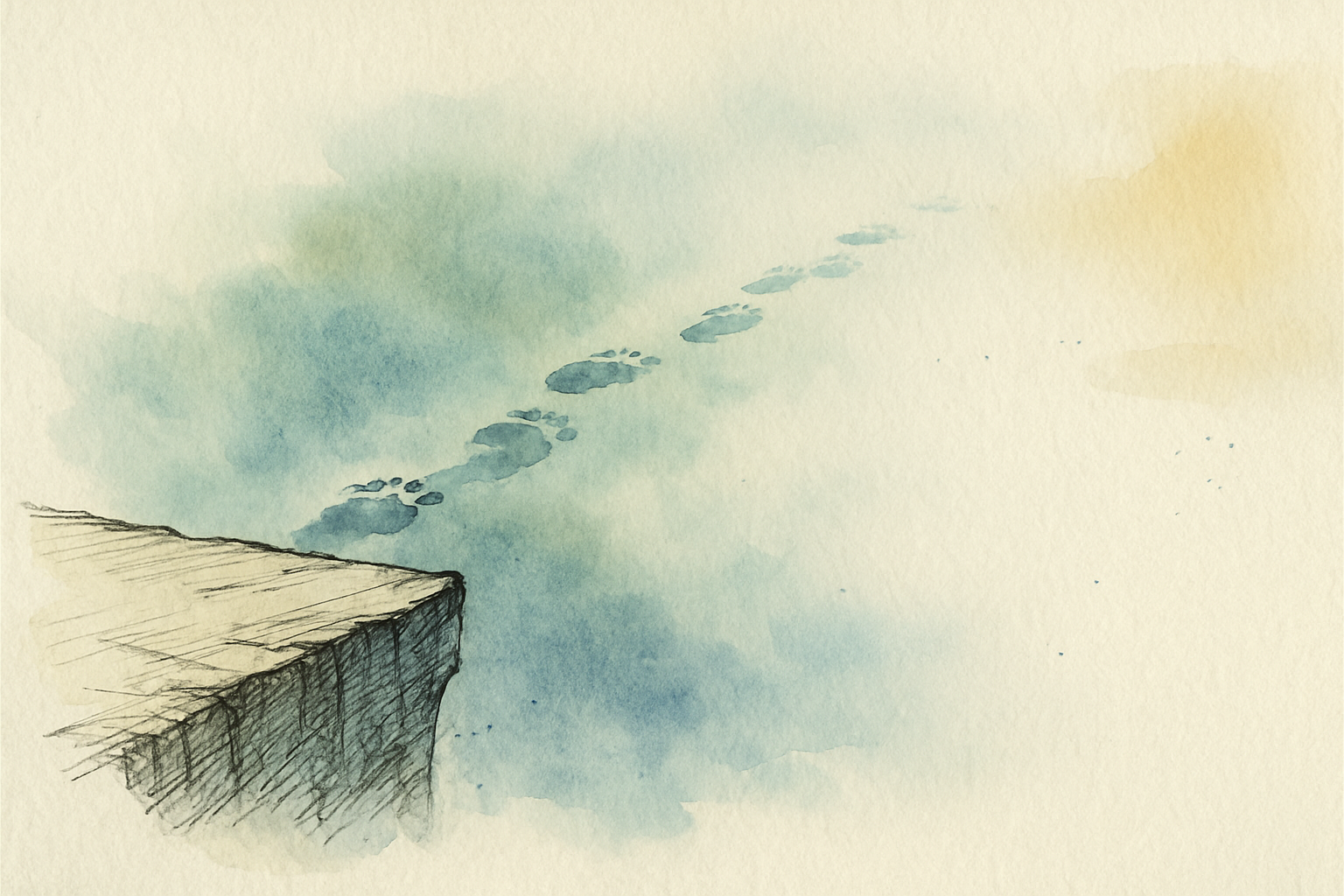
The Leap Beyond the Mind
El Salto Más Allá de la Mente
A question about whether visualization exercises can clarify desire before taking action, leading into a broader exploration of fear, play, and what makes certain fears feel life-threatening.
The Leap Beyond the Mind
A question about whether visualization exercises can clarify desire before taking action, leading into a broader exploration of fear, play, and what makes certain fears feel life-threatening.
The last clarification you made about how you can never see it from the mind was great. You can never see it at the level of the mind, because you see the pros and cons of each side. But could you actually find what you want, or get in touch with what you want, if you manage to go deeper? For instance, with an exercise like the one you described: imagine there's nothing that will make you fail, nothing you won't be able to face easily. You get out of the mind and maybe imagine different future scenarios, like "me doing this" or "me feeling like this." It can become clearer that way, can't it? Even if you don't start walking in that direction.
Yes, exactly. That can give you a really strong movement, a really strong expansion in a direction. What that amounts to is freeing up movement to happen naturally, versus the tightening that comes from trying to keep movement from happening naturally. When we're in that tightness and it opens up, we experience it as, "There's an expansiveness in this direction, and I feel like going this way." But in a sense, it's actually unlocking, unblocking something so it can move naturally.
The fruit you've never tasted
And it's creative, because every moment is new. Every next moment is new. To try to decide purely from thought what you want is like imagining a fruit you've never tasted. You can look at it and think, "I'm curious to taste it, I want to taste it," versus, "It doesn't look appealing." But beyond that, you can analyze endlessly how it's going to taste and try to decide whether it will be pleasant or not. Until you taste it, you won't know if it's pleasant, or if it's something you want to keep eating. What comes first is: "I'm curious. I want to taste that. It might not taste great, but I'm curious. I feel this desire to taste it. It might taste good, it might taste bad."
That's the part where only in the movement into it can you start to see how you relate to it, how it actually is.
Desire clarified through doing
And it often happens this way. For example, you as a guitarist: you started playing the guitar because you were drawn to it. You kept doing it. You've played other instruments, but the guitar is the one you kept going back to. First you get in touch with the desire. You imagine, "This could be great," and you go do it. Maybe it's not great, or maybe you don't like it, or maybe that's all you needed and nothing more. Everything is always changing. The only thing that's permanent is change, as somebody once said. Very Buddhist.
Fear, play, and what feels life-threatening
The more we become friends with the human experience of fear and pain, the more there's a playfulness to the dance. What happens when we're so convinced that what we are is perishable, through identification with body and mind, is that fear and pain become life-threatening. The fear becomes a fear of that which can bring about the end of "I."
Could you explain the connection between the sense of it being life-threatening and the fear itself being life-threatening?
If you go on a roller coaster, you're going to go through fear. If you watch a horror movie, you're going to go through fear. Those are often enjoyable experiences for a lot of people. The difference is that you know it's not life-threatening. On a roller coaster, the body has an adrenaline response, an edge of something potentially life-threatening. But if you feel confident that the engineers have made it safe, then the fear is going to be enjoyable. If you're not confident in that, if you really think you're going to go flying off, you will go through a different kind of fear entirely. The key difference is whether, underneath the fear, there is a ground of safety.
So in other words, evolutionarily, we're set up for this?
There's a different kind of fear at play here, yes.