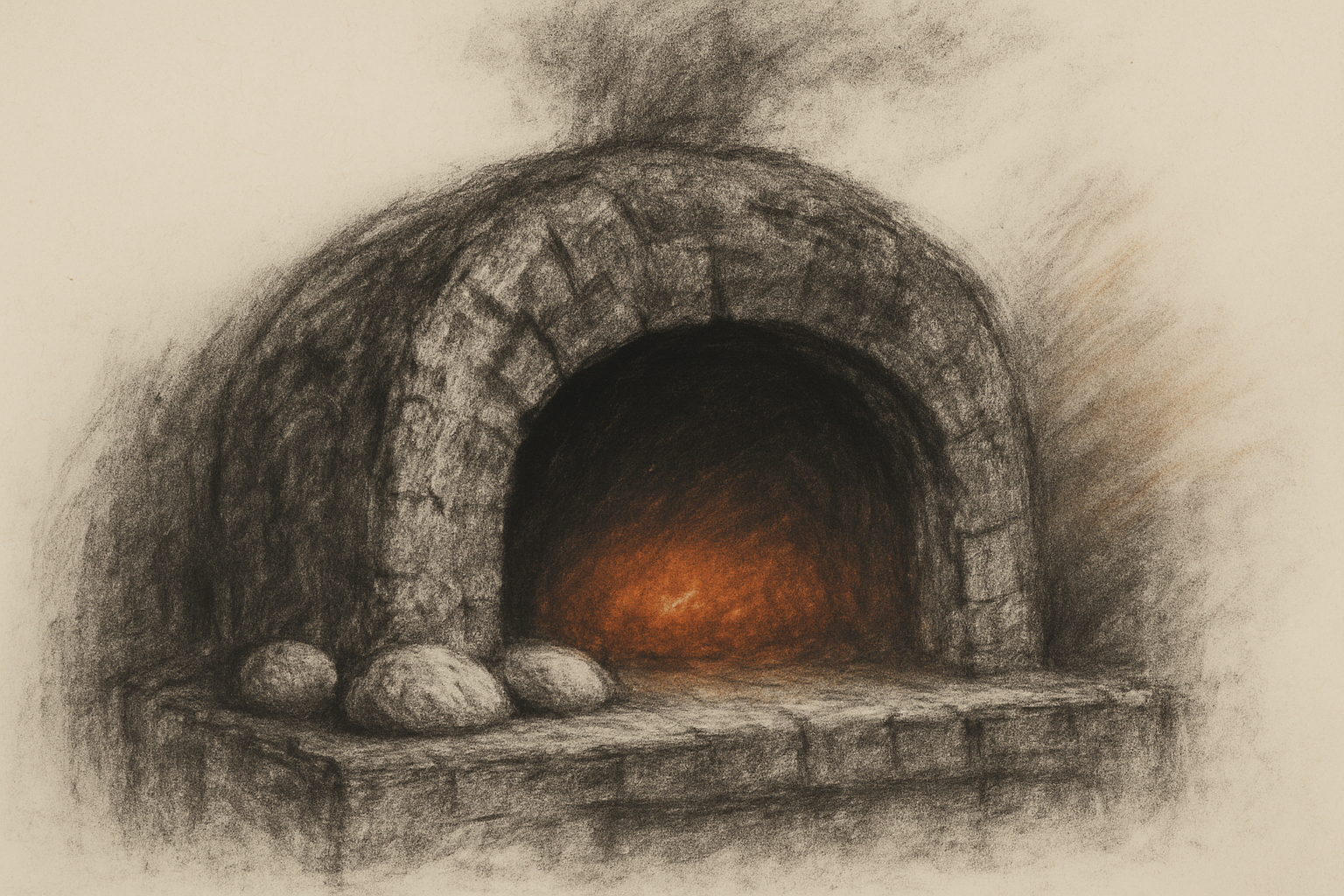
Entering the Oven
Entrar al horno
A soon-to-be father shares his mixture of deep peace and anxious grief about the life he is gaining and the lives he imagines losing. The conversation opens into themes of sacrifice, authenticity, perfectionism, and trusting what emerges from commitment.
Entering the Oven
A soon-to-be father shares his mixture of deep peace and anxious grief about the life he is gaining and the lives he imagines losing. The conversation opens into themes of sacrifice, authenticity, perfectionism, and trusting what emerges from commitment.
I'm becoming a father soon, and I think this is common: I feel a mixture of, on the one hand, a deep peace and expansiveness. In an indescribable way, this is threading me into the web of life in a really beautiful way. It's also calling me into deep integrity. I'm about to have a son, and I feel a responsibility as a male parent to model healthy masculinity.
That's one hand. On the other hand, I feel this worry that I'm about to lose a lot of my time, a lot of my agency, a lot of my choice and flexibility. The former feelings generally outweigh these ones. I recognize this is a beautiful constraint, and I'm perfectly happy to feel less like my time is my own. But I still feel it, and I still occasionally find myself grieving other lives I could have had, other relationships or potentially future relationships.
My partner is wonderful and deeply capable, and I'm really grateful for our relationship. But I find this is a habit of mine: in every relationship I've been in, there's a kind of comparing. I'm struggling to find a way to relax the part of me that wishes things were different or is scared of this intense change. It's also going to require that I can't take as many professional risks now that I have to bring in money.
On the one hand, I don't even think I need to ask this question, because it's just happening and it's wonderful. And yet I sometimes feel, when you say that going after what you want is one of the more potent paths to understanding who we are, I worry because it feels like this chose me, as opposed to the other way around. I think I'm worried about using the situation as an excuse not to go after what I want. Maybe I'm worried about protecting something around my desires and ambitions and not giving absolutely everything away to my family and my child.
That's a lot there.
On modeling masculinity
One thing around masculinity: as a male parent with a son, don't be too worried about being a masculine role model, because then you will focus on ideas of masculinity, and that's just going to be conditioning. You are a man. Your being in this world is a male body-mind, and that already has all you need. At another level, we are neither male nor female, and we are both. The key is just to be you, and then you will be the role model that is needed. Whether that is masculine or not doesn't matter. It might be the right mix, but the key is: what is it that you are?
What do you really want?
When I say "be you," it touches on your paraphrasing of something I say, for example, "go after what you want." The key there is: what do you really want? That's where we get confused. Part of what you're talking about is a questioning of what you really want, and it's very natural to have these questions.
In a sense, it's an infinite process to discover what we want at the deepest level, and it's a moment-to-moment thing. You could learn that what you thought you wanted was just an indulgent, immature impulse. Ideally, you would recognize that over time, as you learn and grow and realize, "Oh, that was childish," meaning you've outgrown that part of yourself. That's a good thing.
But then you could discover that you're actually pushing away something you really want, and you would need to learn to embrace that and meet its challenges. Often when we deny something we want, it's because we are trying to avoid the challenges it brings. And often when we are moving in the direction of what we truly want, it does feel a bit like what you said: it kind of happens to you.
Yeah, it feels really confusing. It's almost as though what's happening in my life is a step beyond my current level of maturity and awareness. There's a bit of a lag, and then I'm like, "Oh, I do want that," or "Oh, that does feel good and grounding." I feel lucky in that way.
The phoenix from the ashes
Question (second speaker): I think you sort of can't avoid those fears at this stage. It's going to be like a phoenix from the ashes. There absolutely is a sacrifice, possibly bigger than anything you've ever done before. But there's a phoenix from the ashes where you're in service to your son, and it really has to be that way, but it will happen naturally. You will want to. Right now it's like, "Oh God, what's coming." Every parent deals with that. You will want to, in a way, but at five in the morning you don't want to. There's this constant sacrificing in a really positive sense of my own ego desires or more self-serving desires. I could extend a love to my daughter that I had a very hard time extending to anybody else. It's like: your needs first. You're not loving me right now, and I'm going to love you. And it's beautiful.
I feel that already. And I think maybe part of my worry is, for example, I definitely feel that about my mom. She always put us first. But there have been times growing up where she's caught herself not supporting herself enough to robustly support us. I've heard her say things like, "I'm always spending money on stuff you guys need, and I wait for myself until the last moment before upgrading this or that for myself."
So in that sense, I can be a people pleaser. I can marginalize my own needs or excuse them away. I think it's a common trap: thinking that I need to be other than I am in order to maintain relationship and keep the peace. I'm worried about going too far. I recognize what you're saying, and I know that when I'm feeling full and good and stable and in that integrity, whether masculine or feminine or just the unique mixture that is me, I feel that effortless quality. And at the same time, I know that I sometimes lack the boundaries necessary to cultivate that robustness in order to be able to give.
Awareness without deciding
But that's the thing: you're now going to work with this, because you see it. You don't need to see it any deeper right now. It's just the awareness that this is a pattern. Life is going to move forward. The baby is going to be here, life is going to be happening, and you will be dancing with all of that.
These questions you have are important, but it's also important for you not to decide it has to be one way or another, because the questions you're having all have to do with balancing: how to be in service to a child but not sacrifice something that shouldn't be sacrificed. What should be sacrificed, and what should not. That is something you will explore in the living of it. As you go up the mountain, you will be figuring it out.
Question (second speaker): My experience with that is that your priorities come into such sharp focus. It becomes: what can you not sacrifice? And what can you?
Grieving the dream
I love something you said earlier that I wanted to address: when you said you're grieving potential other decisions and futures and partners and lives, that you're worried about a certain kind of loss. I would say: yes, grieve it. Part of the phoenix from the ashes is exactly this. The ashes, the fire, is the grieving of all that could be, all that is imagined. And the committing into this life and its responsibility will be the oven that brings the temperature up.
Question (second speaker): It's like a crucible. It will just sharpen you.
I don't know; that oven seems too hot.
I do want to say something related to this. At one level, yes, you can avoid that, but it's going to be tragic. At that level, what is needed is that sacrifice, that surrendering into the responsibility and commitment of this life. And at another level, nothing can be lost, because there wasn't anything prior to this that is being lost. All that is being lost is the dream of what could be.
Yeah. One of my issues is perfectionism, and I seek it in career and friendship and relationship. It's a struggle for me that this relationship doesn't speak to as many sides of me as I would ideally want. There's a part of me that says: "Sorry, dream, see you." But there's another part that's like, "Well, I can meet those needs in friendships or other relationships." There's a part of me trying to figure out how to feel like my full self, like all of my sides are being met. And I know on some level that's the dream. If I try to hold on to those possibilities, I think it will end in tragedy.
I sometimes have that clarity and think, okay, the only way is through, so get in the oven. Through that transformation, rise as the phoenix. Then I'll discover whether there are parts of me that are undernourished in this situation, and I can find other ways of meeting that. But it's never going to happen if I don't commit and actually go through.
Question (second speaker): You prioritize, and through prioritizing you find yourself. If you have to let go of something that was important for a while, it will come back. But if you're just keeping options open, you're not actually actualizing who you are. You're not fully engaged in your own being, in your own life. That's why he keeps saying "dream." It's just up here.
Trust that what is essential cannot be blocked
There's something needed here, which is trust. Trust that what is essential in you, whatever is the reason you're here, whatever your wants are that are true and deep, won't be blocked by becoming a father. I think there's a sense of either/or: "If I become a father, then things essential to me are going to be lost, or potentially lost. I will lose an essential amount of time or ability to develop in a way which is essential." And that's where I would say: just trust that it's not this either/or. They can completely work together.
It's almost less the either/or and more that I am becoming a father, and part of what I meant by coming into integrity, whether you call it healthy masculinity or healthy personhood, is: given that I am becoming a father, how do I be me in such a way that will naturally resonate and support this child being them? And I guess, as we've covered: get in the oven.
Dispelling inner lies
That has to do with authenticity and integrity. Be honest with yourself. First of all, just dispel all of your inner lies. You know how you see all the ways you try to fool yourself. What is left after that is you being you. The only way you're not you is when you're pretending something to be real which is not, pretending things to be a way they're not, rationalizing, pretending to feel a certain way you're not feeling. That's how we are inauthentic, and it begins from a need to sustain an idea or belief about ourselves that isn't true.
Yeah, and I'm realizing a lot of the issue is what I said: sometimes feeling like I need to be a certain way to keep the peace in relationship. I think maybe the answer is just show up authentically and trust. That process may be turbulent at times. It won't necessarily keep the peace, but that's not the goal, right?
Right.
Question (second speaker): You can't keep the peace with a two-year-old. Not necessarily. If it's his way or the highway, you have to be authentic. You have to recognize: that feels irritating, I should do something about it.
Sometimes anger is appropriate, in total contrast to the idea of peace. If peace means the absence of anger, at least that's not the peace I'm talking about.
Perfectionism and the void
Question (second speaker): Someone once said to me that perfectionism is associated with a void. Platonic forms are perfect; they don't exist. Do what you can. You've got a kid to look after, you've got your career, whatever you want to do in that realm. You do whatever you can.
You have a great role model in your mother, who managed to accomplish a lot in her career while being a parent. A lot of people have amazing careers and are parents. You give up something else. That's the kind of stuff that tends to go.
I think part of me started this conversation thinking about how to strategize, how to build time in to make sure I'm still playing guitar, still doing this or that, how to protect these little pockets of myself. What's occurring to me now is: just trust the process. Go into it and trust that things will rearrange how they need to.
Don't plan the unknown
You can't plan now. You're going into such a new universe and way of being that you can't plan how you're going to manage your time. You can't imagine that right now. Don't come in with conditioning around how things need to be so that you can play your guitar. I would recommend that you be more fully open to what can emerge from that new universe. Maybe guitar is something you gravitate to, and maybe something else.
So if I should try to protect anything, maybe it's a meditation practice, or that subtle discernment to be able to tell what's arising.
Yes, or for example, how you can practice meditation while you change diapers.
Question (second speaker): I do think it's also important not to over-enmesh with your child. Sometimes a parent should go to a retreat, and it will be better for the child if they do, depending on the circumstances. Obviously nothing that puts the child's well-being at risk, but the awareness of not losing yourself entirely is important.
That's maybe the balance you can't plan for. You just have to be in it. Maybe the baby was just born, so let's not go to this retreat. Then later on, it feels manageable and appropriate and beneficial. The idea that everything has to go out the window and all your energy has to be on a single way of being with a child is also a conditioned way of being.
I have a renewed excitement for deeply listening to what is emerging and what wants to or needs to happen.
Nothing essential can be lost
This connects directly to the method of removing layers. That which is lost is not essential, and in fact needs to be let go. The language of sacrifice is appropriate, because if you cling to preserving something that needs to be sacrificed, then it's problematic.
Question (second speaker): I think of it like a card game. You're in the game now. You're playing. You have to drop some cards to pick up a new one. You could do everything, you have so many talents, so many things could be. But you played your hand.
The thing is just to play the next hand and continually renew. As you learn to let go and sacrifice, there is that grieving of the ideas of what you are and how life should be. The moment of the game has moved to the next. That hand is lost and this one is won, but it's all past. You start to learn that that which is essential cannot be lost.
Question (second speaker): I think there are times when, as a parent, your development can become uneven. You might become really developed in making money or being a father or husband, and you leave your creativity to the side for a while. If you do that too much, it will come knocking at your door as soon as there's an opening. I think you can trust that process too. For a while you might be more narrowly focused.
The infinite game
Don't try to feel ready. It's not going to happen.
There's a story from a book, I think it's called The Infinite Game. It's about a boy who learns to play soccer and becomes really good at it. In the world he is in, he becomes the best player, the number one. The instant he becomes the best, the universe shifts. He doesn't change; he still has that incredible ability. But now, in this new universe, everyone else is at a level where he's suddenly a beginner again. So again he starts playing, and he loves the game, and he gets better and better. When he reaches the top of that game, the universe shifts again, and he's a beginner once more. He's constantly improving, loving the game, becoming more intricate and subtle and flowing in his performance, and then the universe where he's mastered everything disappears, and in the new one he's a beginner again.
This is a metaphor for how to live. At that level, it's infinite.
I feel like that, except I get to about sixty-five percent of my capacity and then the universe shifts.
My experience is the same. I don't feel like I'm the master of the whole thing. It's more like there's a certain confidence, and then a whole other level of challenge just appears.
Some people are incredible at computation but don't advance to more sophisticated concepts in mathematics. You don't need to be an absolute expert at the more fundamental levels. You need to be solid. And I think that's something important: sixty-five percent sounds like a solid number. Don't waste time trying to perfect every level before moving on.
Perfectionism as the enemy of living
When you mentioned perfectionism, that is a really good metaphorical antidote. You'll never advance if you're always trying to nail it. It's like trying to have more perfect form in weightlifting when what you're actually training for is to go on a long hike. At some point you're ready. If you compare yourself to the people who are just trying to lift weights, you're never going to be good enough, but your objective isn't weightlifting. It's a means to an end.
The weightlifting is the training and the preparation, but it's not the actual thing. Diving into life versus feeling ready: with a perfectionistic mind, you're never going to feel ready, and so you're not going to dive in. You're stuck in the gym, and life is waiting.
Question (second speaker): Two words come to mind: humility and fulfillment. They're much more internal experiences and not achievement-related. I find that when I'm focused there, I forget myself, and then, oh, achievement happens. It's the forgetting of the "me," the one that has to get from A to B. It's what we're always talking about here: presence. There's a magic to that process.
Humility and fulfillment. Don't try to feel ready. It's not going to happen.
The universe shifts, perhaps naturally, in cycles, again and again. Even if you're a perfectionist, at some point you get good enough, maybe it's sixty-five percent, and everything shifts, or things change. It might be that it shifts if you're actually open to it. But some people might be very attached, and they don't want it to shift. They want to stay in the world that is known and controllable and limited. If you keep going, if you're open, the universe shifts. But some people are attached to the known.
Listening to the deepest thing
If you just open up to the deepest thing you want and listen to that, then everything else will tend to cure itself.