The Image of the Knower
La Imagen del Conocedor
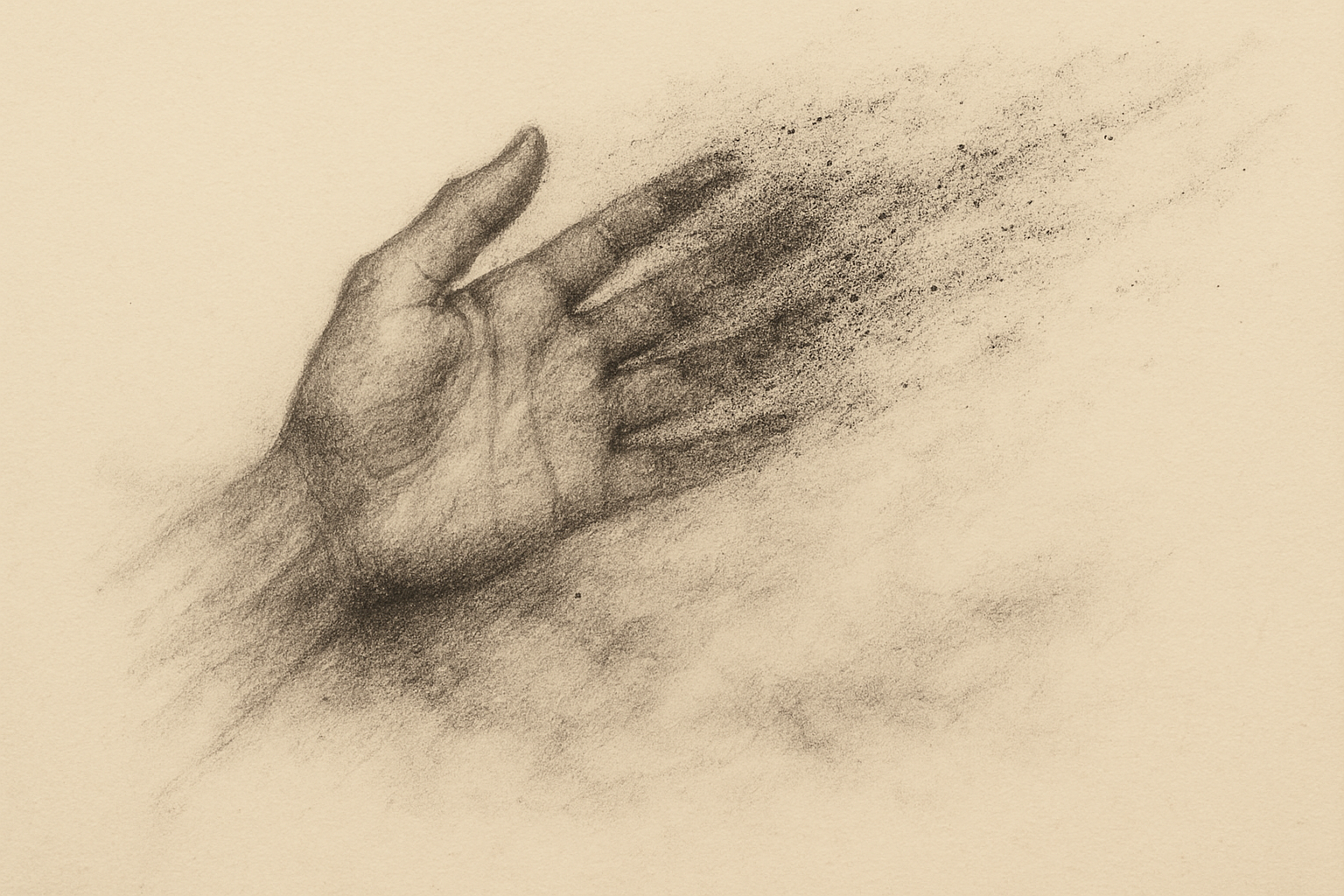
A student who has learned to disidentify from thoughts asks what it means to say "there is no one," and the teacher explores how the sense of being a someone is constructed from images and sensations, much like the image of a hand overlaid onto raw feeling.
The Image of the Knower
A student who has learned to disidentify from thoughts asks what it means to say "there is no one," and the teacher explores how the sense of being a someone is constructed from images and sensations, much like the image of a hand overlaid onto raw feeling.
I'm getting pretty clear about recognizing that I'm not my thoughts. I'm not judging myself for the thoughts that come up, and I'm seeing them clearly as a kind of program. But this pointing I keep hearing, and have heard probably millions of times, that there is no one, that there is no self: I don't get this. I've been reflecting on it recently. It was always something I pushed aside, thinking I'd figure it out later and just focus on disidentifying from thoughts. But recently I've been sitting with it, asking, "What does that mean, there is no one?" Of course there is someone, because I notice that I'm having an experience. And then I go deeper into that, and I feel like there's something in the pointing that's calling me in. Do you have any pointers around this?
It has to do with a belief, and the belief is not just a one-line thought. It creates a perspective, a mental construct.
You could reflect on it this way: "no one" is addressing the sense of a "someone." If there weren't already a sense that there is a someone, the pointing of "there's no one" wouldn't make sense. It would actually be unnecessary.
The someone is a filter on knowing
So then, what is this someone? You said you're experiencing. Right now you're hearing sounds, hearing words, seeing, having sensations and perceptions. But that which knows all this is being known through a kind of perspective or filter that is interpreting that which knows. Does that make sense so far?
Yeah, I can sense the filter.
That which knows right now (and by "knows" I mean you're aware) is aware of sensations and sounds. But there is an assumption that there is an entity, something separate from the sound, separate from the sensation.
If you pay attention to, for example, a sensation in your hand, there could be an interpretation that there's something aware of that sensation at a distance from the hand. Usually that "something" will have a location: somewhere in the body, around the chest, or in the head behind the eyes. The sensation of the hand, as you experience it, will be filtered through this perspective of a location that is knowing the hand, and the hand is felt as separate from the knower of the hand.
Mm-hmm.
The knower as a thought construct
You could find this in your experience now. It might be a little blurry, not entirely clear, but it's actually a thought construct.
The sensation of the hand is appearing. This is where you could say it is known by no one. To be more precise: it is not known by that which you assume to be the location that knows it. There's a thought construct placed in a location, then a creation of a sense of distance, and then that becomes the "I" that knows. That becomes the someone who knows the hand, knows the sound, knows the computer.
But that position from which the knowing seems to happen, that which is described as "the someone," is a thought. It's not you.
When that is seen to be a thought, several things can happen. One of them is the recognition that there is no one. But it can be expressed in many ways, and "there is no one" is just one way. It might not be the right formulation for you. It's addressing the sense that "I am that someone."
Seeing the image
If you keep looking at that which seems to be the knower of the sensation of the hand, you will notice that it's an image. It can also be attached to a sensation in the body, some part of the body that becomes the center of this "I." Now there are two sensations: the one I'm paying attention to as the hand, and then a sensation somewhere else where I'm attaching the sense of "I am here." Because I have called this sensation "I" and that sensation "not I," I can create a sense of distance between the two. I can create a seer and a seen, a feeler and a felt.
But actually, if we look closely, the "seer" is just another sensation. It's just another thought. It's usually a combination of thoughts, which are images, and sensations.
The hand as direct experience
To explore this a little more: go back to the hand. Just the experience of, let's say, the right hand. Without looking at it, what is the experience of your hand? How would you describe it?
Like the sensation of it?
Everything you know about your hand, but only through direct experience, without looking at it.
It feels kind of cold and tingly, more so at the fingertips. There's more sensation on the palm than the back of the hand.
What's the shape?
I know the fingers are there, and I guess if I move them, I can sense that. But it does feel like a blob of tingles.
Two layers: sensation and image
Right. But you know that it's a hand, so you know the shape. If you include the thought of the hand, then there are two things. There's the blob of sensation: tingly, cold, and so on. And then there's the image of it. That image is, in a sense, overlaid onto those sensations. Do you recognize that?
Yeah, I can't help but imagine the hand in my head when you ask me that.
You say "in your head," but it's not really in your head, right? The image is appearing and the sensation is appearing, and then what happens is the image gets overlaid onto the sensation. You don't have the image of the hand over here and the sensation of the hand over there. It's like a glove fitting the hand.
The image and the sensation. Interesting. I've never thought about it like that.
That's something the brain does; the mind does it. It's called proprioception, a biological mechanism to align our image of the body with the actual sensation of the body.
What I'm distinguishing now is that the image and the sensation, as you are aware, are not the same thing. Not many people are aware of that. The fact that you could describe the hand directly as a blob of sensation is actually unusual. That shows there is quite a bit of awareness already, which you can refine further: isolating the image, the thought, from the sensation.
From the image of the hand to the image of "I"
I'm reflecting on this because it's quite important, and because the image of the hand is a metaphor for the image of "I," that someone who is knowing all of this.
If you now, instead of the hand (which is easier to isolate), look at that which is watching, that which is seeing, that which is knowing, you're going to encounter the same structure, but it's going to be trickier. There will be the sense that, yes, there is something here. And then there's going to be that someone watching, that someone, the sense of a subject. But that sense of a subject, that someone, is like the image of the hand: it is overlaying on something, which is the knowing itself.
The difference is this: the knowing, as opposed to the sensation of the hand, doesn't have a location. The seeing doesn't have a location or a direction. What has a location is the image.
You can pay attention to this and start recognizing the image of "I": where it is, what it looks like. At times it may be related to a sensation in the body: something in the chest, the breathing, something behind the eyes, a certain contraction that gets referred to as "I." There is an anchoring. But it's not like the hand, where there is a blob of sensation and then the image of a hand. Here, there is the anchoring of an entire idea of what I am onto a location in the body.