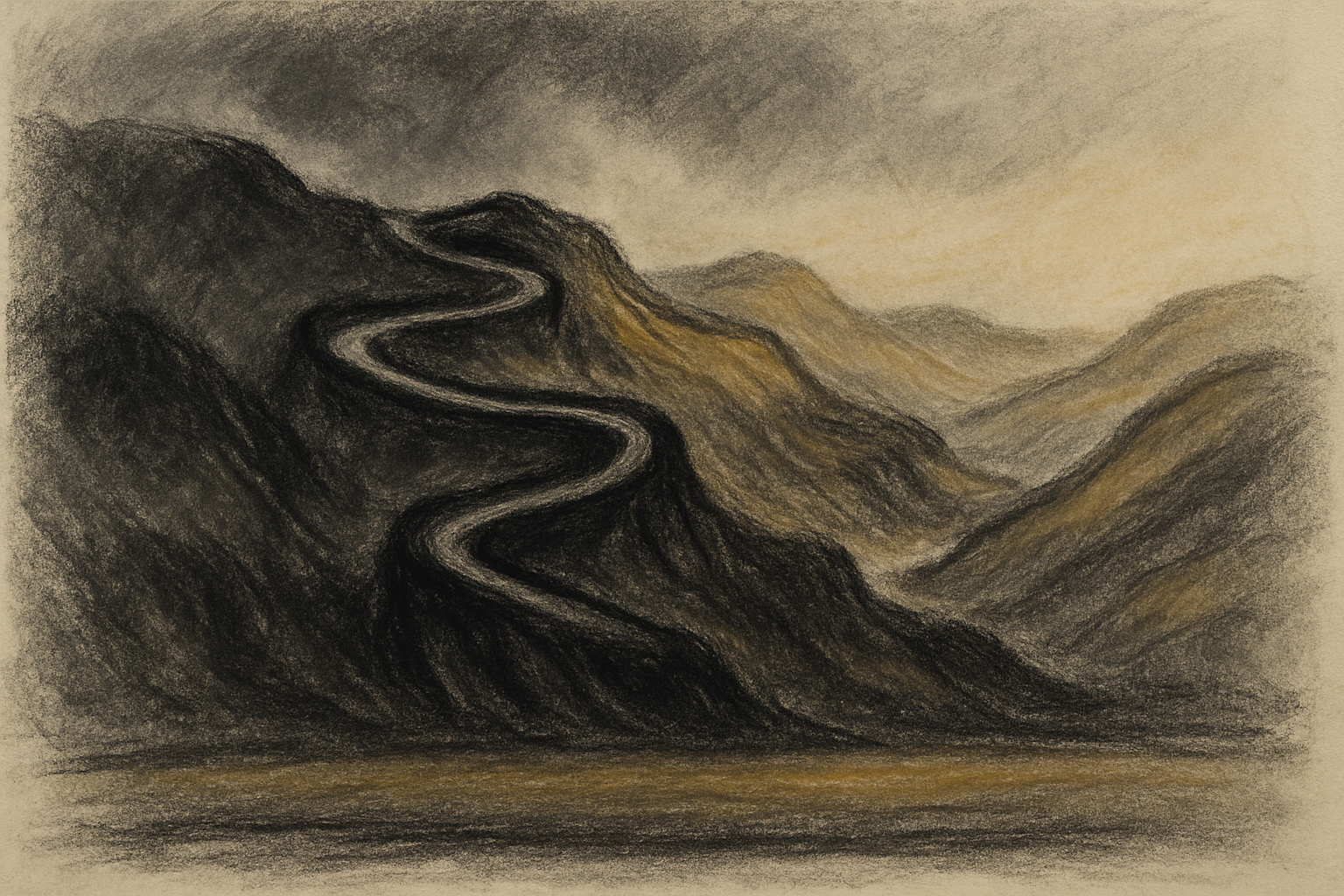
The Roller Coaster and the Journey Through
La Montaña Rusa y el Viaje a Través
A question about the emotional ups and downs of returning home after travel, the impulse to identify with shifting moods, and learning to recognize what remains unchanged beneath them.
The Roller Coaster and the Journey Through
A question about the emotional ups and downs of returning home after travel, the impulse to identify with shifting moods, and learning to recognize what remains unchanged beneath them.
I was traveling recently in Argentina with my partner. My mom came, and we were very welcomed by family. I felt a sense of relaxation and ease, and part of it was the novelty of traveling. When I came home, I was almost a little frightened by what felt like a relative shallowness, a sense of not being so fully embraced by the community here, and on some level feeling less inspired or stimulated by it.
I was jet-lagged and sleep-deprived, and I noticed my system going on these wild ups and downs: feeling a lot of aversion, then swinging to "this is my life and I can create it how I want," a sense of power and authorship.
I went to a meditation that evening and really tapped into the body. I felt I had to get a handle on this roller coaster. Because of my state, the radical change of scenery, the long flight, it almost felt like being on a psychedelic trip, as though I had been shaken loose from the usual constellations of my day-to-day life. When I tapped into the body, I ended up feeling an energy channel, and that turned into a kind of meta-meditation. Then I felt a beautiful peace. I thought of a conversation we had had before, and the phrase "I am love" came very naturally, on its own.
It felt true, and almost embarrassing. I did not know exactly what to do with it. I became worried on a relative level: what if I love someone too much, or not enough? Just a worry about what this might mean socially. Then I thought, "I am just going to tap into the field of love." And that seemed to work. It felt deep, calming, stabilizing, uncomplicated, true. I am having trouble accessing it right now, but it felt that way in the moment.
Since then, the roller coaster has continued. Yesterday I dove into the job search, got into computer brain, became way too much in my own head. It feels like I know better now, or like I should know better.
Which one do you mean: "I know better" or "I should know better"? One is a realization. The other is self-criticism.
It is the feeling that I almost know better. I am cognizant of not doing the action that would actually be nourishing or stabilizing or generative, and instead doing the action that feeds the sense of self, a sense of lack, a sense of hopelessness. Sometimes I just do it. But sometimes I can watch myself do it, and it feels like the part of me that wants to stay small and contracted.
The roller coaster as the problem
When you say "the roller coaster," is that the problem? You keep referring to something as "it," as though we are talking about the problem you are bringing, and it is not entirely clear to me what that is. Is it something around identification, contraction, the roller coaster?
It feels like I can quickly descend. I call it a roller coaster because when I go down, it feels like a really quick drop.
And the descent is into what? What is the experience at the bottom? Hopelessness, you said.
Yes. I do not know if this is the life I have chosen. I do not know if I am going to be able to find a job.
So it is a mood, a negative mood, and the up is a positive mood.
The positive mood has a feeling of getting into the here and now, getting into my body, and getting into a sense of agency and clarity. Seeing through all of those thoughts.
Moods and the trap of interpretation
When you describe the roller coaster, it is these changes in mood. You also referred to going to Argentina, coming back, and the contrast: the warmth, the cultural differences, which are very real. You go to a different country. There are qualities there that are different, and there is a change when you come back. You realize the qualities you find missing you can bring yourself, or you can see how to create that in your community, to the degree that you can. But this is the ups and downs of your moods too.
There is a trap in the interpretation: when I am in an up mood, I am doing things right, things are going well, I am getting it. The moods are simply the nature of the body-mind. Maybe when the mood is actually on the down, that is when you are doing the best work. What if?
It is really hard not to adopt the assumption that there is a goal, that things progress and get better, that I am improving at it. This could be a spiritual goal, or it could have to do with the experience of life being a certain way. We map our moods, call this "up," call this "down," and then it becomes a very subtle rejection of what is happening.
Realizing you are love
And one more thing, around the discomfort you described about the social impact of considering, and possibly realizing, that you are love. You are that which you have, in a way, been looking for. This is a very important thing. We operate on a paradigm that love is something people give to each other. If you need to get it from somebody else, and if you do not, then you suffer. But if you see that you are the love you have been looking for, and in a sense it is the nature of reality and everybody, then it becomes more about how we share this and make it more explicitly the experience.
This will completely disrupt your paradigm, your belief system about relationships. So it makes sense that you would feel a certain vulnerability. You said something like embarrassment. There is a very young part of us that comes up there, because that is what we knew as children. It brings up innocence. And in a sense there is a not-knowing, because all of the knowing has been about how to do the right thing and get the love you want from others. And that whole thing goes out the window.
It feels like I am flip-flopping between believing in that ability to just be loving, to channel love, to fountain love. It is something I am consciously cultivating in anticipation of having a child. And then the slide down is when I slide back into victimhood or shame.
Who knows the up and the down?
I understand that, and that is the thing we work with. We work with our moods and thoughts and beliefs. But what I am trying to point to is this: you say "I am flip-flopping." Now, how do you know the up and the down? How do you recognize the up and the down? Or, what is it that knows the up and the down?
There is only one answer to that question. Let me put it differently. Who knows the up and the down? Who recognizes that which is going up and down? Who is the knower?
It felt like a koan.
It is a koan because you are stuck on something, but the answer is really simple. It is very obvious. One letter.
Me. I.
Yes. But are you that which goes up and down, or are you that which notices what is going up and down, what you call these moods, this river flowing to apparently known temperatures back and forth?
Can you restate the question?
You said, "I go up and down." I am referring to these moods, the temperature of experience going up and down. I am asking: are you that which knows and notices what is going up and down, or are you that which goes up and down?
I know the correct answer is "that which notices." But this inquiry got me thinking. I wonder, in those moments when I felt like I could really see through all the thoughts bubbling up, not identifying with any of them, I felt the freedom of that. And now I wonder: was that more of just a taste while I was still identified with "me," or was that more of "that which knows"?
Appropriating the taste
Definitely a taste. What happens is we get tastes, and then we appropriate it: "That is what I am. I am only that when I am feeling in that specific way." We taste a certain well-being, and then the mind and the process of identification turn that into something I did in order to get that. Then the whole thing becomes about how to figure out how to do this more, how to get there more, how to get better at being there.
That could be what you are calling the up: the feeling better, the well-being, more loving. But it is actually a misunderstanding of what is happening. It is a mind-appropriation of that, as if it is something I am doing and can do.
That is why, in a sense, it is more important that you see this when you are going down, when you are at the low. That is when you can more powerfully recognize what you are, because it does not depend on the experience. That is where the love is. That is where the peace is. Then the roller coaster can keep happening and something remains unaffected. Over time, the roller coaster settles, because there is a lot of energy put into the roller coaster through this appropriation: "Now I am doing it right. Now I am getting it. Now I am not. Now I am going down. Now I have to try again." The nature of a roller coaster is like a river. It is going to flow, and the flow is change, and the change is up and down.
Is the approach you would recommend, regardless of where I am on the roller coaster, to simply be with that and observe it?
Yes, and look at that which knows what is going up and down. Because when you say "I go up and down," that is not you. Conventionally, in society, we do say "I am feeling low" or whatever. But here we are pausing the social norm of language to address the nature of what we refer to as "I." If you notice something going up and down, are you more what is noticing, or more what is going up and down?
You said earlier that you know the right answer. What matters is for that to become an obvious part of your experience, the obvious way in which you relate to your experience, rather than something you arrive at after contemplating, which remains an intellectual understanding. The intellectual understanding is good, valid, and important. But for it to become obvious: then the up and down is no longer a problem.
In fact, when you are in the down, it becomes: "Interesting. What is happening now? What can I see more clearly, more deeply, thankfully, because I am in the down?" You can see what is in the depths of this murkiness. It is no longer a problem. It is an opportunity for clearing, for dissolving.
Two paths: identification and disidentification
I would imagine that iteratively going through the process you just described, you learn to identify more with that which observes.
In a sense, yes. That is one way. And then there is a whole other process around the nature of that which is watching. But there is another way, which is to simply disidentify from that which goes up and down. That is a more direct path.
I feel like I did that on Monday. I was in a meditation class and really got in the groove. Whatever thoughts came up, whatever sense of identity came up, I saw it as something trying to lay claim to me, to what is happening, to what is real. After a while I felt a lot of liberation, not latching on to any of them. And it is funny, the way I started this question was: why am I not doing that all the time? But then we get into the question of trying to resist what is happening. It feels like a paradox. On the one hand, there are methods to disidentify with the map of the self. On the other, if you are trying to do that, by definition you are not doing it.
The limits of methods
Exactly. The methods go so far. The tools, the words, the teachings, the pointers, Buddhism, Advaita, all of it: they are just tools, just methods at best. They can get you so far, to a certain point and not beyond. And then from there, a different pointer or method or tool or technique is needed. It might even contradict the previous one. That is why this is tricky. The pointer could be "look left," and at some point you need to look right. The pointer could be "you are this," and then "you are not that."
The tools and techniques at some point come to their end, and a different one is more useful. The more you do this, the more subtle it gets, the more tricky. What you are pointing to is correct. At some point, there is no tool or method or technique that works. You are left without anything that helps.
But that pointer ("there is nothing you can do, nothing helps"), if heard or adopted too early, would be wrong, inappropriate, harmful, and not useful. There are quite a few teachers who point to this, and it is very useful for someone in a very specific place. But people who come into this work can agree too early: "Oh great, I am already there. I do not do anything. I am enlightened." Or they attempt to feel better by doing nothing. The "doing nothing" is a very advanced pointer.
I am saying this more generally, but it is related to what you brought up about methods to disidentify. The more you use those methods, the more you are doing something, which reinforces the identification and the seeking to get somewhere. You could do that for a very long time and never get past it.
I see that a lot with the commercial wellness cycle: this method, that method, breathwork, tantra, and so on. People can get caught in a loop of seeking methods and experiences.
Because that is all they know. All of those methods are very useful within a context of understanding that they are not "it." They are not going to get you there. In a sense they will get you somewhere, but not beyond a certain point. Then people say, "Well then I will not meditate, I will not do breathwork, because this other thing is the real thing." Same problem.
A lot of people get stuck because they have not done therapy, energy work, emotional work. There is a lot of talk about spiritual bypassing, which is trying to resolve psychological issues through a spiritual practice when you need to do therapy. But there is also a psychological bypassing: using therapy to avoid addressing a more spiritual need. There is a lot of both.
The role of will and discipline
In either case, would you say there is a need for a manifestation of will? A commitment, whether it is to the process or the non-process?
You are bringing up another good point. Will, willpower, free will: that touches on all of this. There is a teaching that says there is no free will, no independent will, and so what is the point? But what I would say is: while you experience having will and willpower and free will, use it. Develop it. Harness it. Use your willpower in this work.
It is important to do that always with balance, always with wisdom and understanding. There has to be enjoyment, a love for the process, not just torture and pushing. It is like learning to play an instrument, which I know you do. If it is all pushing and forced discipline and no enjoyment, you are not going to learn very much or very well. But if you want to practice without any discipline, structure, or commitment, you will be dabbling with very little growth or depth.
I tend to dabble, with music and with life.
So at one point we can realize the best thing is a combination of both: the dabbling, the playfulness, the enjoyment, together with the discipline, the structure, the commitment to push through resistances, to face fears, to face pains. There is something that can be experienced as will: the will to go there, to face that, to cultivate the structure.
Developing the ego before transcending it
You can think of it this way: you want to develop the ego before it can be transcended. It cannot be transcended too early. It cannot be seen through when it is undeveloped. People who have a very undeveloped ego and transcend it end up in a mental hospital. The ego needs to have a certain capacity. Most people do not have that risk, but if you try to transcend it without developing it, it is like pulling on a fruit that is not ripe. You are going to rip the branch off. Instead, nurture it, and it falls on its own when it is ripe.
If you notice, I am going back and forth, pointing in somewhat contradictory directions.
It is helpful because when I was in my early twenties, I think I was lacking a lot of structure. I did have a mental health scare. I did not end up in an institution, but there were some mental health professionals who thought I was in the early stages of psychosis. I noticed my mind doing really wild and powerful things in the context of that desperation. I think on some level my system has a fear of going there again. So cultivating healthy structure, healthy ego, at least simultaneously, if not emphasized beforehand.
Exactly. And that is why I find myself, without knowing this history of yours, always emphasizing with you specifically the side of push, will, and discipline.
It is very rare for people who come to this work not to have some closeness to an edge, some experience at the boundary of their mental stability, to put it clinically. And that is in a sense a blessing and a curse, but mostly a blessing. It happens because we are, early on, curious to see what is true and real and beyond the mind. And the young mind cannot handle that.
If you look at the practices in Buddhism, there are years and years of very dedicated, strict practice. It is not so much that the practice itself will lead to realization. It is about preparing the body-mind to be able to go there. Some people are ready at twenty. Some are at sixty. There is no rule. Some are never ready. But I relate to what you are sharing about the fear of going there, going back there. I relate to it personally.
Going back through, not around
In a sense, you have to go back there. There is no other way than through it. But it is going through something in a different way, because you will be more prepared. The experience will be different. It will feel different. But at the same time, it will feel like you are going to that place, the horrible, scary place. We go back more prepared.
This is very well depicted in Dante's Divine Comedy. He says: "Midway through my life, I find myself in a dark forest." He sees a mountain, and he sees light at the top. He recognizes that is where he wants to go and needs to go. This happens in the first few pages of a three-book poem.
He tries to go up the mountain straight to that light, and he meets three beasts. They are completely overwhelming and terrifying. So he goes back down and meets Virgil, who becomes his guide. Virgil was a real poet, admired by Dante, which is why Dante chose him as the character in his story.
Virgil guides him into the realms of hell and purgatory. Through hell, through the bottom of hell, at the very core, in the last level, there is a door through which he passes and ends up at the beginning of purgatory. That mountain and the heaven he saw at the start is actually Mount Purgatory, but he is not ready to go up. He faces the beasts, which are within himself: his own psyche, his own fears, his own pains. They are too overwhelming. And so it takes a longer journey, which is into the shadow of the psyche. That is hell. And purgatory's shadow is to see what has not been seen in himself.
He starts to see all the aspects of mind that are hellish. As he sees through all of that, he enters purgatory, which is coming to terms with the feelings that have been too overwhelming, meeting them, purging them. Then he is ready to go up and cross into the threshold of heaven.
But if done prematurely, one is simply not ready. One naturally retreats from the beasts. In the story, he does have to make that journey again at the end, but he is prepared.
Peace in the depths
In a sense, yes, you have to go there again. But it is not going to be the same place. It is not going to be the same way. It will be different, because you are not who you were then. And it is important to know that you are preparing yourself to go there, to go back.
I feel like that is the act of will I was talking about. The flip-flopping, the roller coaster, is noticing when that will falters. Being semi-conscious of that. I should not judge myself, but it feels not great, because I know on some level I am more or less ready for it.
The thing I was trying to point out earlier is that when you are in the down, you are actually probably doing the better work. That is when you are close to the depth, to shadow spaces, to the realms of hell and purgatory.
A better way to gauge your progress, if you will, is to notice how much more peace you can bring to the depth. How much more of a sense of innate safety you can have while you are in the depth, in the dark shadow, in the down. Not having the peace and the sense of safety depend on being on the up.
So the issue is not so much with the downfall, but in how to approach or hold it.
We interpret "down" as something wrong, something wrong with me, a confirmation of that. Then we try to control it, to avoid it. But you can bring your realization to it. The more you realize you are not that which goes down, you can bring an innate, unconditioned sense of safety, one that does not depend on anything.
That can be progressive, in the sense that you feel less troubled, less unsafe as the wave of "down" comes again. You can be in the down, in the fear, the pain, the darkness, the melancholy, whatever flavor it takes, depression, and this can happen slowly. You start to recognize: "I am okay compared to a year ago, compared to five years ago, compared to yesterday." And then at some point, you can be in that depth, in the most difficult experience, and you completely see that you are absolutely okay, at peace, and safe.
Through the bottom of hell
That to me is the metaphor of the last circle of hell. At the bottom, there is a tiny crack in the rocks, and by going through there, one exits hell. But it is through it. Once you know it all, once you are familiar with it, you realize you are okay.
The same thing repeats in purgatory. As Dante goes up the mountain, at the last point there is a fire he must walk through. That to me symbolizes the pain of purging. It is the fire that does not burn. Virgil grabs his robe, pushes it into the fire, pulls it out, and shows Dante it has not burned. That is how he encourages him to step through. But it feels like burning. And then when you can feel the burn, feel the pain, feel the terror, and walk through it, you come out and realize: I am unharmed. I am safe. That is peace.
That is the entrance into heaven. And then there are further levels of traversing heaven. But heaven is different, because every being traversing heaven is simultaneously at the center already, even as it traverses.
Stream entry
I find a correlation in Buddhism. In many branches, they speak of nirvana and of entering the river. There is a stage called stream entry. Once you enter the stream, you have tasted the water, and the water, the ocean, is the ocean of nirvana. Once you have entered the stream, something is at peace, because it already knows the destination. It has tasted the destination.
Stream entry is granted when one recognizes an aspect of true nature, and that recognition becomes undeniable, obvious, something that does not need to be reconfirmed. It is related to realizing that what you are is not the body-mind. What happens to the body, what happens to the mind, is not the ultimate consequence to you.
All that journey through Dante's poem is ultimately pointing toward that. It is a map of a journey through stages. You could also say it is the journey of realizing what you already are, the journey of remembering your true nature, where you always have been.
Often the remembering has a certain progression. Even if the remembering comes as a total glimpse, the body-mind goes through a progression, which is some form of that journey. You can consider the glimpse what happens at the beginning of Dante's comedy: he sees the light of heaven. In that moment he tastes it, he knows it, but it is over there. He cannot get to it. It has not become the true, absolute nature of his reality.
Even though there is that initial taste of recognition or remembering, the journey is necessary because the body-mind is not prepared. There are beautiful metaphors throughout. At one point he is crossing a river in hell and sees a light on the horizon. Virgil covers him with a robe: "Cover your eyes, cover your eyes." He is completely overwhelmed, terrified. Virgil is protecting him. It is the presence of an angel that he cannot bear to look at directly.
These glimpses are really powerful. But if you cannot see it directly, cannot be with it directly, it still overwhelms your body and mind. There is a glimpse, and then a contraction, a need to protect from it. What he is glimpsing metaphorically is his true nature, the light of being in the more Christian map.
And it is an apparent journey, because at the end, it is very obviously seen: you are always there. In terms of that which knows, you are that which you are looking for, and you are already that. It cannot be something other than what you are, and you are already that. The only thing that is unknown is that what you are looking for is what you already are.
What you are looking for is what you are
Two things are useful. First, realize that what you are looking for is what you are, not money, wealth, or any external thing. All of that is great. Do not stop enjoying the experience of pursuing whatever passion you have in life, and creating the most beautiful life you can. I one hundred percent encourage that. But while you do that, do it with wisdom. Acquire the wisdom: what you are really looking for is what you are, and you already are that.
So the first thing is that. What you are really looking for is what you are. You are not going to get it with more money, more relationships, more of that. Do not reject or deny those things. Enjoy them. Pursue them. But what you are really looking for is what you are.
And you already are that. So what can you do? You cannot do anything? No. You can. Because that is the other error in teaching, when it is: "There is nothing to do, you already are that." You are already that, but you do not realize it. You do not see it. You think you are something you are not. That is the other part of the process.
Too often what happens is that life is very challenging. We work hard to get what we want. We get what we want. We are not happy. There are many public figures now saying, "I got everything I wanted and I was miserable." That is a realization: it is not happening by getting that. Something I am looking for, that path is not giving it to me. So to some degree you are somewhat convinced that it is not where it is, and you come to this work.
But the work can still give you the idea that it is all about getting to enlightenment in the future, which is the same as making a million dollars. It becomes the same problem: me changing into an idealized version, the enlightened being, and now I have to develop, progress, grow to become that thing. That is another trap.
That is why the pointer is: what you are really looking for is what you are. You already are that. But then, why does it feel bad? If you feel bad, that is good, because you are not lying to yourself. You are not pretending you are fine because you have understood intellectually that you are what you are looking for. If you are honest with yourself, it does not feel very good. That is because there is illusion: I think I am something that I am not.
Seek and do not stop seeking
In that case, as opposed to many teachers who say "seeking is the problem, do not seek," I say what Jesus said: seek, and do not stop seeking. Do not seek for something out there. Seek for the nature of now, the nature of you right now. What is this reality? What are you? Who are you? Where are you? Seek for that which is here, now.
What you will find is the true nature of you, the true nature of this reality. And that cannot be found tomorrow. It is not something you will achieve or develop into.
It can also be very enjoyable, the process.
Why is it so? If you do not mind me asking: why are we so oblivious to our true nature? Why is it so blind to us if it is right in front of us?
I do not really know. I can be creative or poetic about it. I think ultimately it is beautiful to forget, because the process of remembering is an amazing journey. If you do not forget, you cannot have that journey. If you do not fall, if you do not choose to ignore (same root as "ignorance"), if you do not choose to ignore your true nature, you cannot enjoy the process of discovering it, of remembering it.
That is a personal answer. That is how I would say it was for me. It is not something I feel comfortable generalizing, but it feels like a possibly appropriate paradigm. As much as it could feel like a curse at times (and for me it did), even that, I realize, was part of what I wanted to experience.
It seems like there is an evolutionary process there as well, as a species.
It is mysterious. What we are does not evolve. Our true nature, what I have referred to as the absolute, does not evolve. But that which is the process of forgetting and remembering, I think, is evolving: the reasons, the journey, the motivations. My experience is that it is beautiful.