Learning to Read the Path Behind You
Aprender a leer el camino que dejaste atrás
A student shares an image of following one's deepest want through uncertainty, and the teacher explores how we learn from patterns of conditioning, face the fears that drive avoidance, and eventually discover a peace that was always present.
Learning to Read the Path Behind You
A student shares an image of following one's deepest want through uncertainty, and the teacher explores how we learn from patterns of conditioning, face the fears that drive avoidance, and eventually discover a peace that was always present.
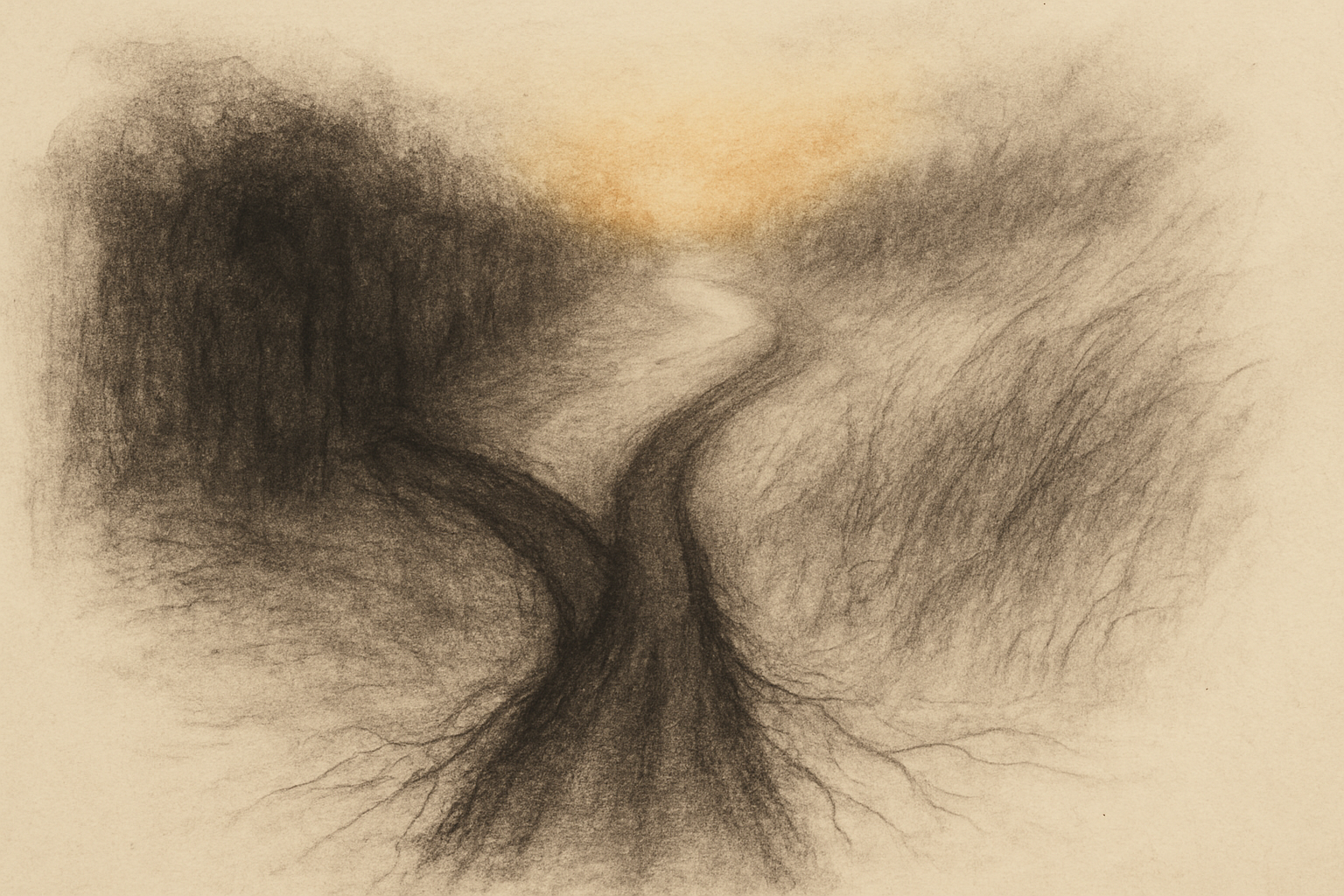
I had an image when you were talking about following your deepest want. It seems that most of the time this happens in uncertainty. The image was of squinting and trying to tune in: "I think it's that way." It's usually misty in the present, but looking back you can see the path you've left behind, and either it's a path with flowers blossoming and green grass, or it's all dead stuff. It's usually by looking back that you realize. You look at the dead stuff and say, "I think I need to change direction." Then you feel into a new direction, but it's always uncertain.
Yes, and to add to that: what happens is you start to see the patterns. You recognize when the mind gets into a certain thing, or where you feel like "this is the way," but it has become a habit. You see that whenever you've gone that way, things turned out not so well. By seeing that pattern (and it could be only twice), you start to recognize: "Oh, that's the conditioning. It's not the deep listening, not the universal one. It's the mental conditioning, the egoic need."
Recognizing the patterns
That's the learning, where you start to see what your mind does, how you use it or misuse it. This is how you end up going off the rails.
Ultimately, the reason this happens is the attachment to the idea of what I am. There are many levels of answers, but there are often fears and pains we avoid. The mind says, "Always go right, don't go left," because left is actually the thing I don't want. But no, it's actually fear and pain. As we learn, we realize: what I do want is this way, but there's fear and pain to face. I'm describing it in a very simplistic way. My point is that the bias, the conditioning, is the avoidance of something that is present. Fear and pain is a sensation that we're avoiding, something we simply cannot be with.
When problems outgrow the avoidance
So we come to a point where living in that way creates so many problems that the problems become bigger than the sensation, bigger than the challenge of the fear and pain. And so we start to learn how to face it.
There are many ways in which this happens. Maybe I enter depression, or relationships go wrong. I get fired from several jobs. Things don't go well the way I think I'm getting to what I want, and it starts to really not work. That forces us to see: "What is it that I'm doing?" It has to do with a taking of responsibility. Even with depression, the solution is a taking of responsibility. Not something in the world that's not working. It has to do with the use of thought.
It must be really tough for someone who has a strong tendency for depression. But it's all about responsibility. Hopefully we learn, and the adjustment becomes faster and faster, in the sense that it needs less.
The triggers thin out
Over time it just becomes more and more obvious, what is coming up. It becomes harder, almost impossible to deny things, to be in denial, to be in avoidance. It all starts to come up and be seen. It still comes up. There's less that comes up, and it comes up less often. But if life stays somewhat similar in its conditions, who knows what would happen in radically different circumstances. Perhaps if there were a worldwide catastrophe, there would be much more to face, much more that would be challenging. But with my life being somewhat stable, what used to trigger me several times a day, or four times a week, now happens once a year. And the triggering is ridiculously small. It never really takes over. It's just, "Oh, that. Interesting." And it's very short in time, whereas it used to last a week or days, or I was permanently in a state of being hurt and upset about something.
Would you say that was a gradual learning, or was it gradual and then a big sudden jump?
If I trace it out, it went like this: trigger, trigger, trigger, then there were these breaks, low trigger, then back to trigger. There were glimpses, sometimes a period of a week or two of tasting that. Over time, slowly less and less and less. Then it was this stable level of being somewhat triggered, with something always missing. And then suddenly, from one day to the next, it was just completely gone.
The sudden drop
There was a little bit of a slow process of adjusting, but it was actually pretty quick. I used to have a lot of triggers with stress and fears about work; those really dropped. I used to have regular fights with my mother and with my partner; those pretty much disappeared. It's been years. My mother herself told me the last time I was with her, "I noticed we don't fight anymore. We used to fight." And it's not because I'm avoiding anything. In fact, we're both naturally inclined toward confrontation, happy to go toward disagreement. Same with my partner. But in three years I can barely remember a fight with her, whereas before it was sometimes twice a day, four times a week, week after week after week.
It's not because anything is being avoided. In fact, it's the complete opposite: we can go to places where we couldn't before. But it just takes one. Same with my mother. She's barely triggered by me either. Even when she is, I can very quickly lead that to a deeper place. She doesn't feel threatened, doesn't feel she needs to react or defend, and then it deactivates all of her defenses. Because I'm not reinforcing that loop of trigger upon trigger. I'm deactivating my own, and then hers.
Things still come up, but it really is a big change. The last several years, let's say three, have been low compared to how it was. Before that, there were moments, glimpses, and after a certain point a steady low level of triggering, but still a sense of unhappiness, of being triggerable, an underlying fear. Then the last thing was that it just completely dropped.
Peace was always there
What became obvious to me is that which I could call that peace, which is now everything, was there always. I can know that it was there even in my most triggered moments. It was just overlooked. It's obvious it was always there. All of my memories of unhappiness, childhood, adolescent years, all of it: there was this vast love and peace. I see it now. I know now that it was there. It's just not in time.
In fact, it became easier for me to go to more extreme places in a sense, too. Before, I wouldn't have been able to handle the business challenges I've had in the last two or three years. Even my co-founders, who are much more experienced than I am, see something in me. They don't know what it is, but they mention it. There's something they find hard to understand. I know what it is, but we don't talk about it. They point to it, though.
It's so strange, this realization you describe of being certain that peace was always there. And on the other hand, the suffering: so many kids committing suicide. It's devastating.
I know. I know the suffering. I was on the edge of that. I got as close as you could get without ending it. And it wasn't just a moment. That close, yes, it was about a year, but a lot of my life it was just a sense of it being unbearable.
It's hard. It's hard even for me to understand. It's not comprehensible. I mention it, I speak about it, and I'm like, "Yeah, it doesn't make sense." I don't understand how I know, but I do know it was always there. It's just very obvious, because it is simply that which was always there.
I think I get it, because when I have glimpses of peace, it is part of the glimpse that it's always been there.
Yes. That's what I wish for the most, for everybody who wants it, who wants to know that. Specifically to those who want it, that is what I wish the most for them. But not everyone does. Some people don't.
Don't you think if it were more mainstream, more in the educational system, more talked about from school age onward, more people would want it?
I don't know. It's both yes and no. For those who don't want it, they will misinterpret it and make it into a thing, like a religion. And at the same time, yes, it could help those who are ready but haven't had access to it, those for whom there is confusion and misunderstanding. That's why I even speak about this, and that's why you're putting videos out. Some people already know about this, and they hear it and think, "Oh, interesting, here's another version." But for some it might be the first time they're exposed to it. The more people who are recognizing this and sharing it in some way, the better. So that it's available to more people. And all of the different flavors and styles matter.