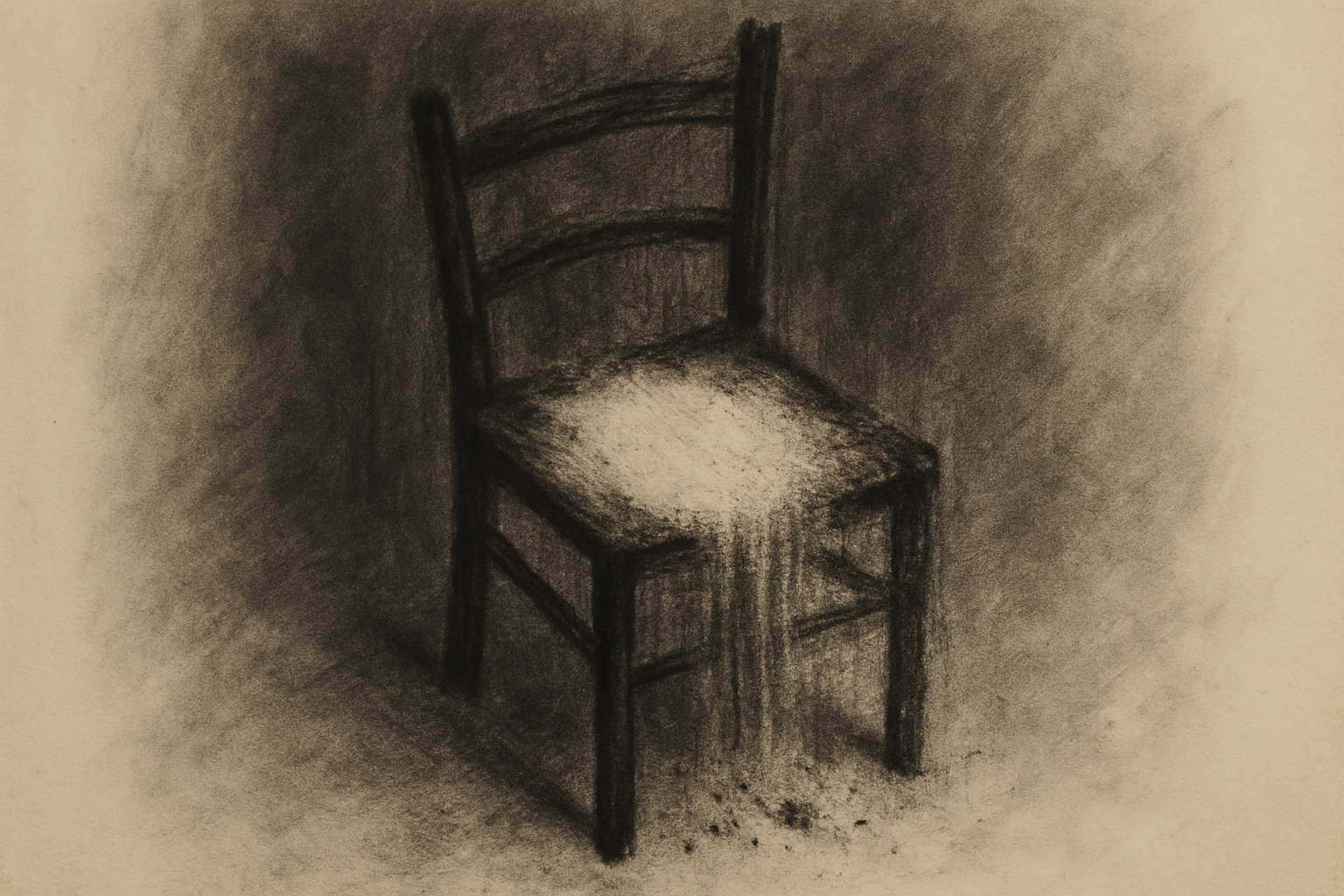
When the Bottom Falls Out of Practice
Cuando se Cae el Fondo de la Práctica
A student describes a disorienting experience in which familiar meditation techniques stopped working, leading to a confrontation with raw, unmediated experience.
When the Bottom Falls Out of Practice
A student describes a disorienting experience in which familiar meditation techniques stopped working, leading to a confrontation with raw, unmediated experience.
Hello. I wanted to share something that happened recently. My practice has been going along fairly normally, and then suddenly it was like everything I knew how to do just stopped working. The techniques, the familiar framings, the way I usually orient to experience. It all just fell away. And what was left was quite disorienting. I didn't know what to do with it.
Can you say more about what you mean by "stopped working"? What was the experience like when that happened?
It was like I would try to do the usual thing, noticing sensations, noting, coming back to the breath, and none of it had any traction. It wasn't that I couldn't do it mechanically. I could still note, still direct attention. But it felt completely hollow. Like going through the motions of something that no longer had any life in it. And underneath that, there was something raw and open that I didn't have a frame for.
Good. This is actually quite important, what you're describing. When the familiar scaffolding of practice falls away, what remains can feel very disorienting precisely because we have been using these techniques not just as tools, but as a way of maintaining a known relationship to experience. The noting, the returning to the breath: these create a sense of a meditator who is doing something with experience. When that structure drops, you lose that reference point.
The familiar meditator dissolves
What you're left with is something closer to experience as it actually is, before you organize it into a project. The disorientation you felt is the disorientation of not having a role to play. The rawness is what experience feels like when it is not being managed.
That makes sense. But there was also something frightening about it. Not frightening in a dramatic way, but more like a groundlessness. I kept wanting to reach for something to stabilize with, and there was nothing there to grab.
Yes, exactly. That impulse to stabilize is very important to notice. It is the mind's habitual movement to reconstitute a center, to find something solid to stand on. And when nothing is available for that purpose, there can be a kind of vertigo. But notice: the vertigo itself is not dangerous. It is simply unfamiliar. What is actually happening is that you are experiencing without the usual buffer of interpretation between you and what is appearing.
This is not a problem. It is actually where practice deepens considerably. The techniques you were using before served their purpose. They helped you develop attention, helped you see certain patterns. But at some point they become a way of keeping experience at arm's length, and when they fall away, you meet experience directly.
Groundlessness is not a problem to solve
So what do I do with that? Just let it be disorienting?
In a sense, yes. The question "what do I do with this?" is itself the old habit trying to reassert itself. It assumes there needs to be a strategy, a next move, a way to handle what is appearing. But what if nothing needs to be handled? What if the disorientation is simply the feeling of standing in open space without walls?
The practice at this point becomes much simpler, though it may not feel easier. You simply stay present to what is, without reaching for a framework to put around it. You let the groundlessness be there. You notice the impulse to grab, and you let that impulse be there too, without acting on it. Over time, what felt like vertigo begins to reveal itself as spaciousness.
There were moments where it did feel spacious. But they were brief, and then the discomfort would come back.
That is completely natural. The oscillation between spaciousness and contraction is the mind moving between openness and the habit of self-protection. Each time the openness appears, the system recognizes it as unfamiliar and contracts. Each time it contracts, if you don't add a story to the contraction, it naturally relaxes again. This back and forth gradually settles, not because you force it, but because the system learns that the openness is not threatening.
Not forcing, but also not retreating
The key is that you neither force yourself to stay in the open space, nor retreat back into technique as a way of escaping the discomfort. You simply allow the natural rhythm of opening and closing to do its work. Your job is just to not interfere.
That feels like a very different kind of practice than what I was doing before.
It is. What you were doing before was practice with a framework. What is being asked of you now is practice without a framework. This is harder in one sense, because there is nothing to hold onto. But it is also much more intimate. You are no longer mediating your experience through a set of instructions. You are simply here, with what is.
And this is closer to what meditation actually is. The techniques are training wheels. They are useful, even necessary, for a time. But at some point they have to come off, and you have to ride without them. The wobbling you feel when they first come off does not mean something has gone wrong. It means you are learning to balance in a new way.
That's helpful. Thank you.
You're welcome. Trust what is happening. The disorientation is not a sign of regression. It is a sign that something deeper is opening up. Just stay with it.