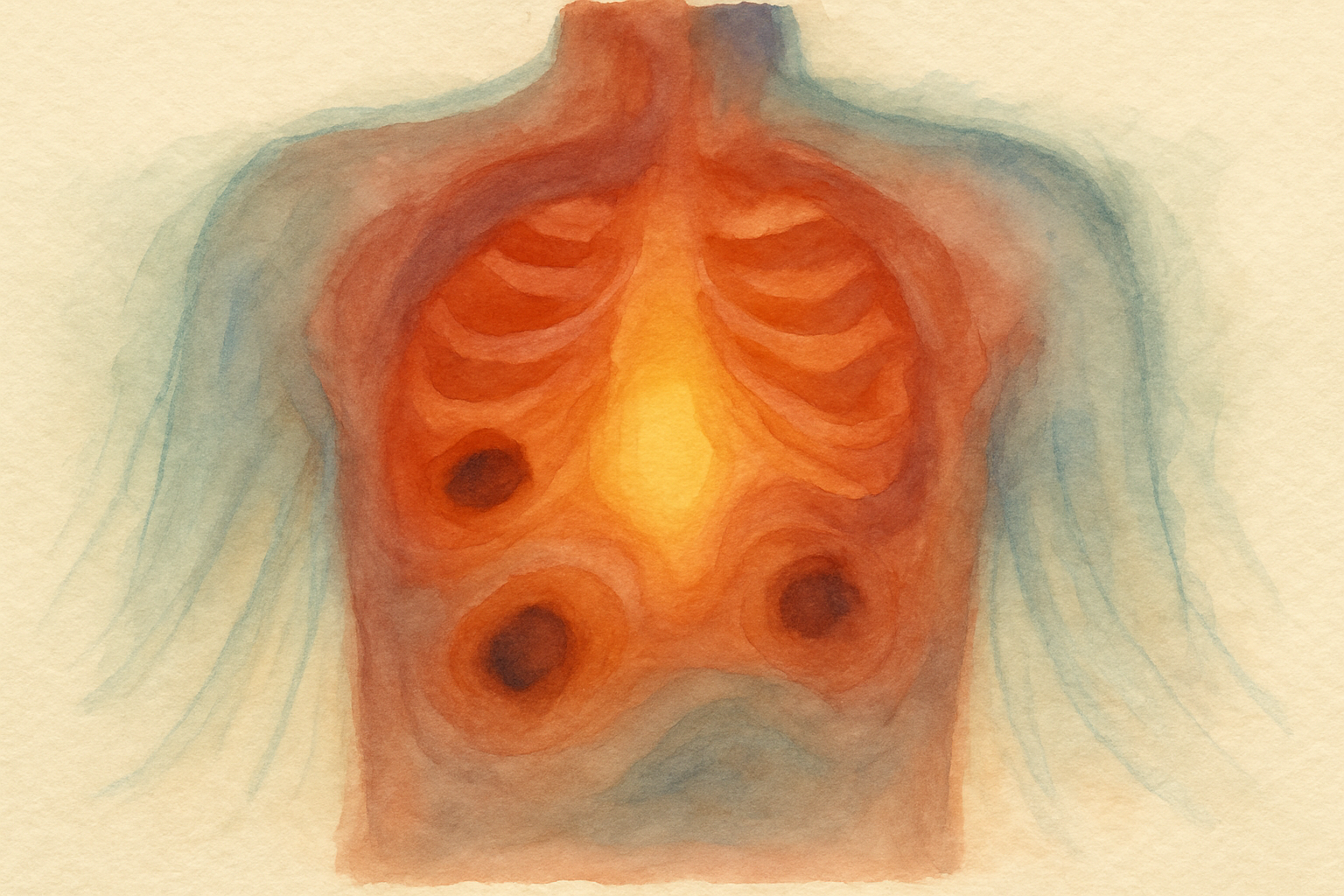
The Heat Beneath the Storm
El Calor Bajo la Tormenta
A question about working with the emotional turmoil and downward spiral that arises during conflict with a partner.
The Heat Beneath the Storm
A question about working with the emotional turmoil and downward spiral that arises during conflict with a partner.
I wanted to ask if you have any tips on how to deal with the distress that comes from fighting with your partner. Sometimes my partner can help me process something, but often it just makes me more confused. I'm more in the boat of having to do it on my own. What happens is I get into a downward spiral with so many thoughts. I don't really feel like I'm processing anything.
Like a turmoil of everything, just crazy.
Yes. I don't even know what's happening. I don't think I'm really processing something. I'm just downward spiraling. "Doomsdaying" is what I call it sometimes, like a black hole.
Naming the fear
You're calling it by its name, and it's fear. "Doomsdaying" is a name for fear. But I wonder if you are directly in touch with fear as fear.
Fear is tricky because when we're in fear, we can be very far away and detached from it. We can still know that there's fear, but we're a thousand miles away from the actual fear.
One way to work with that is to try to get closer and closer. It will be progressive and slow. Over time, and over more conflicts, you're going to start to get more directly in touch with the sensation of fear. At first it's just crazy mind: a lot of thinking, a lot of doomsdaying, a lot of thoughts around that. Then, over time, it's going to be known more as an energy, a current that you feel in the body.
The pressure cooker
All of that thinking and emotional turmoil is like a pressure cooker. If you're cooking rice and you put a lid on that doesn't have a hole, it's going to start to lift. That's what the stormy mind and emotions are doing, because underneath there's fear. The crazy mind and the emotional turbulence are ways of decompressing that energy, because you are unable to be with the intensity of it directly, the direct energy of the fear, the heat.
But once you're able to be in touch with the heat, all of that dispelling of energy becomes unnecessary. If you're trying to stop the steam, it's just going to push. It's going to pop the lid open, and you're fighting something you can't win.
Getting closer to the sensation
The direction is this, and it actually changes your whole nervous system. It's not something you see overnight and then it happens. Your body, your brain, your whole nervous system needs to shift in how it's operating, so that's why it takes time. But the direction is to question: what is the actual sensation? Look for it in the body. You'll notice your breathing is tight or shallow, your chest is contracted. Then ask: what happens if I just slow down my breathing, bring it into the belly, pay attention to the sensations, and pay less attention to trying to stop what the mind is doing? That's going to get you more in touch with the energy, the heat of the fear.
That's one thing. There's a similar thing with pain. But the main thing that's coming up for you now is the fear. And that fear is always about ending: ending of the relationship, losing something, something ending. Which, in the imagination (and sometimes very correctly), is the coming of pain. Something ends, and what comes is pain. So the fear is really a fear of pain.
Working with the thoughts
Student: I think for you I would start with observing the thoughts, even writing them down, so you can see them clearly. Unless you already know the pattern: what sorts of thoughts are you believing? That would be a first step.
The other thing is, when your partner can help you process, it sounds like it's because he's not triggered at that time. But if he's triggered too, then it's probably going to be hard for him to help you. That's what would happen with us: we'd both be triggered. If only one of us was triggered, we wouldn't have a fight.
If he's triggered too, then in a way it's true that you do need to process it on your own. And then it's a question of what the fear really is. Is it a fear of loss of the relationship? A fear of abandonment? For me, there was a deeper fear, which was the fear of losing the relationship and it being all my fault. I was also in shame, which is a really difficult one.
Step by step, layer by layer
So, step by step: work on the thoughts, and then you'll be able to increase your ability to stay with a certain amount of the sensation. Then you'll see a deeper part of it: what is the quality of this fear, what am I believing is true, what am I terrified of? Just observe it. That's my main thing.
It is okay if you have to process it alone to some extent. But that might also be overlapping with some deep fear of "I'm going to be alone, I have to be alone." You were probably quite alone in ways when you were a child that you shouldn't have been. It would have been nice to have an adult to help you process, and that absence was a kind of wrong. There's a residual belief from that time that feels wrong for you. It is true now that you sometimes need to process things yourself, but not always alone. You can process with a therapist, for example. And when your partner can't help, he can't. That's just how it is sometimes.
I have one more thing for you.