Choosing in Uncertainty
Elegir en la incertidumbre
A question about decision-making, the bias of the conditioned mind, and what it means to choose when the mind cannot tell you what to do.
Choosing in Uncertainty
A question about decision-making, the bias of the conditioned mind, and what it means to choose when the mind cannot tell you what to do.
Would you mind saying a little more about what you were talking about before, about decisions and certainty? What I understood was that there's a place of uncertainty in decision-making, and that's good.
Yes. I'll use a kind of metaphor map that my teacher once offered. He said: the mind is a tool. When we look at a choice, a conditioned mind, an unconscious mind, will come up with a list of pros and cons. But the list will be uneven. It will show a few pros and many cons, or vice versa. That's a bias.
The conditioned list
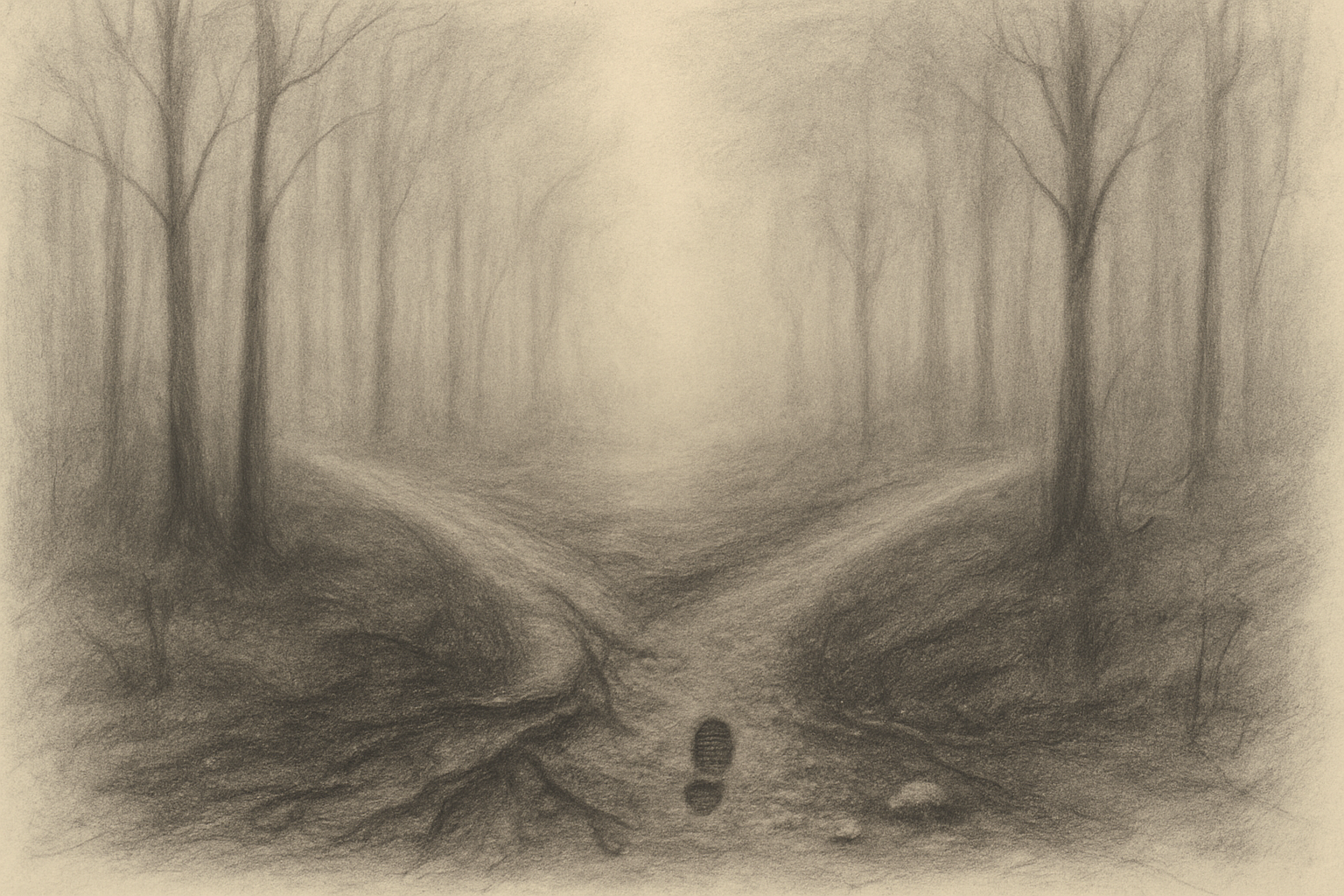
Whereas a mind that is free, a person who is more awake, uses the mind as a tool, and that mind is going to produce a longer and more balanced list of pros and cons. If I take that further, I would say it reaches a point where you cannot use the list to make any decision. You may use it, but the list is never going to tell you what to do.
Why we prefer bias
At a certain level of unconsciousness, we want the list to be biased. We don't want the uncertainty. We don't want the responsibility. We don't want the choice. We want the mind to say "left" or "right," just tell me where to go. That's the conditioned mind. That's the person functioning in ignorance.
The transition into not knowing
In the process of transition, the mind's list starts to become more neutral and longer, more clear, more accurate, and the situation becomes more unknown. What's right and wrong becomes more unknown. Should I go or should I not? And then, where does the choice come from?
My teacher would say: choose in uncertainty. If you choose in certainty, you are using conditioned thought, and the mind chooses for you. That is automated functioning. The mind can only have a bias if it draws on the past, and the past is never this moment, this situation. Every moment, every situation is always unique.
Projection and uniqueness
This is something that needs to be understood. When we are in ignorance and conditioned, unconscious functioning, we project onto situations: same situation, therefore same behavior, same choice is needed. But you never can enter the same river twice. Every moment, every situation is unique. And sometimes, facing something that seems very similar, once you go left, and sometimes once you go right.
Knowing that cannot be known
So where does that choice come from? It comes from something much deeper, prior to thought, and it is uncertain. There is absolute knowing that we cannot know.