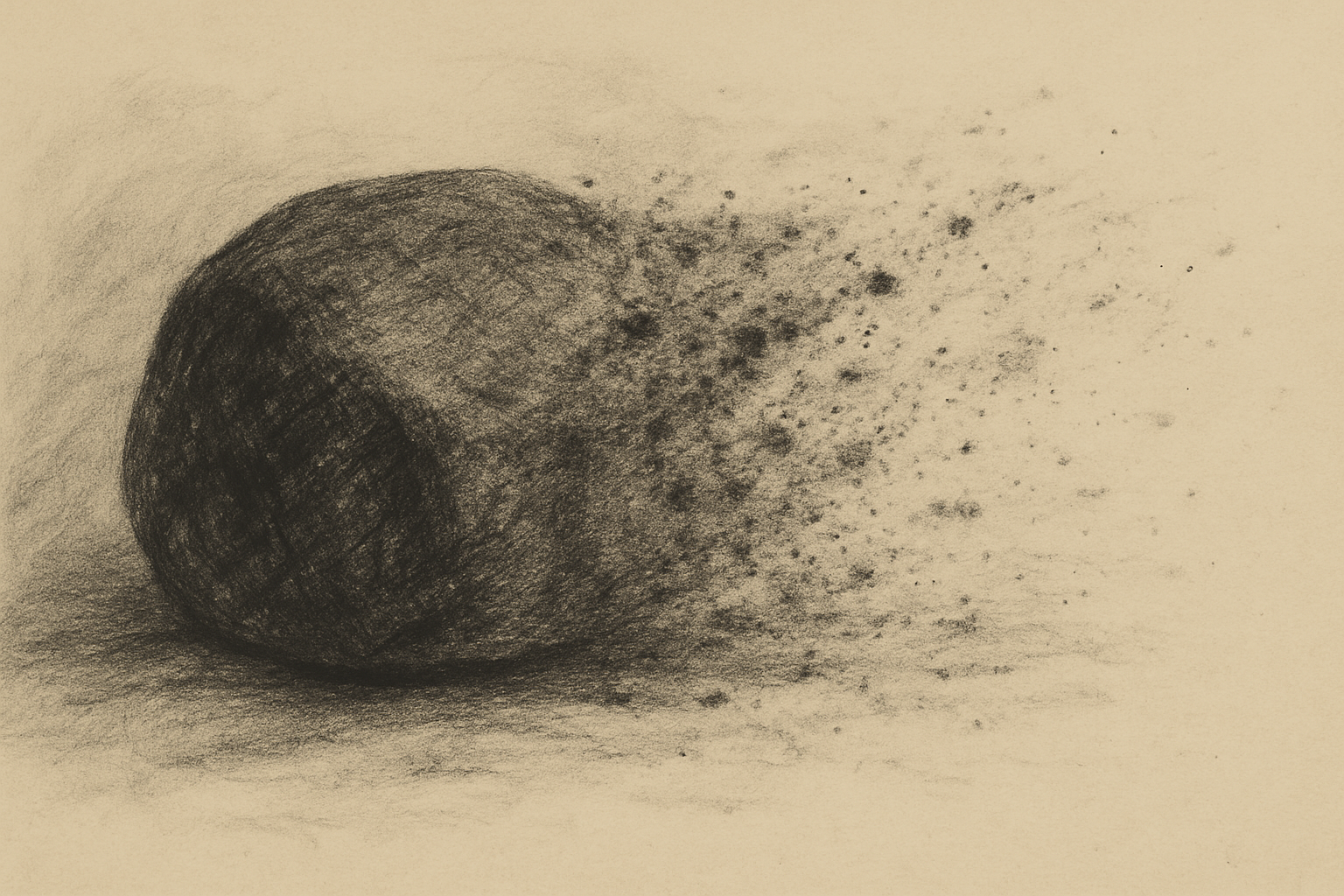
The Universe Choosing Through Us
El Universo Eligiendo a Través de Nosotros
A student raises the experience of feeling lost and overwhelmed in decision-making, and the teacher explores how conditioned fear of uncertainty leads to impulsive or paralyzed choices, and what it looks like when decisions arise from a deeper, more aligned place.
The Universe Choosing Through Us
A student raises the experience of feeling lost and overwhelmed in decision-making, and the teacher explores how conditioned fear of uncertainty leads to impulsive or paralyzed choices, and what it looks like when decisions arise from a deeper, more aligned place.
The same behavior, the same choice, is needed. But you never can enter the same river twice. Every moment, every situation is unique. Sometimes something that seems very similar calls you to go left; sometimes it calls you to go right. So where does that choice come from? It comes from something much deeper, something prior to thought, and it is uncertain. There is an absolute knowing that we cannot know.
I feel validated in my being terrible at making decisions.
I love that. What do you mean by "terrible"? If we make decisions and we see a pattern of things not working out, that is still a sign of conditioned functioning. If you want, we can look into that. We can talk about it some more. It's up to you.
I don't have very much time, but yes, a little bit would be good. It's the feeling of being lost with decision-making, that uncertainty. Sometimes that can actually feel like a good place to be, but it can also be overwhelming. Being lost is just uncomfortable.
The paralysis of uncertainty
Exactly. And that is what happens for some people more naturally, and for some as part of this work of waking up and seeing through thought. There is a sense of: "This is very confusing. How do I make a choice?" There is so much uncertainty. What can happen is not necessarily a paralysis, not exactly a freezing, but the uncertainty brings up fear, and so we go to the mind to bring the fear down. The mind says, "Yeah, this is the way."
Alternatively, what can happen is that because we can't trust the mind anymore, because we see through it, we become impulsive. We make choices more reactively, which is still a form of conditioned thought, but it functions differently. It happens less through "I've thought this out, and it's this way," and more through "I can't figure it out, so I'm just going to jump." That is still a conditioned reaction.
It's almost like a reactive type of thing.
Yes, it is still reactivity, and it is still conditioned. It just functions differently. What we can do is recognize: this is how I operate. Then we look at the fear. We look at the discomfort. We look at what the choice is starting to bring up.
Choosing too early or too late
By being able to sit with that, something shifts. Another thing we do is we often choose too early or too late. When it is too late, we have to jump, we have to be impulsive. When we choose too early, it is because we could not sit with the uncertainty, could not sit with the fear. We think, "I can't contemplate this; the anxiety and uncertainty are too scary." Or: "I can't sit with the uncertainty, so I'm just going to figure this out and decide." But it would have been better to wait a week and have more information. Or we choose too late because we left it to the last minute, and then we force ourselves into impulsiveness.
The core of it is our inability to be with the reality of uncertainty and the anxiety, fear, and responsibility it brings up. A sign that things are starting to work is that we become more settled with the uncertainty. The decision becomes almost spontaneous, rather than impulsive.
Spontaneous versus impulsive
It just arises. It feels right, and it works. More often than not, there is an alignment. Even when things don't work out the way we thought they would, it ends up being okay. "I would have wanted it differently" or "this didn't go as I planned," but it turns out that it actually worked, or it was okay, or we learned something. There is much more of a non-doing and an ease. But it is important to note: things start to work out. There is an alignment with the universe, with life. The choice is actually what I would call life, the universe, choosing. We are just listening and allowing, getting out of the way, so to speak. It is operating through us.
Yes, I'm familiar with that occasionally, and that always feels really great.
That taste of it is great. And it is a sign of something that is possible. It is possible for that to be our normal state.
That is what feels right and true and best. And alive. That is like really feeling alive. It also feels quite connected to what you were saying about thought and the story of "I know."
Exactly, because it is the same problem. We don't allow, because we can't sit with the uncertainty, because we have a problem with what is happening. We have a big "no" to things being how they are, and then we are operating in a fight against the universe. "I know how it should be, how it is."
And in decision-making, maybe also "I should know." There is a mind that says, "I should know."
The conditioning underneath
Yes. And that is where we get into the particular flavors of how it is for any particular person. For you, it seems like something comes up: "You should know. You need to know. So figure it out." You try, but it is actually coming from conditioning. You heard a million times that you need to get things right. You were made to feel pain when you didn't. So now you are on a mission to know, and it is an avoidance of the pain of getting things wrong.
We start to discover the old woundings, which we can call old, but they are very much alive now. The healing of that starts to happen as we learn to sit with it and drop the judgments, as we come to understand: "I was just a child, and my caretaker was a confused person." Then there is an embracing and an owning of the pain that is here, a holding of it. You could call that reparenting. You become the parent of your own inner child, your own pain, your own fears. But it is a path of owning and responsibility, not self-blame. It is simply: "This is me. This is my heart that is broken. These are my heartaches, my fears."
What do you really want?
It also really matters, which is why I speak to it so often, to do what we really, really want. And then the question is: what do you want? But when I say "you," I mean the universe. You as the universe. Not you the person who is conditioned, hurt, confused, wanting to avoid pain. That wanting is never going to go in the right direction.
I am speaking generally to human beings here. This is how it was for me as well. When we really discover what we truly want, it is the universe wanting that, and it is out to get what it wants, and it often does. It is aligned.
I say this sometimes a bit too dramatically, but I believe the universe wanted Jesus to be crucified. So it is not all fun and games. But, subjectively, my interpretation is that he was liberated, and going through that was what he wanted. He listened so deeply, deeper than anyone before him. And, wow, did it change the nature of humanity and consciousness and what is possible.
It feels like that is the deepest thing we want as a person: to be what the universe wants through us.
The crucifixion of illusion
And at a level, it is a crucifixion. It is a crucifixion of the illusion of being only human. Metaphorically, that is what it requires. It is a surrendering that happens, not something we do. It happens through listening to the deepest, and then the person is crucified, and the universe gets what it wants. And it is never not what I want. There is not the universe wanting one thing and me wanting another. My deepest want is the universal want. The issue is what I call myself, what I interpret to be "I."
I say this so that it is not interpreted as the universe wanting something you don't want. If it is wanting something that conflicts with you, that is not the universal desire. That is why I say: what do you, as the universe, want? Because it is one and the same.