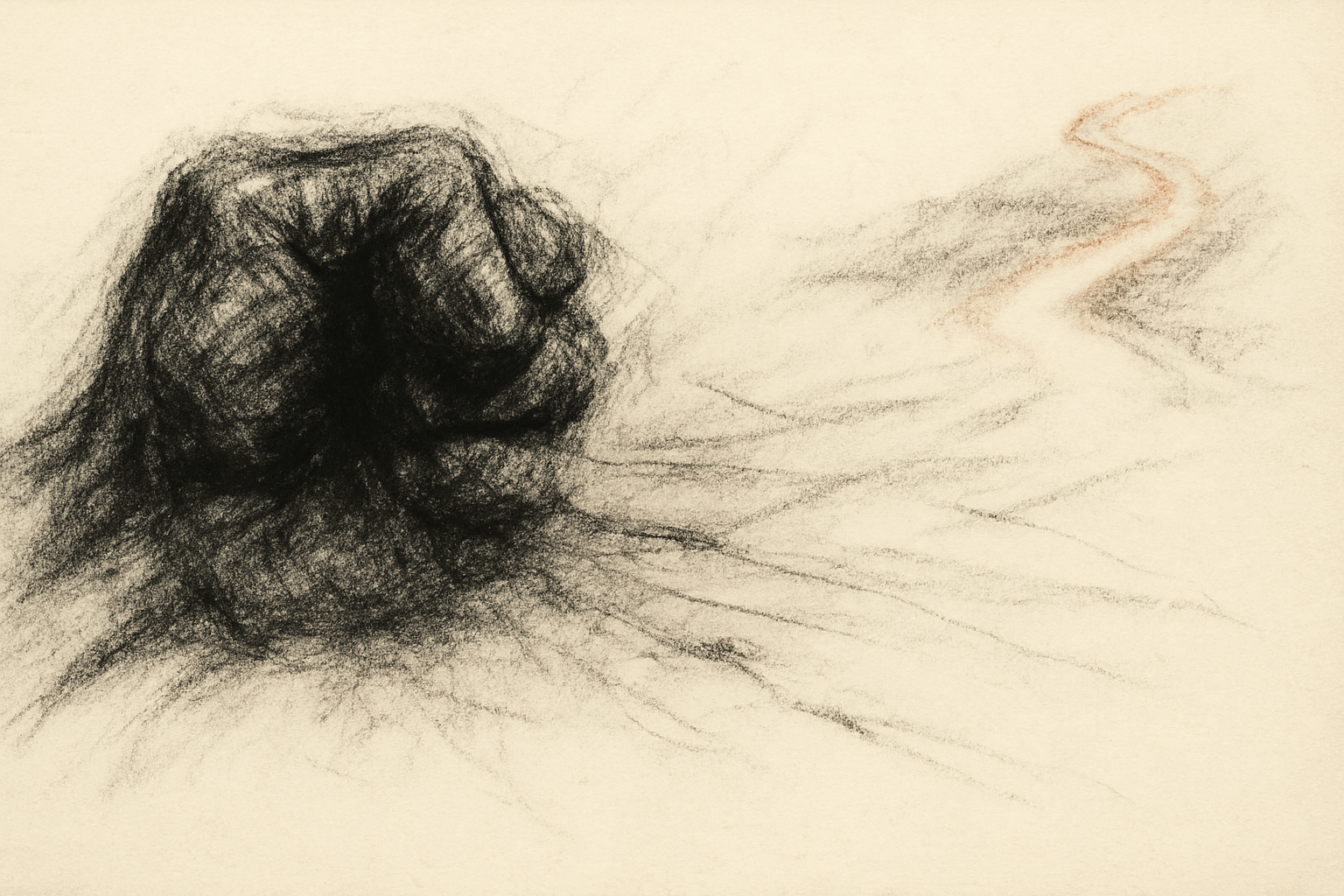
The Fist and the Calling
El puño y el llamado
Two students explore the nature of contraction and identification: the first asks about reactivity in conflict and what it means to "open the fist," while the second wrestles with the tension between following a heart-calling into challenging work and retreating to a monastery for peace of mind.
The Fist and the Calling
Two students explore the nature of contraction and identification: the first asks about reactivity in conflict and what it means to "open the fist," while the second wrestles with the tension between following a heart-calling into challenging work and retreating to a monastery for peace of mind.
I've been working a lot with the metaphor you used about the closed fist and the open fist, what represents contraction and what it means to go into a difficult situation with an open hand. Recently, I was with someone and we got into it a little bit. I was challenging them and they became condescending, sarcastic with me. I stood up for myself, but I noticed inside there was a lot of contraction. My body really responded. It affected my nervous system. I was trying to be with those sensations without resisting or judging them, and then I noticed that too. So in that situation, what part of it is the closed fist? Is it when my body reacts and there's an identification? Or is it the judging, the resisting, the saying it shouldn't be there?
In a way, there's more than one answer, because what the fist represents could be many things at different levels. Let me put it on two levels.
The natural reactivity of the body-mind
One is what you're describing, which is a natural reactivity. That's the kind of work that takes more time. The point of the fist metaphor is that you realize the contraction is you. You are doing it. Because we've done it for so long, we first become numb to it, unaware that there is a contraction at all. Then, once we notice it, we are still unaware that it's us doing it. So a lot of this work is the recognition: "Oh, that's me. I'm doing that." Then something can begin to be undone. But that takes time. It's not instantaneous.
There's an aspect of this where the metaphor applies at different levels, and where the opening is, in a sense, endless. There is a natural reactivity of the human body-mind around survival and death, which for the body-mind is ultimately guaranteed. There will be trigger responses. Theoretically, they can all be undone, but I wouldn't consider that a practical goal, because you start talking about maybe a few people in the history of humanity.
So understand that at one level there is a constant movement of recognizing and realizing that openness is more efficient in every sense: more efficient for the harmony of whatever situation. But do not interpret openness as, for example, not saying no to somebody. That's not what I'm referring to. It's at an energetic level. It's an accepting of what's happening, meeting it directly, and then deciding and discerning how to relate from there.
Identification as contraction
But the deeper pointing is this: at a more fundamental level, it is you who is doing the contracting, and that contracting is the identification itself. The body-mind can still contract, and there's this constant practice of opening. I often refer to this as growing up: we apply the wisdom we've learned, and that is the opening. But at a deeper level, the identification itself is also a contraction.
That's why I'm talking about two levels. One is the body-mind contracting. The other is the sense of "what I am" contracting into an appearance. In the meditation I was pointing to how there might be a sense of focusing on sensation or thought, and there's this crunching quality that can happen. It's this constant filtering of experience into "what is I, what is inside" versus "what is not I, what is outside." That is the contraction I'm ultimately referring to.
So, back to your question: they're both happening. You're noticing the reactivity with this person, and there's the application of your understanding at the level where you're working through it. But don't expect the reactivity to fully stop. Expect that at whatever level it was in the past, certain types of reactivity will suddenly be gone. But there will always be a human element. In fact, I recommend the choice of full involvement in the human aspect of life, where all of it is appreciated and experienced, and then there's the discernment of what to act on. Let yourself feel everything you feel, including the instinctual elements of being a mammal. That will bring energies and contractions and reactions that are natural. But that is different from the sense that this is all I am, because when "what I am" is only that, then the survival instinct rules. The mammal leads, and fear takes over.
This can only really be undone with realization. You can't talk yourself out of it. You can't believe yourself out of it. You have to see so clearly that you are not that, and it has to be very, very clear in your experience. Then, when the instinct appears, it will be known as just that, and there will be a possibility of choosing whether to move with that energy or not.
When you said there's a part of it that I'm choosing, which I think was really interesting, what part is it exactly? I'm not choosing the mammal contracting because there's a conflict. But is the part I'm choosing the identification with it as real, as an "I"? That's where I get a bit confused.
Because of where you're at, there's a level of subtlety that can be confusing. But it will be the sense that, to some degree, "what I am" is limited to the body-mind.
Yes.
It's not a black-and-white thing. The contraction is something like: "I am more of that than what is real." The degree to which that is activated shifts, because identification is a movement of coming and going. The choice is actually a kind of preference, a preference to be exclusively this limited sense of self.
Serving the whole versus serving the self
For example, to the degree that you experience the person you were having this conflict with as an "other," you're taking sides with your limited self. Whereas you could have a point of view that is your own, but what is experienced is the whole of that dynamic. Then the functioning can be in service to the dynamic, to the energies of the whole system. What moves then is "what is best for this," versus "what is in service to me exclusively." And it could be that, from your point of view, what is in service to the whole is you pushing back on something.
Just to clarify: you're right, it was partially identification and partially not. But is there something subtle I could have done to move more toward realization, to see it with less of the self-and-other dynamic, rather than becoming identified?
I don't think there's a lot to say in terms of "you should have done this." We could go into the details of your process and figure out what you can learn from it. But there isn't something you did that was wrong. It's about what you can see now from that experience.
What I can see is that I identified, that there was a pulling into self and other. My actions did feel in service to the whole, and it felt like I was able to respond for the greater good. But there was a sense of survival in there that felt more identified.
Inquiring into the dynamics
One thing you can look at, more generally speaking, is this (and this is not for you to answer now in the group, but for you to be transparent and honest with yourself): Do you have a sense that you unnecessarily hurt another? To what degree? And to what degree were you suffering, meaning a deep essential sense that "what's happening shouldn't be happening"? Those two go together. Usually, when "what's happening shouldn't be happening," we unnecessarily hurt another. That's a way to more deeply inquire into the dynamics, and it has to do with what you're asking about: how to deepen in realization.
Yes. Thank you.
---
I'm currently exploring the idea of listening to my heart, my intuition, and trying to confront the things I feel a lot of resistance to facing. At the same time, I feel there's still a lot of space for me to work on quieting my mind and functioning in situations in a grounded and relaxed way. On one hand, I want to listen to my heart and be more daring, do things in the world. On the other hand, I want to fine-tune my ability to stay calm. How can I balance my heart's desire to confront things, to start work, to do things, with my desire to move away somewhere, to really be in an environment that supports my ability to be more open and calm?
I think I understand your question well. There are a few things. First, for some of us, a full retreat from modern life may be the right thing, but I think that's a very small minority. It should only be the answer from a very deep calling. And we can never really know with certainty what the calling is. If we have certainty around it, it's always likely to be thought-based, and therefore identification- and fear-based.
So let me set aside the sense of fully retreating. I'm interpreting what you're saying as: what's calling you is not to retreat to a monastery, or to a suburban small town, or wherever you imagine retreating to. There is a way to do this work intensely while having it mixed with modern life. One very obvious way is actual retreats with a time frame of whatever it is, three days, four days, a week, placed at convenient times throughout the year, with a mix of teachers. That's something I'd generally recommend.
The contradiction in desire
But to your question, I think there's something deeper. There's a contradiction in your desire, and I think it has to do with a misunderstanding, which is very natural and also common in many conventional spiritual teachings. It has to do with the value of a calm mind and the purpose of it.
A quiet mind, a calm mind, an empty mind: in my understanding, which is all I can speak to, that is a consequence. It's not a means. The quiet mind and the relaxed approach you talked about are consequences, not forms or methods. Obviously, we can try to be calm, and we can approach things with the most calm that we have. But if you listen to the desire for a calm mind alongside your intuition that you're called to face something that's going to aggravate your body-mind, that you're going to have thoughts that are not easy and sensations that are not easy, which is the absence of relaxation...
Yes. It's like: what is the balance between being okay with that aggravation and being realistic about how much I'm able to handle? How much of that is realistic to work with?
The body-mind can handle more than you think
The general direction is: a lot more than you think. The body-mind can handle a lot more than we think. A lot of this work has to do with coming to those edges and realizing, "I've gone through what I thought would be the end of me, what I thought would break me, and I am still here." I can't emphasize enough how big that gap is. There are ways to leverage that in practices, and many practices are designed for exactly that.
What I would say is this: by going straight toward what puts your mind at dis-ease, your body into stress, and persevering, you will learn the calm mind. A calm mind will be a consequence. A relaxed body will be a side effect. It will not come from attachment to relaxation or desire for it. That's a regressive pull, like the pull to not leave the house because it's dangerous outside. I would treat that impulse as regressive about ninety percent of the time, and then learn when there's a genuine call that has to do with resting, with balance. But we have to lean much further into the discomfort.
Do you mean that on everyone's journey, at some point, it's just leaning into more and more discomfort in order to free ourselves?
Generalizing, I would say yes, with the generalization always having exceptions. The peace we look for is not the absence of discomfort. It's not the absence of thought. It's a peace that is present in the deepest discomfort and in the most stirred mind. And that can only be seen when there is discomfort or when there is a disturbed mind.
Basically, what you're saying is that my desire for a calm mind is just coming from a desire to avoid discomfort.
At a level, yes. At a deeper level, it's a true longing, but it's misrepresenting what it's longing for. It's the longing for peace. But the peace is not in the calm mind or the relaxed body. That's where the confusion is. At the deeper level, it's a very beautiful calling. So what I'm offering here is: what's the way to arrive at that? The way is through listening to the calling of life, to what you really want to do, your desire in this life, what's calling you. I think you were addressing that with your mention of intuition, your heart-intuition.
Discerning the heart's calling
But then, how do I know which part of my intuition is more true? On one hand, I have this intuitive calling to, say, move to a monastery. On the other hand, I have an intuition to just face things at work and live a regular life, facing my fears.
Your question is: how can I know which one is right? The answer is you can't know, but you can experiment. Through trial and error, you can learn. How do I know if I prefer an apple to an orange if I haven't tasted either? As a metaphor: you have tasted sitting to meditate, and you have tasted work. But at another level, you're contemplating a bigger thing, which is facing work in a bigger way, exploring meditation in a bigger way. And that is only through the experience of it.
But I do have a sense that the calling of the monastery is, more likely than not, an avoidance of life. If I were to say the peace you aspire to gain in a monastery you can find in work faster, do you still want to go to the monastery?
I can see how that is. I can also see how approaching the thing that's right in front of me can lead to immense peace, just by moving forward with it. My way of thinking about it will change, I know. But it feels very overwhelming, almost unbearable, to the point that I'm afraid I won't grow out of it. I'll just do the thing and it will lead to only more attachment and more suffering.
The fear of failure
You appropriately called that a fear. It's the fear of failure, of not being able. But there's one aspect, which is "how I want to feel," and another, which is "what I want to do." If you were saying, in a very genuine way, that you have very little calling from modern life, and that the beauty of the monastery, the scriptures, a life of sitting, was simply calling you and nothing else really interested you, then it would be a different conversation. You would try it out, and maybe two years later you'd be done, or not. But what you're presenting to me has more the flavor of a calling to retreat versus a calling to go for what you want, with the fears of failure in two senses: one, that maybe you achieve the lifestyle you want but still feel the suffering and discomfort, so it's a failure of how you want to feel.
There is a longing there. A longing for beauty, peace, and simplicity of life. And I guess that comes from not feeling like I have that built into my life now. It leaves me feeling stuck in my environment, like I'll have to learn how to use this environment to meet my needs.
You can very much do that: use the environment, use the experience to get what you need. You spoke about peace, beauty. But what you're describing is only available now, here. That is what you can discover: that it's in work, it's in the monastery. It's not seen because it's not seen now, in the reality of this moment.
How would you recommend I approach the feeling of fear or overwhelm when I do go to work and have the experience of not wanting more of it? My intuition calls me to do it, but I'm worried that at some point my thoughts will tell me, "Don't do this anymore, it's safer elsewhere, it's more comfortable."
What matters there is: what are you going to work for, such that you are following a deeper desire? It's not just about going to work. What's the deeper calling, aside from the deep longing for peace?
I guess the deeper desire is to really listen in, to fine-tune what my heart wants from me, and to not be afraid to listen to that.
What does the heart actually say?
That's the way: to listen to your heart. You expressed that very beautifully. But the question I'm getting at is more specific: what is the answer? If you listen to the heart and the heart alone, what does it say? Not for it to be an answer you write down and it's forever the answer. It's a constant asking, a constant listening, a constant discerning: "Oh, this is fear again. Oh, no, this is really a hard calling." The answer isn't to listen to the heart. The answer is what the heart says. Otherwise, it's a circle: "What I want is to listen to the heart, which is saying to listen to the heart." But what is the heart actually saying?
It's more specifically around life, around abundance, around radical living. What if you have the power to create a life? If you strip away all your fears and sense of limitation about what that life could be, and you trust all of your abilities and potential and intelligence and wisdom and develop them fully, what is life? What does it look like?
As opposed to: "I don't know that I can. I want peace because this is too hard," and contemplating withdrawal.
Yeah, that's exactly the way I see it.
And that's beautiful, because it's a mystery. You can't know the answer. It's what I speak of as a co-creation. It's like a dance, but you're on both sides dancing. You're listening and responding and creating. If you're dancing and you want to go to that corner of the room, but the partner you're dancing with makes a move that sends you the other way, you listen and respond. That's the kind of constant creation that is possible. But always listening to the heart, always in this calling from what is beautiful, what is loving, and the greatest thing you can imagine going for. You answered that it could be simple. It could be a monastery. I don't know that, but that's for you to discover.
I guess the way I see it is: what is the most appropriate decision in this moment right now, rather than looking ahead? One of them is more relevant for the moment, and one is more of a "maybe in a future moment that will be the best thing for me."
Yes, but you also know: there isn't that future moment. There is only this. It's around your relationship with imagination and creativity in every sense, and that is only possible now. You can imagine the next week or you can imagine the next ten years, and then it's what you're dancing with as you move in this moment. It's not compartmentalizing: "I have to deal with this decision of this week or this month, and then in the future I will contemplate a decision that has to do with the future." In a sense, you have to contemplate all of that now, because it's only now. The contemplation of this week and this month is in touch and connected with the deeper imagination around this whole life, in this moment, which is only real in this moment. And there is the understanding that a function of time appears, that the body ages, that things evolve in the way they do. But the calling from the heart is now, and it's the answer to any direction at any level. Do not risk postponing what's important for what is urgent. You can deal with urgent things, but not if they're completely in opposition to what's important.
I guess it's not either-or. It's not that I need to confront my fears and can't have peace of mind. Sometimes I tend to look at it in terms of black and white.
Peace in the midst of a stirred mind
Yes. The opposition you expressed at the beginning of the question is purely a mental construct: the idea that they're exclusive, that you can get either this or that. In fact, you can have peace of mind with your mind going crazy.
Can you teach me?
This is what we do here and what I talk about. You can start to see that the mind is like a kaleidoscopic appearance. It's beautiful and useful, and a lot of it is not very important. The more we can see the nature of mind, the empty nature of mind, the absence of objects within mind, the more all the problems that come with the appearance of thought dissolve. We equate peace with the absence of thought or the absence of a busy mind. In fact, we are the ones stirring that pot.
How are we doing that?
Resistance and the illusion of control
It comes from what we talk about as resistance. We have a pre-existing belief about how things should be, and it's an absolute position: things as they are should not be. This can operate in very subtle, tricky ways. It's like an arrogance of "I know how things should be." From that attitude, there is a closedness, a certain "no" to what is. And the only way we can keep this going, the only way we can have this appearing, is with a lot of thought, because all of it only exists in the mind.
And essentially, the more you resist it, the more...
The more thoughts you need in order to resist. Because resistance is an illusion. Try to not hear the sound of my words as I speak. How well is that going? Is it working? That's exactly what we do. The only way to resist the sound of my words as I speak is by creating more noise in your thinking. And the sound of my voice is a metaphor for life, for everything that is appearing. Once you realize it's impossible, and that it only creates trouble to try, everything changes when you stop trying. We stop trying for what is to not be. And ultimately, "what is, that should not be" is also an interpretation of what is. It's not what really is. We first interpret something negatively, and then we have a problem with our own negative interpretation.
That interpretation comes from childhood or wherever.
I think it's prior to that. Sure, it doesn't help that everybody around us is doing it, that we grew up in it. But I don't think the cause is just the parenting. I think it's built into the human mind. There may be metaphysical reasons. I could philosophize about that, but I don't think it's practical right now. It's simply what it is: what we do, what happens, how the mind works.
Thank you.