The Flower and the Future
La flor y el futuro
A student reflects on watching an amaryllis slowly open and connects it to the temptation of seeking fulfillment in the future, wondering whether spiritual opening has its own natural timeline.
The Flower and the Future
A student reflects on watching an amaryllis slowly open and connects it to the temptation of seeking fulfillment in the future, wondering whether spiritual opening has its own natural timeline.
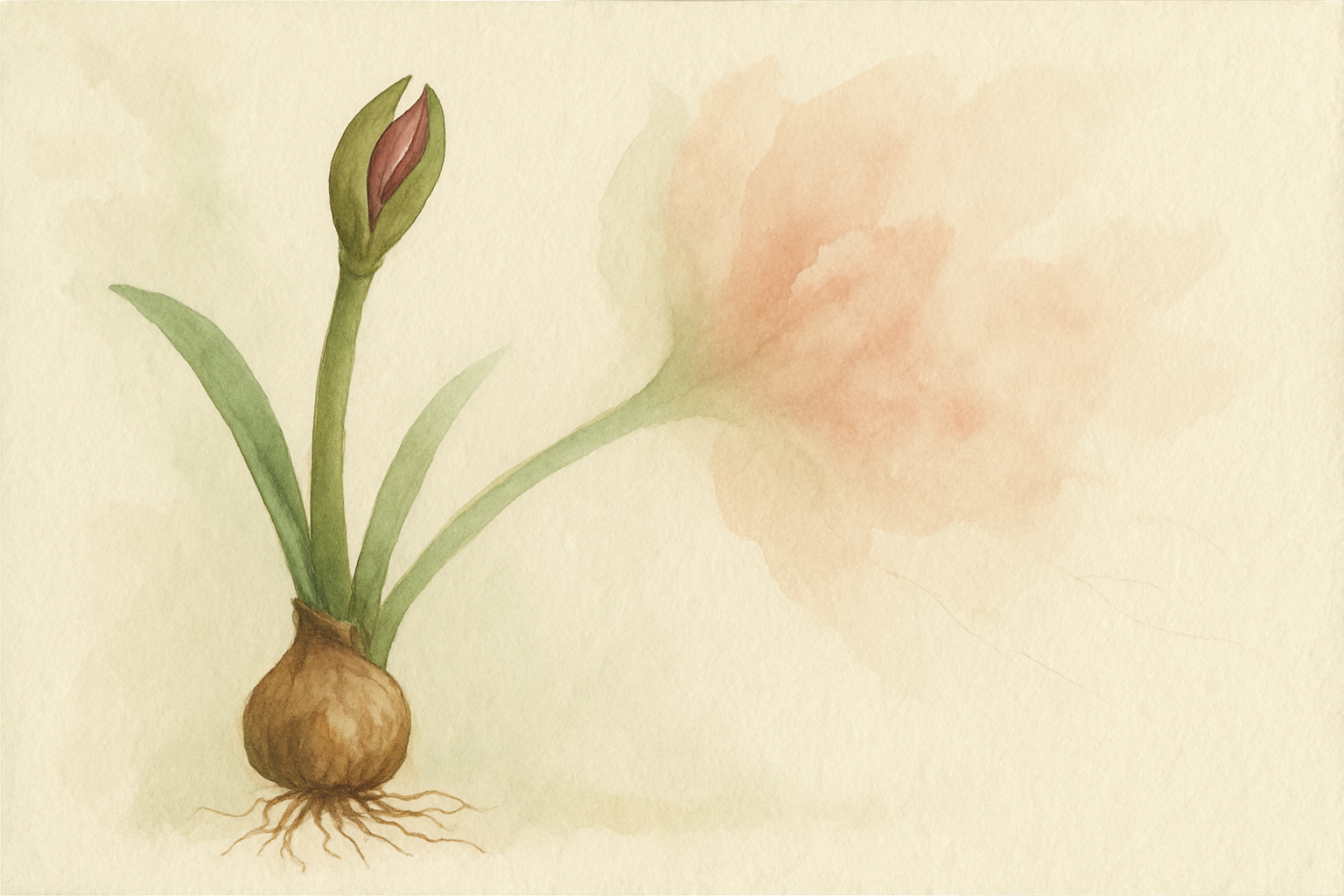
I have a couple of amaryllis bulbs, and one of them has a bud that has slowly unfolded over these past days. It's just about to open up into flowers. I've been watching it and thinking about what you've talked about before: that opening up is a choice, or maybe it isn't. With the amaryllis, it will open when it's ready. It has its own natural timing. And it seems like where that choice to seek something else comes in, it feels like reaching toward the future, toward something that isn't here yet. I don't know; it's a paradox, because maybe that's where I am. I've been somewhat accepting of that when it shows up. But at the same time, there's also a paradox because I know I can explore this. I notice I'm seeking, and because of this work and these meetings, I can investigate it. Maybe there is a part of this that is gradual, like the unfoldment, where the body can open up as much as it can to the energetic aspect, and that has its own timeline.
Two kinds of opening
I think you're talking about what I would separate into two different things. One is something that does manifest in time, like a flower blossoming. There is an aspect of this work that matures and evolves in time, and sometimes it's important to focus on that.
But more fundamentally, what I'm pointing to doesn't behave that way. Because we are aware that there is evolution, that we do grow and mature and blossom in that sense, we then confuse these two aspects. We think, "I will come to that peace, that which I'm looking for, through the evolution, through the blossoming." But that will never come. It might arrive in moments where something does mature and blossom, but what you're tasting was already there.
The metaphor of the flower and the choice of opening up works at both levels. In the meditation, I was pointing to a putting down of the search, and that is a choice. That can happen now. In a sense, the blossoming will happen now. There's a kind of blossoming that only can happen now; it's not in the evolution, not in time. But simultaneously, there is still a remaining evolution of growth, which is beautiful and can be explored.
Reaching into time
The first thing is to really see, when you're in that seeking, that you're reaching into time. You might be able to recognize it more regularly: "Oh, here it is again. Here it is again." But it repeats because the illusion hasn't been seen through totally. The illusion of time, in the sense that you're reaching for something to happen in time, and that reaching only exists in thought.
There is no future other than in your imagination. It's a very tricky thing, because you could say, "Well, but tomorrow will come." For sure. There will be changes that happen. So it's very tempting to grasp for those changes, to expect to be satisfied when certain changes happen, and to try to make them happen. But that process is always reaching into imagination, into thought.
One aspect is, yes, the flower or the tree will give fruit when it's ready, when it's at that stage of evolution. But it can be at peace the whole way. The trouble is when we, as the plant that gives flowers, are restless until we blossom. And then there isn't an actual moment of blossoming; it's a constant process: flowering and the flowers fall, flowering and the flowers fall. That process could seem like we're only satisfied with certain moments, because we're attaching to the flowering.
What I'm pointing to says: yes, you can live all of that and really enjoy it, but you can be completely at peace and satisfied in the movement right now, the whole movement. That's the deeper opening I'm talking about. It is a choice. You could describe it in many different ways. It's a choice of allowing, of letting go of the illusions, letting go of the beliefs. But it's also a choice of seeing what is actually true and real versus maintaining a preference for attachment to illusions.
Grieving the familiar
Something that's coming up for me: a couple of weeks ago when I last spoke with you, I was noticing that choice, and it seemed funny at the time. I was noticing the temptation of the future and the seeking, how alluring it was. But there's also some sadness around it, some grief. I think I understand why that pattern developed: as a way to try to have a sense of control, to feel safe. That's why, maybe starting young, I built that habit. And that's why maybe I'm connecting with the flowers. There's something about wanting to hold on to the belief in the future, because it's a habit of feeling safe.
Yes. Ultimately, the habit of feeling safe has to do with the underlying driver for all of this, and that has to do with pain. You're talking about grief, and there is a grief, a sadness, in the undoing of illusions. There's also a pain in something we weren't yet able to fully meet when we were very young.
What often happens as we let go of the seeking is that this pain starts to come up. There is a very deep drive, which is, in a sense, the avoidance of that pain or sadness that we've just never been able to deal with. All this contraption, all these mechanisms, are a form of distancing from that. It can have different flavors. For you it might be something specific; I'm using the word "pain" very generally. But it's very common for this to start bubbling up as you begin to see the futility of seeking in time. In a sense, a huge amount of energy that we've invested for a long time starts to dissolve. Something starts to end. It's like all the dreams of what could have been, which you could think of as a kind of Santa Claus dream. As you see the unreality of it, there is a sadness.
Fear and the pull back into thought
It's hard to generalize these things because they're always changing, but what I'm noticing around the seeking, when it comes up, is that there's often a lot of energy. More recently, it can feel like fear. If I'm able to just see it as energy, I can loosen some of the interpretation of it as fear. But sometimes it does feel like fear, like I'm trying to find a foothold, and then thought will create more fear: "It's because of this," or "You need to do that." The thoughts say, "You should do this; this is how to get out of it." So I'm just observing that. It is always in the future, like you said, that illusion. It's a not-wanting-to-be-with the energy, and then the thought, "In the future, this is how you can manage it."
That sounds to me like you're starting to taste more of the unknowable. These energies can't be fully labeled with thought. There's a realm of what you can label and function with in thought, and then there's a realm that's prior to that. As you start opening up to that prior realm, you begin to taste something more real, and what's more real is unknowable, in the sense that the mind can't label it or grasp it.
What will happen is that there will again be a pull, a temptation to go back into mind. The mind will give you directions, because you are reaching to thought for the way out, which is really a way back into thought. What you're describing, the thoughts coming in saying, "This way, this way, this way," that's into the future, into time, which is into thought, which is away from the unknowableness of this foreign-feeling sensation. Energetics are basically sensations of a quality that you can't really think at. They require a kind of pause in the thought process.
You're in that in-between realm: the contraction into thought and time on one side, and what is real on the other. That's often when these energetics start to move. Fear, pain, or strange sensations are possible labels for it, but labeling them won't help. It's more like diving deep, swimming into the sensations, tasting the experience, and becoming comfortable with the unknown.
My connection was a little spotty, but I know what you mean because I've been observing that in my experience. I think that's why I'm connecting with the flower.