Surfing the Wave You're On
Surfeando la Ola en la que Estás
A student reflects on praying from a place of not-knowing, and the teacher explores how projecting beliefs onto reality creates suffering, using the metaphor of surfing to illustrate the difference between controlling and responding.
Surfing the Wave You're On
A student reflects on praying from a place of not-knowing, and the teacher explores how projecting beliefs onto reality creates suffering, using the metaphor of surfing to illustrate the difference between controlling and responding.
So: stay curious. Pray from a place of not-knowing. And notice when you're looking for validation for your theories.
Yes. And from that perspective, you can have a balanced approach. You can recognize that you're looking for validation or evidence and say, "Well, there's this information that points in this direction. Let's try this out." But you remain open to it simply not working, because you don't know. Even the sense that something is a problem, you can't be sure of. But you might have a feeling: "This is causing some struggle that may be unnecessary. Let's see if we can resolve it or improve it in another way." And then you explore that.
Projecting beliefs onto reality
Otherwise, what's really happening is that we're projecting our own beliefs and ideas, our own sense of what's needed, and we're not actually in relationship with the reality of a partner or a child. Yes, as a parent you need to make calls. You need to take risks. You need to act. You need to listen. But if you do it from a place of "I know what the problems are and how to solve them and it's all up to me," that's going to be far less effective than if you operate from reality, which is: I don't know. I don't even know if there's a problem. I don't know what to do, but I'm going to try this or that.
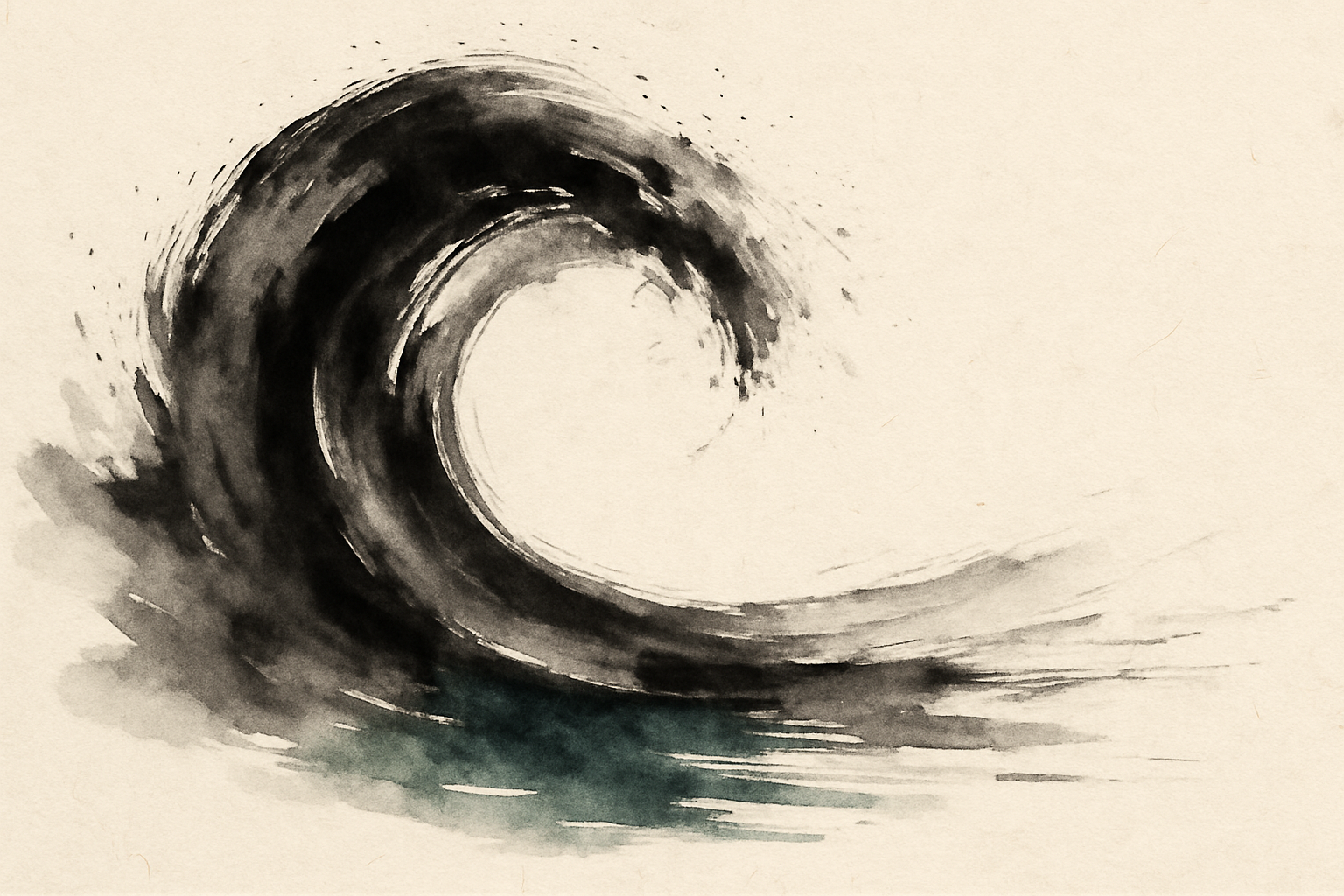
That openness is more aligned with reality. Think of a surfer who goes into the ocean, waits for a wave, and says, "I'm always going to go left. I'm always going to push on my right foot. I'm going to do that over and over again, and it's going to work." It's just not going to work. But if a surfer goes into the ocean and moves with the feel of the water, taking time to respond to what's happening intuitively and with attention, that surfer is going to stay vertical much longer.
Responding to the present.
Exactly. And staying open. Because what normally happens is the wave is going in a certain direction, and you're just telling yourself it's going the other way. You're convinced, ignoring what's right in front of you.
So first there's that misinterpretation, that projection. We humans project beliefs onto reality and then insist, "I have to do it this way for things to go this way." What we're actually trying to do is make the wave go in the direction we want so that we can be right about it always going left.
Sensitivity versus strategy
Compare that with: I'm surfing this wave. I'm attentive. The wave is, as you put it, the present moment. I'm attentive to what's happening, in complete openness and sensitivity, without any preconceived ideas about how I should move. I'm responding to whatever is happening, moment by moment. And the more I do this, the wiser I will appear to be. The longer I will stay vertical. But it's not that I'm wise because I always know which way to put my foot. It's because I'm sensitive to the moment, and I'm in balance. It's not a knowing from thought or from beliefs.
Operating from beliefs is such a trap.
Yes. We're on the wave, and first of all we're saying, "This wave shouldn't be here, and I'm going to make it go away," instead of asking, "How do I surf this and have fun?"
Two surfers, same ocean
That initial preconception is going to create enormous difficulty. Picture the same ocean, the same waves, two people. One is thrown in on a boat, trying to get on the board, trying to make the wave go away, trying to force it in a preferred direction. The other is simply figuring out the shape of the wave and how to navigate it, attentive and open. One is having a blast. The other is getting tortured. It is literally like that.
The thing is, if you then study what is actually happening in each of these two cases, that's when we talk about identification, about the actual mechanism that creates the whole belief system, the one generating all that suffering and struggle. But the effect is that difference.
It's like I'm the crazy person thinking that everyone else is crazy and I'm sane.
Exactly. You're the person struggling with the wave, and you look at the surfer who's having a good time, and you think, "That seems like a better option." Recognizing that is actually a rare thing.
I learn so much every time we talk.
You're very welcome. I'm learning all the time too. That makes two of us.
The root of fear
It's like touching this fear.
That's the root of the fear of death. And that question is the antidote, or at least the direction toward the antidote. The seeing of it is the antidote.
You give me such good questions every time. You offer some pointer, and I take it and it gives me an opening. I think last time it was something about seeing love in every moment. I don't really remember exactly, but I did it. And then I had this shift where I started laughing and crying at how ridiculous it was that I had been looking for myself, when I am the looking.
It was so clear. My brain was rewiring all day. I was walking outside, and things I would normally do, people I would normally avoid, it was all so silly. There was nowhere else to go. Everything was so clear. Thoughts were so clearly just arising, and I didn't have to touch any of them. Nothing was a problem. And then something returns, and here we are.
That's great. And that's how it is. Just keep looking deeper and deeper.
I'll take this question with me. Thank you.
You're welcome. It might take a bit more time, but you never know.